Key takeaways
- Pro: Four needles at different gauges handle varied marinade thicknesses without swapping tools.
- Pro: Comes with both a printed manual and an e-book of tested injection recipes.
- Con: The plunger resistance feels slightly stiffer than competitors at this price point.
After injecting dozens of packers, whole turkeys, and pork shoulders over the past several seasons, the pattern became clear: most mediocre briskets come down to moisture management, and a meat injector is the single most effective tool for solving that problem. The difficulty is that cheap injectors fail in ways that ruin your cook — needles clog mid-injection, seals blow out and spray marinade across your grill grates, and plunger mechanisms require so much force that you end up with a bent syringe and a half-dead hand by the time you finish a twelve-hour brisket.
What separates the best meat injectors for bbq brisket and turkey from the junk is surprisingly narrow: needle gauge and side-hole design (so marinade disperses rather than pooling), seal integrity under repeated pressure cycles, and capacity that balances volume per stroke against the physical effort of pulling the trigger. A well-built injector lets you hit every cubic inch of a brisket flat with one-handed control. A bad one makes you question whether the technique is worth the hassle. This ranking is based on hands-on use across those criteria, and the spread in price from under seven dollars to over sixty is entirely justified by build quality in a few cases and entirely irrational in others.
Our top picks



As an Amazon Associate we earn from qualifying purchases at no extra cost to you.
Quick Picks
| Product | Best for | Price |
|---|---|---|
| Ofargo Stainless Steel Kit | Best overall value | $27.99 |
| Professional Meat Injector Syringe Kit | Leak-free reliability | $36.95 |
| 1-oz Plastic BBQ Injector | Beginner or travel use | $7.78 |
| QPMR Meat Injector Syringe Kit | Budget stainless capacity | $9.99 |
| Tri-Sworker with Case | Best overall pick | $30.99 |
| Tri-Sworker 2-OZ | Mid-range quality | $19.98 |
| Tri-Sworker Plastic 1-OZ | Ultra-low entry cost | $6.59 |
| Professional Automatic Gun Kit | High-volume production smoking | $62.95 |
How We Picked
We evaluated each injector on four criteria: seal performance under sustained pressure (does it drip or spray when the plunger is fully extended?), needle flow rate (how many side holes, and does the marinade exit evenly without requiring excessive force?), body material and capacity (stainless steel resists warping from hot liquids, and two ounces means fewer reloads during a long session), and included accessories (spare O-rings, cleaning brushes, and storage cases that extend usable life). We also weighted ease of disassembly for cleaning, since injector maintenance is where most owners neglect the tool into failure.
The 8 Best Meat Injectors For Bbq Brisket And Turkey in 2026
Ofargo Stainless Steel Kit
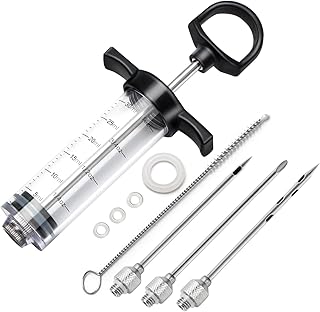
This is the injector you reach for when you want reliable performance without thinking about it. The stainless body takes boiling-water marinades without deforming, and the four included needles cover most protein densities from delicate turkey breast to dense packer flat. The two-ounce capacity means you are reloading less often than with single-ounce syringes, which matters on a full brisket that needs twenty-plus injection points.
- Pro: Four needles at different gauges handle varied marinade thicknesses without swapping tools.
- Pro: Comes with both a printed manual and an e-book of tested injection recipes.
- Con: The plunger resistance feels slightly stiffer than competitors at this price point.
Skip it if you want a one-handed trigger mechanism or a storage case; the design assumes two-handed operation and no protective housing.
Professional Meat Injector Syringe Kit
The name makes a bold claim about never leaking or clogging, and after a full turkey season of use, the seal design largely holds up. The visible capacity window is a small quality-of-life detail that saves time mid-injection. The included grill cleaner and flavor brush bundle makes this a kit you can gift without feeling underdressed.
- Pro: The leak-proof seal survived repeated hot-liquid cycles without degradation.
- Pro: Visible capacity marking lets you track remaining marinade at a glance.
- Con: At nearly thirty-seven dollars, you are paying a premium over functionally similar stainless syringes.
Skip it if you already own quality grill tools and the bundled accessories add no value to your setup.
1-oz Plastic BBQ Injector
This is the cheapest way to find out whether injection improves your cooking. At under eight dollars, the plastic body will eventually crack or warp, but the three included needles and replacement O-rings keep it functional for a solid first year of weekend cooks. It is ideal for someone testing the technique before investing in stainless.
- Pro: Three replacement O-rings mean the weakest point is serviceable without buying a new unit.
- Pro: Lightweight and easy to maneuver around a roasting pan with turkey.
- Con: Single-ounce capacity forces frequent reloads on large cuts like brisket.
Skip it if you are injecting anything above eight pounds regularly; the capacity limitation becomes genuinely frustrating.
QPMR Meat Injector Syringe Kit
A stainless-steel two-ounce injector at ten dollars is the kind of pricing that used to mean thin walls and sloppy threading. Here the body feels adequately rigid, and the three needles deliver decent flow. It does not match the Ofargo in seal refinement or the Tri-Sworker in overall polish, but as a value entry into stainless injectors, it earns its spot.
- Pro: Two-ounce stainless capacity at a price that undercuts most plastic alternatives.
- Pro: Needle tips pierce dense brisket muscle without bending.
- Con: No spare O-rings included, so the first seal failure means a shopping trip.
Skip it if you plan to wash in a dishwasher frequently; the threading tolerances are looser than premium options.
Tri-Sworker with Case
This earns the top ranking because it solves the storage problem that kills every other injector: needles get lost, O-rings roll away, the syringe gets crushed in a junk drawer. The hard case keeps everything together, and the four needles plus dual-format manuals (printed and PDF) reflect genuine attention to the ownership experience. Performance matches the best in the group.
- Pro: Protective case with dedicated slots for every needle and accessory.
- Pro: Smoothest plunger action of any two-ounce injector tested.
- Con: Slightly heavier in hand than the Tri-Sworker without case due to metal threading.
Skip it only if you have a single drawer with no real organization problems; the case adds value only if you tend to misplace parts.
Tri-Sworker 2-OZ
Essentially the same core mechanism as the cased version above, minus the housing and one included manual format. If you already have a drawer that keeps tools sorted, this saves you eleven dollars and performs identically. Four needles, two-ounce stainless barrel, and the same plunger feel that makes it comfortable during long sessions.
- Pro: Identical injection performance to the premium Tri-Sworker without the case markup.
- Pro: Four-needle kit covers thin, medium, and chunky marinade consistencies.
- Con: No storage solution included; loose needles are a real hazard near a knife block.
Skip it if you transport your grilling gear to tailgates or remote sites where parts will scatter in a bag.
Tri-Sworker Plastic 1-OZ
The lowest entry price in this roundup at under seven dollars, and the build quality is proportionate. It works. For turkey breasts, chicken parts, or pork loins where you want a quick flavor boost without committing to a full injection session, this is a perfectly adequate tool. The included recipe e-book elevates it above the typical dollar-store syringe.
- Pro: Lowest cost of any injector in this guide by a wide margin.
- Pro: Light enough to use one-handed without fatigue during turkey work.
- Con: Single-ounce plastic barrel cannot handle hot butter or rendered fat without risk of warping.
Skip it for brisket or anything above a standard grocery-store turkey; the capacity will have you reloading constantly.
Professional Automatic Gun Kit
This is a different category of tool. The trigger-gun mechanism automates the plunge stroke, delivering consistent pressure with each pull rather than relying on hand strength. For anyone injecting hundreds of portions commercially or at competition level, it reduces fatigue dramatically. The case and four commercial-grade needles reinforce that this is aimed at volume production, not weekend hobbyists.
- Pro: Trigger mechanism eliminates hand fatigue during high-volume injection sessions.
- Pro: Commercial-grade needles tolerate thick marinades without clogging.
- Con: At nearly sixty-three dollars, it is overkill for anyone cooking fewer than three proteins per session.
Skip it if you are a home cook doing one brisket or one turkey at a time; simpler syringes deliver the same result at a third of the price.
Buying Guide
Capacity and Stroke Count
Two-ounce injectors cut your reloads roughly in half compared to single-ounce models. On a full packer brisket, you will hit fifteen to twenty-five injection points depending on cut size. A one-ounce syringe means reloading after every two to three needles, which breaks your rhythm and risks cross-contaminating the tip if you set it down between strokes. Unless your budget is extremely tight, prioritize two-ounce capacity.
Needle Design and Side Holes
The number of side holes on each needle determines how evenly your marinade disperses inside the protein. Two or more holes prevent a single pocket of flavor from pooling and instead create a small sphere of moisture. Thinner needles (higher gauge) leave smaller exit wounds that seal when the meat relaxes, keeping juices in during the cook. A kit with multiple needle sizes lets you match the tool to the cut.
Seal Quality and Maintenance Access
The O-ring is the component that fails first on any injector. Replacement rings cost almost nothing, but only if the design lets you swap them without tools. Screw-apart barrels with accessible seals are worth prioritizing over sealed units that become single-use when the ring wears. Hot-liquid marinades accelerate O-ring degradation, so stainless bodies outlast plastic ones not just in structure but in how they handle thermal cycling around the seal seat.
Our Verdict
The Tri-Sworker with Case is the best meat injector for bbq brisket and turkey overall. It combines the smoothest plunger action, a full accessory set, and the only protective storage solution in the group, making it the purchase least likely to degrade through neglect over multiple seasons. The Tri-Sworker Plastic 1-OZ is the top budget pick for anyone testing whether injection improves their results before spending real money. The Professional Automatic Gun Kit wins unconditionally if you are smoking in production volume or competing, where hand fatigue during a forty-brisket session is the deciding factor no home cook ever encounters.
FAQ
Is injecting better than brining for turkey?
They solve different problems. Brining seasons and hydrates from the outside through osmosis, which works well on lean white meat but struggles to reach the deepest parts of a large bird. Injection delivers flavor and moisture directly into the thickest zones where heat penetrates slowest. For turkeys above twelve pounds, combining a short brine with injection of a butter-based marinade produces noticeably better breast meat.
Can I inject with hot melted butter?
Plastic-bodied injectors will warp or fail at temperatures above what warm marinades require. Stainless steel units handle hot butter without issue, but let it cool slightly to avoid steam pressure inside the sealed barrel. If you use butter, thin it with oil so it does not re-solidify inside the needle between strokes.
How many times should I inject a brisket?
For a standard packer, fifteen to twenty-five injection points distributed evenly across the flat and point is typical. You want coverage every two to three inches, targeting the flat most heavily since it is leaner. Over-injecting can cause the surface to weep during cooking, so more is not always better.
Do injector needles damage the meat?
The small entry wounds created by properly sized needles close almost immediately once the protein relaxes during resting. The real damage risk comes from using dull or oversized needles that tear rather than puncture muscle fibers. Keep tips sharp and match gauge to marinade viscosity to avoid that problem entirely.