
Key takeaways
- Rim-mounted bars: easiest to install and usually the most stable option for framed aquariums.
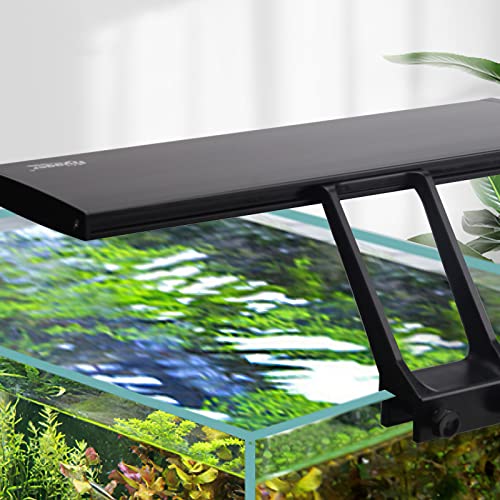
- Leg-mounted fixtures: useful when the light must sit above the rim or when the tank has unusual dimensions.
- Suspended fixtures: best for broad, even coverage, but use ceiling anchors or a purpose-built stand rated for the fixture’s weight.
- Clip-on lights: practical for nano aquariums, though their narrow beam can create bright spots and shadowed corners.
The best aquarium LED lighting is a dimmable, programmable fixture whose spectrum and intensity match your tank: a low-output bar for a basic freshwater aquarium, a stronger full-spectrum light for planted tanks, and a properly sized fixture with a timer for almost every setup.
Our top picks

As an Amazon Associate we earn from qualifying purchases at no extra cost to you. Ratings are shown as listed on Amazon.
Quick picks by aquarium situation
| Tank situation | Best light type | Useful target | Why it fits |
|---|---|---|---|
| Small freshwater tank, 5–20 gallons | Compact adjustable LED bar | 6–18 watts; 18–24 inch coverage | Low heat, low energy use, and enough output for fish and easy plants |
| Community tank, 20–55 gallons | Full-spectrum dimmable bar | 15–45 watts; 24–48 inch coverage | Balances even illumination with manageable algae risk |
| Low-tech planted tank | Programmable full-spectrum planted-tank fixture | Moderate output; roughly 6–8 hours daily | Supports hardy plants without demanding injected carbon dioxide |
| High-light planted tank | High-output planted LED with intensity control | High PAR output; often 30–100 watts depending on size | Provides stronger light for carpeting plants, but requires careful fertilizing and algae control |
| Rimless or open-top aquarium | Suspended or elevated fixture | Mount 6–12 inches above the water | Spreads light across the surface and leaves room for plant growth |
What separates the best aquarium LED lighting from an ordinary light
Spectrum: color quality versus plant-growing output
Aquarium LEDs commonly combine white, blue, red, and sometimes green diodes. A broad full-spectrum setting usually makes fish and plants look more natural than a blue-heavy “actinic” setting, which is primarily associated with marine aquariums. For a freshwater community tank, look for adjustable white light around a neutral daylight appearance, often described in the approximate 6,500–7,000K range.
Color temperature is not the same as growing power. Two fixtures can both claim 6,500K while producing very different usable light. For planted aquariums, PAR—the amount of photosynthetically useful light reaching the plants—is more informative than watts or Kelvin alone. If a manufacturer publishes PAR measurements, check the reading at the depth of your aquarium rather than only at the surface.
Red and blue channels can improve plant appearance and support photosynthesis, but maximum intensity is not automatically better. Excess light encourages algae when nutrients, carbon dioxide, and plant growth are out of balance. A fixture with separate channels and a dimmer is usually more useful than an unnecessarily powerful light operated at full brightness.
Coverage: match the fixture to the aquarium, not just the gallon rating
Measure the aquarium’s actual length and front-to-back depth. A light made for a 24-inch tank may illuminate a 24-inch aquarium well but leave dark corners on a wide 29-gallon tank. Adjustable legs are convenient for standard framed tanks, while a longer bar or suspended fixture is better for unusually wide aquariums.
Depth matters too. Light loses intensity as it travels through water. A low-output bar may be suitable for a 12-inch-deep aquarium but disappointing over a 24-inch-deep tank, especially if you want carpeting plants. Tall decorations, floating plants, and dark substrate also reduce light reaching the bottom.
Head-to-head comparison of common LED fixture types
| Fixture type | Typical power | Best for | Limitations | Typical market range |
|---|---|---|---|---|
| Basic white LED strip | 3–15 watts | Fish-only tanks and very easy plants | Limited control, weaker penetration, less attractive color adjustment | Usually $20–$60 |
| Full-spectrum freshwater bar | 10–45 watts | Community aquariums and low-tech planted tanks | May not provide enough PAR for demanding plants | Usually $40–$150 |
| Programmable planted-tank LED | 20–100 watts | Medium- to high-light planted aquariums | Costs more and can produce algae if set too intensely | Usually $100–$350 |
| Suspended high-output fixture | 40–150 watts | Deep, wide, or showcase planted tanks | Needs secure mounting and exposes evaporation more visibly | Usually $150–$500 |
Energy use: watts are simple, but not the whole story
LEDs generally use less electricity than older fluorescent aquarium lighting, but the monthly difference depends on wattage and schedule. For example, a 30-watt light running 8 hours a day uses about 7.2 kilowatt-hours per month:
30 watts × 8 hours × 30 days ÷ 1,000 = 7.2 kWh.
At an electricity rate of $0.20 per kilowatt-hour, that is about $1.44 per month. A 90-watt high-output fixture on the same schedule uses about 21.6 kWh, or approximately $4.32 monthly at that rate. The larger expense is often the fixture itself, not its electricity consumption.
A built-in timer, sunrise ramp, or programmable schedule is valuable because consistent lighting is better for fish, plants, and algae control. Aim for about 6–8 hours of effective full light when starting a planted aquarium. Blue “moonlight” should not run all night; fish need a dark period.
Mounting and safety details people often overlook
For a standard aquarium with a lid, choose a fixture that rests securely on adjustable brackets without blocking the filter, feeding opening, or cable routing. Leave enough clearance to remove the lid. A light that fits the tank’s length but sits directly over a hinged lid can become inconvenient every day.
- Rim-mounted bars: easiest to install and usually the most stable option for framed aquariums.
- Leg-mounted fixtures: useful when the light must sit above the rim or when the tank has unusual dimensions.
- Suspended fixtures: best for broad, even coverage, but use ceiling anchors or a purpose-built stand rated for the fixture’s weight.
- Clip-on lights: practical for nano aquariums, though their narrow beam can create bright spots and shadowed corners.
Keep power supplies and plugs above the aquarium’s waterline and form a drip loop in every cable before it reaches an outlet. Water-resistant does not mean submersible. Salt spray, condensation, and fertilizer residue can corrode contacts, so wipe the fixture and inspect the cable periodically.
Freshwater versus planted-tank suitability
Fish-only freshwater aquariums rarely need intense lighting. A moderate full-spectrum fixture improves visibility and color while limiting unnecessary algae growth. Choose dimming, a timer, and even coverage before chasing maximum output.
Planted aquariums need a closer match between light and plant requirements. Anubias, Java fern, Cryptocoryne, and many mosses can work under low to moderate light. Stem plants, red plants, and carpeting species generally need stronger and more evenly distributed light. High-light plants may also require consistent fertilization, adequate carbon availability, and regular maintenance.
Do not use a light’s “plant mode” as proof that it will grow every species. Ask whether the fixture publishes PAR readings, whether intensity is adjustable, and whether the measurement applies to your tank depth. A slightly oversized dimmable light is often more flexible than an underpowered fixture that must run at full output.
Buying checklist for a clear, healthy tank
- Measure the aquarium’s length, width, and water depth.
- Choose a fixture with coverage at least equal to the tank length, allowing extra spread for plants at the sides.
- For freshwater, prioritize balanced white light and natural color rendering.
- For planted tanks, compare PAR at the substrate and look for dimming or channel control.
- Select a timer or programmable controller for a repeatable day-night cycle.
- Confirm that the mounting legs fit the rim width and do not interfere with the lid or filter.
- Check the fixture’s moisture-resistance information and keep the power supply dry.
- Start at lower intensity and increase gradually if plants show slow growth without excessive algae.
Bottom line
For most freshwater aquariums, the best aquarium LED lighting is a dimmable full-spectrum bar sized to the tank’s real dimensions, with a timer and adjustable mounting legs. Choose a stronger programmable planted-tank fixture only when your plants require it. The right spectrum, coverage, and schedule matter more than the highest wattage, while secure mounting and a dependable dark period help keep the aquarium clear, stable, and healthy.


