Key takeaways
- Check storage access before buying. A 16-foot canoe will not turn through a narrow garage or shed doorway, and the required diagonal clearance can exceed 18 feet once bow and stern are considered.
- Use two people for most 60–90-pound canoes. A center yoke makes shoulder carrying more comfortable, while a roof rack with properly spaced supports reduces hull deformation.
- Store the canoe upside down on padded supports, ideally near the stronger areas around the bulkheads or seats. Do not leave it resting on its ends or flat on the ground for long periods.
- Rinse off sand and salt, dry the interior, and inspect seat hardware, grab handles, skid plates, and gunwales. These parts commonly loosen or wear before the main hull does.
- Keep the canoe below its rated load and carry approved flotation equipment for every passenger. Capacity ratings do not replace judgment about weather, current, or wave height.
The best canoes for most buyers are 15–17 feet long with a moderate-V or shallow-arch hull, enough stability for the intended passengers, and a weight you can safely carry from vehicle to water; the right choice changes substantially between calm lakes, moving rivers, and family trips.
Our top picks


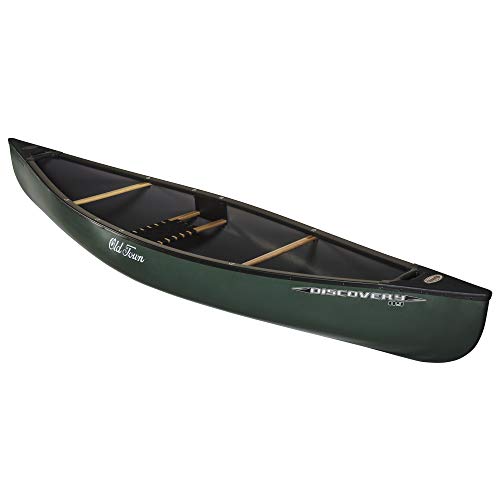

As an Amazon Associate we earn from qualifying purchases at no extra cost to you. Ratings are shown as listed on Amazon.
Quick picks by paddling situation
| Situation | Best canoe type | Useful specification | Why it fits |
|---|---|---|---|
| Two adults on calm lakes | Touring canoe with moderate rocker | 15–17 ft; 900–1,200 lb capacity; 55–75 lb in composite or 65–85 lb in aluminum | Tracks efficiently while remaining manageable around coves and docks |
| Families with children and gear | Wide recreational canoe | 16–17 ft; 36–38 in maximum width; 1,000–1,300 lb capacity | More initial stability, room for coolers, and a forgiving platform for movement |
| Small rivers and winding streams | Short maneuverable canoe | 13–15 ft; 2.5–3.5 in rocker; 34–37 in width | Turns more readily and is easier to correct in current |
| Flatwater fishing | Stable square-stern or wide recreational canoe | 14–16 ft; 36–40 in width; 800–1,200 lb capacity | Resists rocking when casting, standing, or reaching for tackle |
| Remote trips and portages | Lightweight composite or pack canoe | 10–15 ft; approximately 20–55 lb; 500–900 lb capacity | Reduces carrying fatigue, though lighter materials usually cost more |
| Rocky rivers and frequent beaching | Polyethylene or aluminum canoe | 14–16 ft; reinforced keel or abrasion-resistant bottom | Handles scraping and impacts better than a thin ultralight hull |
Hull shape: the decision that affects everything
Flat-bottom hulls
A flat-bottom canoe feels steady when you first step in and offers excellent initial stability for fishing, photography, and family use. Its broad bottom also creates plenty of usable interior space. The compromise is efficiency: flat hulls tend to slap against waves, drift more in wind, and feel less comfortable when tilted during a turn. They are best on protected lakes, slow rivers, and short outings rather than exposed open water.
Shallow-arch hulls
A shallow-arch hull is a strong all-purpose choice. It is stable enough for ordinary family paddling but has less wetted surface than a flat bottom, so it glides more efficiently. The rounded profile also responds better when edged into a turn. If you want one canoe for lakes, gentle rivers, and weekend camping, this shape usually offers the most useful balance.
Moderate-V hulls
A moderate-V hull has a defined centerline that improves tracking and gives the canoe a smoother ride through small waves. It is particularly suitable for longer lake crossings and tandem touring. It will not feel quite as instantly steady as a wide flat-bottom model, but experienced paddlers often prefer its predictable secondary stability—the support it provides as the canoe leans farther.
Rocker and keels
Rocker is the upward curve of the hull at the bow and stern. More rocker shortens the effective waterline, making a canoe easier to turn in bends, current, and technical water. Less rocker keeps more hull in the water and improves straight-line tracking on lakes.
A keel can help a canoe hold a line and protect the center of the hull, but it may catch on rocks and reduce turning ability. For shallow rivers, a rounded or shallow-arch hull without a deep keel is often easier to maneuver and slide over obstacles.
Length, width, and passenger capacity
Length is not simply a measure of storage space. A longer canoe generally tracks better, carries more load, and glides efficiently, but it is harder to turn, transport, and store. A 12–14-foot canoe suits one or two people on short trips. A 15–16-foot model is the most versatile tandem size. A 17–18-foot canoe provides excellent speed and cargo capacity for expedition-style travel, but it demands more room at home and more coordination between paddlers.
Width affects stability and wind resistance. A canoe around 33–36 inches wide at the maximum beam can feel efficient and responsive. Models around 37–40 inches offer greater stability and interior room but require more effort to paddle and can act like a sail in crosswinds. Width at the waterline matters as much as maximum width, so compare manufacturer specifications rather than judging by the gunwales alone.
Never choose capacity by adding body weights only. Include paddles, seats, flotation gear, food, water, coolers, fishing equipment, and dry bags. For example, two adults weighing 175 and 150 pounds, plus 120 pounds of equipment, create a 445-pound load. A canoe rated for 600 pounds may carry it, but a 900–1,100-pound-rated canoe will sit higher and feel safer in waves. Staying below roughly 70–80% of the stated capacity leaves more freeboard for wind and changing conditions.
Weight and construction: what you gain and give up
| Construction | Typical 15–16 ft canoe weight | Durability and handling | Typical market range |
|---|---|---|---|
| Polyethylene | 75–95 lb | Impact-resistant and affordable; heavy for solo loading and portages | Usually $700–$1,500 |
| Aluminum | 60–85 lb | Long-lasting and tolerant of abrasion; can be noisy and less comfortable in cold weather | Usually $1,000–$2,000 |
| Fiberglass composite | 45–70 lb | Efficient and repairable; can be damaged by hard impacts against rocks | Usually $2,000–$4,000 |
| Kevlar or other aramid composite | 35–55 lb | Very light and efficient; expensive and needs more care around rough landings | Usually $3,000–$5,500 |
| Rotomolded or composite pack canoe | 20–45 lb | Excellent for carrying; usually optimized for one paddler and limited gear | Usually $1,000–$3,500 |
Weight matters most before and after the trip. A 70-pound canoe can be awkward for one person to lift overhead, especially onto a tall vehicle. Measure the distance from the ground to the roof rack, and consider whether you can carry the canoe 100–300 feet over uneven ground. A lightweight canoe that is used often may provide more practical value than a cheaper, heavier model that stays in storage.
Stability and maneuverability for lakes versus rivers
For a large, exposed lake, prioritize a moderate-V or shallow-arch hull, good secondary stability, and enough length to maintain momentum. A very wide recreational canoe is comfortable near shore but may be tiring in wind. Spray covers or higher freeboard can help keep water out, although high sides also catch more wind.
For narrow rivers, choose shorter length and more rocker. A 13–15-foot canoe can pivot around bends and recover from rapid corrections more easily than a 17-foot touring hull. If the river includes regular Class II or rougher water, look for a purpose-built whitewater canoe with substantial rocker and reinforced construction rather than adapting a long flatwater model.
For family trips, stability and capacity usually matter more than speed. A broad 16–17-foot canoe with two proper seats and a center seat or removable child seat gives the best layout. Children should remain low and near the center; standing, kneeling on the gunwales, and sudden side-to-side movement are avoidable causes of capsizing.
Moving, storing, and maintaining a canoe
- Check storage access before buying. A 16-foot canoe will not turn through a narrow garage or shed doorway, and the required diagonal clearance can exceed 18 feet once bow and stern are considered.
- Use two people for most 60–90-pound canoes. A center yoke makes shoulder carrying more comfortable, while a roof rack with properly spaced supports reduces hull deformation.
- Store the canoe upside down on padded supports, ideally near the stronger areas around the bulkheads or seats. Do not leave it resting on its ends or flat on the ground for long periods.
- Rinse off sand and salt, dry the interior, and inspect seat hardware, grab handles, skid plates, and gunwales. These parts commonly loosen or wear before the main hull does.
- Keep the canoe below its rated load and carry approved flotation equipment for every passenger. Capacity ratings do not replace judgment about weather, current, or wave height.
How to choose the best canoe in five steps
- Define the water first. Choose flatwater efficiency for lakes, rocker and responsiveness for rivers, and impact resistance for rocky shorelines.
- Count people and real cargo. Add body weight, equipment, food, water, and safety gear before comparing capacity.
- Set a carry limit. If you load alone, treat the canoe’s actual weight as a primary specification rather than an afterthought.
- Match hull width to behavior. Wider is steadier but slower and more affected by wind; narrower is more efficient but less forgiving.
- Confirm transport and storage. Check vehicle rack compatibility, lifting height, doorway clearance, and where the canoe will rest between trips.
For a single versatile purchase, a 15–16-foot shallow-arch or moderate-V canoe with moderate rocker, a 900–1,100-pound capacity, and a manageable composite, aluminum, or polyethylene weight is the safest starting point. Choose shorter and more rockered for winding rivers, wider and higher-capacity for children and fishing, or lighter construction when portages and solo loading will determine how often you actually use it.