Key takeaways
- "Non toxic" is one of the most overused phrases in cookware, which makes shopping for the best non toxic pots and pans harder than it should be.
“Non toxic” is one of the most overused phrases in cookware, which makes shopping for the best non toxic pots and pans harder than it should be. The phrase can describe a ceramic coating, a bare stainless steel interior, a coating free of one specific chemical, or just a marketing mood. Before you compare sets, it helps to know that the title claim is only the starting point and that the material underneath tells you far more than the adjective in front of it.
This guide is for buyers who are replacing scratched nonstick pans, cooking for young children, or simply trying to cut down on coatings they are unsure about. Seven sets are compared, split between ceramic nonstick and tri-ply stainless steel, with every judgment drawn from the listed titles. None of the descriptions below can verify a safety claim independently, so use them to narrow the field in 2026 and then read the manufacturer’s material details before purchasing.
Quick Picks
Our top picks




As an Amazon Associate we earn from qualifying purchases at no extra cost to you.
| Product | Best for | Key spec taken from the product title |
|---|---|---|
| Umite Chef 21-Piece Ceramic Set | Full replacement with a ceramic surface | Nonstick ceramic, detachable handle, induction |
| EWFEN 3-Ply Stainless 11-Piece Set | Coating-free cooking | 3-ply stainless steel, with lids, oven and dishwasher safe |
| Astercook 19-Piece Black Titanium Set | Large kitchens that want nonstick | 19 pieces, black titanium finish, induction |
| Redchef 5-Piece Ceramic Set | Small households and tight storage | 5 pieces, detachable handle, space saving |
| SENSARTE 17-Piece Ceramic Set | Mid-sized family kitchens | 17 pieces, ceramic nonstick, dishwasher safe |
| FELAMP 10-Piece Ceramic Set | Starter kitchens | 10 pieces, PFOA-free, oven safe |
| CAROTE 15-Piece Tri-Ply Stainless Set | Stainless cooks who like detachable handles | Tri-ply stainless, detachable handle, dishwasher and oven safe |
How to Choose
Decide between ceramic nonstick and bare stainless
Ceramic sets release food easily with little oil but the glossy surface wears with use; a typical daily-use ceramic pan holds its slickness for a couple of years. Tri-ply stainless contains no coating at all, lasts for decades, and tolerates metal tools, but food sticks unless you preheat and use fat. If you cook delicate eggs often, ceramic is the easier path; if longevity matters most, go stainless.
Read what the claim actually names
“PFOA-free” is a narrow statement, since PFOA has been phased out across the industry, while “non toxic” is a broad claim with no single standard behind it. Treat both as marketing signals. A more useful spec is the construction: three layers of metal in a stainless pan, or a stated ceramic coating in a nonstick pan.
Check the temperature limits
Ceramic coatings generally prefer low and medium heat, while stainless handles high searing heat. If a title gives an oven-safe limit, compare it against your usual recipes, because 350 degrees covers most baking and 450 degrees or more covers broiling and roasting. Detachable handles often lower the oven limit, so confirm before putting any pan in the oven.
Where budget sets cut corners
Low-cost sets thin out the base, shrink lids and pad the piece count with spatulas and pot protectors. Before buying, count the true number of pots and pans, and look for a stated induction capability if you may switch cooktops later. Lighter pans warp more easily and heat unevenly, which defeats the purpose of paying for a healthier surface.
The 7 Best Options
Umite Chef 21-Piece Ceramic Set
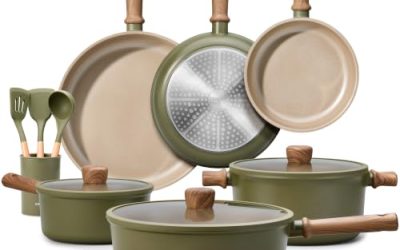
This 21-piece bundle leans hard into the healthy-kitchen angle, pairing a nonstick ceramic surface with a non toxic label and induction compatibility. The detachable handle design is meant to make cabinets less cramped, since pans can stack tightly without bulky grips poking out. Families who have been burned by flaking coatings in the past often start with this kind of ceramic bundle because it removes several pans from the shopping list at once. Expect to cook at modest temperatures, since ceramic surfaces are commonly paired with low and medium settings.
- Strength: ceramic surface that the title positions as a healthy alternative to traditional nonstick.
- Strength: induction cookware labeling, so it survives a future cooktop change.
- Trade-off: a 21-piece count includes lids and accessories, so the number of true cooking vessels is smaller than it looks.
Skip it if you want a coating-free pan, since this set is ceramic nonstick through and through.
EWFEN 3-Ply Stainless Steel 11-Piece Set
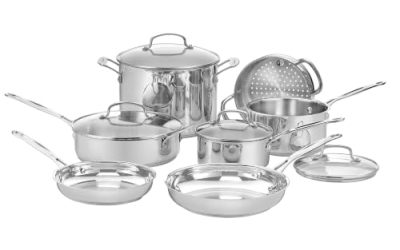
For buyers who want no coating at all, this three-layer stainless set lists lids, induction support and oven and dishwasher safety. It is a straightforward all-metal answer to the question of what a non toxic pan can be, and the professional chef wording suggests a classic stainless look. Three layers of metal are meant to spread heat across the pan wall instead of only the base, which helps with simmering sauces and browning onions. Stainless also gives you a surface that tolerates metal spoons, a real advantage over any nonstick coating.
- Strength: 3-ply stainless construction with no nonstick layer to wear off.
- Strength: oven safe and dishwasher safe, which makes cleanup forgiving.
- Trade-off: stainless needs a preheat and some oil, so a nonstick-minded cook faces a short learning curve.
Skip it if you cook a lot of delicate eggs and want effortless release.
Astercook 19-Piece Black Titanium Set
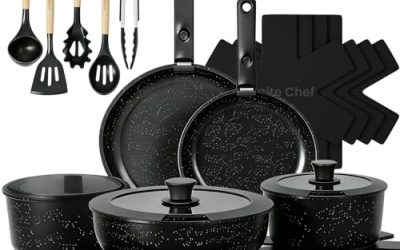
A nonstick set with a black titanium finish, described as healthy and non toxic, with frying pans and induction compatibility. It suits larger households that want a wide range of vessels and a coordinated black look in the kitchen. Because the title groups its frying pans with the rest of the set, it works for buyers who want several skillet sizes plus pots from a single brand. The non toxic wording is front and center, but the specific coating material is not spelled out, so treat the claim as something to confirm.
- Strength: 19 pieces including frying pans, with induction compatibility stated.
- Strength: a titanium-branded nonstick finish aimed at durability.
- Trade-off: the title leaves the coating chemistry vague, so the non toxic claim deserves a closer look at the product page.
Skip it if you want a clearly named ceramic or bare stainless surface.
Redchef 5-Piece Ceramic Set
The most compact entry here, with detachable handles, ceramic nonstick, induction compatibility, and both dishwasher and oven safety listed. At five pieces, it targets a couple, a student or anyone in a small kitchen where a 20-piece set would simply be clutter. Both dishwasher and oven compatibility are mentioned, which is unusual in a set this small. If you want to try a ceramic surface without committing to a big cabinet purge, this is the lowest-commitment way to do it.
- Strength: space saving design built around detachable handles.
- Strength: induction compatible with dishwasher and oven safe labels in the title.
- Trade-off: five pieces means a limited range of sizes, so large batch cooking is awkward.
Skip it if you regularly cook for four or more people.
SENSARTE 17-Piece Ceramic Set
A mid-sized ceramic set that calls itself nontoxic and healthy, lists induction compatibility, and notes dishwasher safe care. The count lands between compact starter sets and giant bundles, a sweet spot for families who want choice without a pile of extras. The word healthy appears alongside nontoxic in the title, a pairing that is aimed squarely at parents and at cooks who have recently switched away from older coated pans. Dishwasher-safe care is listed, though gentle hand washing generally preserves ceramic longer.
- Strength: ceramic nonstick surface with induction compatibility.
- Strength: dishwasher safe label, helpful for busy weeknights.
- Trade-off: ceramic coatings need moderate heat, so the set is not ideal for aggressive searing.
Skip it if you want to sear steaks at high temperatures.
FELAMP 10-Piece Ceramic Set
A 10-piece ceramic nonstick set marked PFOA-free, healthy, induction compatible and oven safe. It makes sense as a first full set for someone moving out or replacing a mismatched pile of old pans. The PFOA-free note and the induction-compatible label cover two common worries at once, and the mention of oven safety means a casserole or a frittata can finish in the oven. A smaller set also makes it easier to see which pieces you actually reach for.
- Strength: PFOA-free ceramic nonstick with oven-safe rating stated.
- Strength: a 10-piece count keeps the bundle manageable compared with sprawling 20-plus piece sets.
- Trade-off: the title does not give an exact oven temperature, so check the limit before roasting.
Skip it if you want a large bundle with lots of pot sizes.
CAROTE 15-Piece Tri-Ply Stainless Steel Set
This set mixes tri-ply stainless bodies with detachable handles, so it offers a coating-free interior and tidy storage together. The title lists non-toxic, induction compatible, dishwasher and oven safe, which covers the practical checkboxes. At 15 pieces it sits in the middle of the pack, large enough for a family yet smaller than the 21 and 30-piece stainless bundles from the same brand. Stainless needs a little technique, but the payoff is a set that can outlast several generations of nonstick.
- Strength: tri-ply stainless build with no coating to flake.
- Strength: detachable handle design to save cabinet space.
- Trade-off: handles that detach introduce a mechanism that needs to be checked and kept clean.
Skip it if you prefer fixed riveted handles for a heavy, confident grip.
Which One Fits Your Situation
You want zero coatings in the kitchen
The EWFEN 3-Ply Stainless 11-Piece Set and the CAROTE 15-Piece Tri-Ply Set both use stainless bodies, with CAROTE adding detachable handles for storage.
You cook for one or two people in a small space
The Redchef 5-Piece Ceramic Set keeps the collection tight, and its detachable handles make stacking easy.
You are feeding a family of five or more
The Astercook 19-Piece Set or the Umite Chef 21-Piece Set provides the biggest range of vessels.
You are setting up your first kitchen
The FELAMP 10-Piece Ceramic Set or the SENSARTE 17-Piece Set gives a balanced starter lineup in a ceramic finish.
Common Mistakes
- Treating “non toxic” as a regulated label when it is mostly a marketing phrase.
- Overheating ceramic pans, which shortens the life of the slick surface.
- Counting lids and utensils as cookware when comparing piece totals.
- Putting detachable-handle pans in the oven without confirming the oven limit.
- Scrubbing ceramic with steel wool, which strips the coating that the set was bought for.
Specs and Terms Explained
PFAS-Free and PFOA-Free
These phrases are not interchangeable. PFOA is one specific compound that was phased out of most cookware manufacturing years ago, so a PFOA-free label is now close to the baseline. PFAS is a much broader chemical family, and a PFAS-free claim is a stronger statement. Look for listings that name the family outright instead of settling for the narrower term.
Sol-Gel Ceramic Coating
Most ceramic nonstick pans use a silica-based sol-gel layer sprayed over a metal body. It is slick when new but is generally described as a thinner and less durable surface than traditional coatings, and owners often report that release fades with heavy use. It is a coating, not solid ceramic.
Tri-Ply and 3-Ply
These terms describe layers bonded together, typically stainless steel on the outside and inside around an aluminum core that spreads heat. The cooking surface is bare steel with no coating at all, which is why this construction suits cooks who want nothing to flake or wear away.
Titanium Reinforcement
Some coatings add titanium particles for hardness. Treat it as a durability claim rather than a safety certification, and do not assume it changes what the cooking surface is made of.
Setup and Care Tips
- Keep ceramic-coated pans on low to medium heat; high heat shortens release performance faster than anything else.
- Use a little oil or butter every time, even if the listing promises oil-free cooking.
- Wash gently by hand and avoid abrasive pads that scour the surface.
- For stainless pieces, preheat the pan first, add oil, then add food, which keeps proteins from clinging.
Who Should Skip These
Anyone expecting a ceramic coating to behave like a lifetime pan will be disappointed, since coatings wear while the metal underneath has no such limit. People who rely on a dishwasher for every dish may also prefer the stainless route, where cycles are far gentler on the cooking surface than they are on coatings.
Questions to Ask Any Listing
- Does it name the actual coating material instead of using a vague word such as healthy or natural?
- Does it state a maximum safe temperature for the pan, the lid, and the handles separately?
- Are the handles stainless, silicone-wrapped, or plastic, and what is their stated heat limit?
- Does it explain which chemicals the coating leaves out, in specific named terms?
- Does the care sheet say what is safe in a dishwasher, and what the maker advises against?
A listing that dodges these questions is telling you something. Specific answers are a better sign than a lot of green leaf icons, and vague ones are worth treating cautiously until more detail appears.
Related guides
- Bathroom Makeup Organizer With Dustproof Lid
- Stackable Bathroom Storage Bins With Lids
- Widespread Bathroom Faucets 8 Inch
Frequently Asked Questions
Is stainless steel safer than ceramic nonstick?
Stainless has no coating that can wear away, which is why many buyers choose it for longevity. Ceramic can still be a good option when used at moderate heat and cared for gently.
What does PFOA-free really tell me?
It tells you one specific compound was left out, which is now standard practice. It does not describe the rest of the coating, so look at the material named in the title as well.
Do non toxic pans work on induction?
Only if the base is magnetic. Every set above states induction support, but a quick magnet test on the base confirms it before you commit.
How long should a non toxic ceramic set last?
Most ceramic nonstick surfaces slowly lose slickness with daily use. Low heat, soft utensils and hand washing stretch the lifespan the most.