Key takeaways
- Compare the best clay trap for sink setups in pottery and plaster studios: two Gleco trap options by capacity, clearance, lid design and changeout routine.
As an Amazon Associate we earn from qualifying purchases.
Clay and plaster share one dangerous habit in a studio sink: both travel down the drain as a harmless-looking slurry, then settle, harden, and narrow the pipe from the inside. Liquid clay slip dries into a solid lining. Plaster is worse, because it does not merely dry in the pipe — it sets, chemically, into stone, and it keeps expanding as it cures. A drain that handled rinse water for months can slow to a trickle in a single busy week of throwing, trimming, and mould making, and by the time the sink backs up, the blockage is usually well past the reach of a plunger or a bottle of drain cleaner. The fix that studios, dental labs, and art classrooms rely on is not a stronger chemical. It is a clay trap: a settling container fitted under the sink, between the basin and the wall drain, that gives heavy solids somewhere to stop before they ever reach the household plumbing.

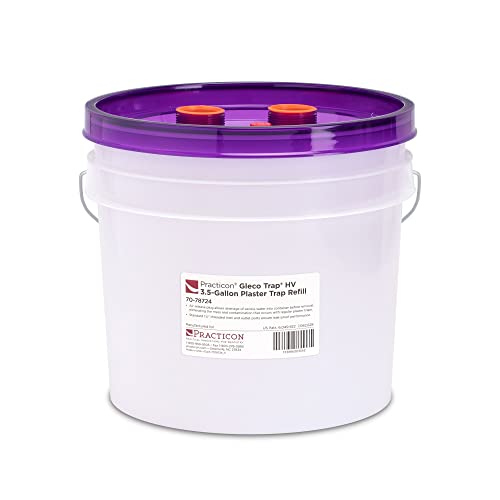
A clay trap works on a simple principle. Waste water from the sink enters a sealed container and slows down. Clay, plaster, glaze sediment, and other heavy particles are denser than water, so while the flow is calm they sink and collect at the bottom. The clearer water near the top exits through an outlet into the drain line. Nothing is filtered in the mechanical sense, and nothing is dissolved. The trap simply buys the solids time to fall out of suspension, and it holds them in a container you can remove, empty, and replace on your own schedule instead of a plumber’s.
This guide covers the two clay and plaster sink traps from Practicon’s Gleco Trap line that could be verified as listed on Amazon US with a confirmed ASIN at the time of writing. That is a deliberately short list. The market for true sink clay traps is narrow: most products sold under similar names are ordinary P-traps, grease interceptors, or hair catchers, none of which settle plaster or clay, and none of which belong in this roundup. The two Gleco options below are genuine settling traps designed for exactly this job. They differ mainly in scale. The 64 ounce Gleco Trap System is the compact under-sink kit for a single studio sink, a classroom basin, or a home pottery corner. The 3.5 gallon Gleco Trap HV refill serves the high-volume version of the same system, built for sinks that see plaster work, casting sessions, or several users a day. Choosing between them is mostly a matter of how much sediment your sink produces and how much vertical room your cabinet gives you.
Disclosure: This article contains affiliate links. If you buy through these links, we may earn a commission at no additional cost to you.
How to Choose a Clay Trap for a Sink
Start with the sediment you actually produce
Capacity is the first decision, and it should follow your material, not your optimism. A hobby potter who rinses tools and hands at one sink produces clay sediment slowly, and a trap in the two-quart range can run for weeks before it needs attention. Plaster changes the maths completely. Mixing bowls, mould rinses, and casting spills send far denser loads down the drain, and plaster sediment also cannot be allowed to sit and harden inside a trap you intend to reuse casually. Busy teaching studios, dental laboratories, and prosthetics benches generate enough combined clay and plaster waste that a multi-gallon trap earns its cabinet space simply by stretching the interval between changeouts. Match the trap to the heaviest week your sink sees, not the average one, because an overfilled trap stops settling and starts passing solids straight through to the drain — silently, and exactly when you are busiest.
Measure the under-sink clearance before anything else
A settling trap hangs below the sink tailpiece, so vertical room is the hard physical limit. Measure from the underside of the sink drain flange down to the cabinet floor, then subtract the space your existing trap arm and drain connection occupy. The Gleco HV guidance, for example, calls for six inches of clearance between the top of the bucket and the flange of the sink drain for proper installation and easier changeout, and that kind of working room matters every time you swap a full container for an empty one. Shallow vanity cabinets, sinks with a disposal taking up the centre bay, and low drain rough-ins can all rule out a tall high-volume container. If the big trap does not fit with room to lift, tilt, and disconnect it, the compact system is the correct choice regardless of your sediment load — you will simply change it more often.
Understand the changeout you are committing to
Every clay trap is a maintenance device. The question is how the maintenance happens. Disposable-bottle systems such as the Gleco design replace the whole sediment container: when the bottle fills with settled solids, you disconnect it, cap it, and install a fresh one, and the full container leaves with its contents sealed inside. That is a cleaner routine than scooping wet plaster sludge out of a permanent bucket, and it matters in spaces — classrooms, clinics, shared studios — where nobody wants to handle open containers of setting plaster. Look for a lid design that seals tightly, because the moment of highest spill risk is carrying a full trap across the room. An air-tight lid and a way to drain the inlet and outlet plumbing into the container before disconnecting, as the Gleco HV provides with its air-release plug, turn a messy job into a controlled one.
Check the connections against your drain
A clay trap sits in line with standard sink plumbing, but confirm the basics before ordering. Note your tailpiece diameter, whether your drain arm is at a height that leaves a workable fall to the wall outlet, and whether you have room to add the trap without re-plumbing the whole cabinet. Traps with threaded inlet and outlet extensions, like the Gleco HV design, adapt more forgivingly to existing pipework than fixed fittings. If your sink also handles glaze waste, remember that a settling trap captures suspended solids; it does not treat dissolved chemicals, so local rules on glaze and lab waste disposal still apply to what you pour and to how you dispose of the full container.
Build the habit, not just the hardware
A trap only protects the drain if it is changed before it fills. Put the changeout on the same rhythm as other studio maintenance, check the fill level whenever you are under the sink for any other reason, and keep a spare container on hand so a full trap never tempts anyone into rinsing plaster straight into an unprotected drain “just this once.” That single rinse is how pipes are lost. Studios that run traps successfully treat the spare bottle the way kitchens treat a spare bin liner: always in stock, never a special trip.
The Best Clay Traps for Sinks
1. Practicon Gleco Trap System, 64 oz — The Compact Under-Sink Kit
- Amazon US: https://www.amazon.com/dp/B00JVEOFN4
The 64 ounce Gleco Trap System is the standard answer for a single studio sink, and it is the place most potters and small labs should start. Practicon lists the kit at 12.4 x 12.24 x 6.57 inches and 2.35 pounds, under item model number 7078713, which gives you a concrete footprint to check against your cabinet before ordering — a step worth taking, because under-sink space disappears quickly once supply lines, a stop valve, and stored bottles are in the picture. The system format means the trap arrives as a complete kit for the sink rather than as a bare container, so the installation is a matter of fitting it into the drain path beneath the basin and letting gravity do the rest.
In use, the working principle is the Gleco pattern: sink water enters the trap bottle, clay and plaster solids settle to the bottom of the 64 ounce container, and the clarified water leaves through the outlet to the household drain. Two quarts of settling volume suits the rhythm of a home studio or a single classroom sink well. A potter throwing and trimming through a week produces sediment steadily but not in flood quantities, and the bottle format means the changeout, when it comes, is a swap rather than a scrub. You disconnect the full bottle with its load of settled clay sealed inside, fit the replacement, and the sink is back in service in minutes. There is no open bucket of slurry to carry, no scraping, and no plaster residue smeared across the cabinet floor.
The honest limitation is the same as its strength: 64 ounces is a modest reservoir. A sink shared by a full class, or one that takes daily plaster mixing runoff, will fill this bottle quickly, and a full bottle that is not changed stops protecting the drain. If your sink’s workload is genuinely high-volume, treat this system as the light-duty option and look at the HV format below. For the far more common case — one sink, one or two users, clay first and plaster second — this is the proportionate, tidy, and proven configuration, and its long presence on the market, with a listing dating back to 2014, reflects how settled the design is.
2. Practicon Gleco Trap 3.5 Gallon HV Refill — The High-Volume Option
- Amazon US: https://www.amazon.com/dp/B00YPLE3NK
The Gleco Trap HV line exists for sinks whose sediment load overwhelms a two-quart bottle, and this 3.5 gallon HV refill is the replacement container at the heart of that high-volume system. Where the standard trap suits a single potter, the HV format is built for the sinks that serve casting benches, dental and prosthetics labs, school art departments, and production studios — the places where plaster, in particular, goes down the sink in quantity every working day. A 3.5 gallon settling volume stretches the changeout interval from days to a realistic maintenance cycle, and it gives a heavy plaster load room to settle without the trap passing solids downstream between services.
The HV design details are aimed squarely at the changeout, which is where big traps usually fail their owners. The container uses a newly engineered air-tight lid with threaded inlet and outlet extensions that reserve an air pocket inside the trap. When the trap is full, you remove the air-release plug to drain the inlet and outlet plumbing down into the bucket before disconnecting anything, so the lines empty into the container instead of across your cabinet floor. That pre-drainage step is what makes a genuinely full, heavy, plaster-laden trap manageable: the patented arrangement is designed to prevent the mess that traditional plaster traps make at removal, and the sealed lid then keeps the load sealed while the container is carried out.
Fit is the deciding factor. Practicon’s guidance for the HV is that there must be six inches of clearance between the top of the bucket and the flange of the sink drain for proper installation and easier changeout, and a 3.5 gallon container needs a cabinet with real vertical room and a clear path out. Measure honestly. If your sink base cannot give the HV that working space, forcing it in will make every changeout a struggle and quietly discourage the maintenance the trap depends on. If the space is there and the sediment load is real, this is the correct scale of trap: fewer changeouts, a drier and more controlled swap, and a settling capacity matched to plaster work rather than occasional clay rinsing. Note that this listing is the HV refill container, so it pairs with the Gleco Trap HV system plumbing rather than replacing a standard bottle installation.
Comparison Table
| Product | ASIN | Capacity | Best for | Changeout style |
|---|---|---|---|---|
| Practicon Gleco Trap System | B00JVEOFN4 | 64 oz | Single studio or classroom sink, clay-first use | Disposable bottle swap |
| Practicon Gleco Trap 3.5 Gallon HV Refill | B00YPLE3NK | 3.5 gallons | High-volume plaster and multi-user sinks | Air-release pre-drain, then sealed container swap |
FAQ
Does a clay trap replace a normal P-trap?
No. A clay trap is a settling stage fitted under the sink in the drain path; it captures clay, plaster, and sediment before the water continues on. Your sink still needs its code-compliant trap arrangement for sewer gas protection. Think of the clay trap as a solids guard upstream of the household drain, not as a substitute for the plumbing that seals the drain line.
Can I rinse plaster down a sink with a clay trap fitted?
That is exactly what the trap is for — within reason. The trap settles plaster solids out of the rinse water so they collect in the container instead of setting inside your pipes. It does not make unlimited plaster disposal safe: bulk plaster should still be wiped and scraped into a bin before rinsing, and the trap must be changed before it fills, because a full trap passes solids through.
How often does a clay trap need changing?
It depends entirely on load. A home potter may go weeks on a 64 ounce bottle; a teaching studio rinsing plaster daily can fill a trap far faster. The reliable method is inspection: check the fill level regularly, and change the container when the settled solids approach the level the maker specifies, rather than waiting for the sink to drain slowly — by then, solids are already reaching the pipe.
What do I do with a full trap container?
Seal it and dispose of the contents according to your local rules for plaster and studio waste. Settled clay can often be reclaimed while it is still workable if it has not been mixed with plaster, but plaster-contaminated sediment should be treated as waste, allowed to set fully, and binned rather than washed anywhere near a drain. Never empty a trap back into any sink.
Will a clay trap catch glaze and other studio sediment?
A settling trap catches suspended solids that are denser than water, which includes most clay, plaster, and many glaze particles. It does not remove dissolved chemicals or make glaze waste safe to pour freely. Studios working with glazes should follow their local disposal guidance for both the rinse water and the collected sediment.
Why are there only two products in this guide?
Because the verified pool is genuinely that small. A true clay trap is a settling container made for clay and plaster; ordinary P-traps, grease interceptors, and hair catchers do not do this job, and including them would put the wrong product under your sink. Both products above were confirmed as clay and plaster sink traps listed on Amazon US with an ASIN in the product information.
Conclusion
A clay trap is cheap insurance against the most expensive sentence in studio plumbing: the blockage is plaster, and it has set. The Practicon Gleco Trap System in 64 ounce form, ASIN B00JVEOFN4, is the right default for a single studio, classroom, or lab sink — compact, complete as a kit, and changed by swapping a sealed bottle. The Gleco Trap 3.5 Gallon HV refill, ASIN B00YPLE3NK, serves the high-volume end of the same idea, with an air-tight lid, threaded connections, and an air-release pre-drain step that keeps big changeouts controlled. Measure your cabinet, be honest about your sediment load, keep a spare container in stock, and the drain behind your studio sink will stay a drain — not a mould for a plaster casting you never meant to make.
FAQ
Does a clay trap replace a normal P-trap?
Can I rinse plaster down a sink with a clay trap fitted?
How often does a clay trap need changing?
What do I do with a full trap container?
Will a clay trap catch glaze and other studio sediment?
Why are there only two products in this guide?
More from Amazon
Programs that pair well with the guide above. Offers and eligibility are set by Amazon and may change.
Set up recurring deliveries of everyday items on eligible products. Terms and savings are set by Amazon.
Explore Subscribe & SaveCollect the home and kitchen items you want in one registry that guests can shop from.
Create a wedding registryFree shipping on eligible items, Prime Video and more. Eligible new members can start with a free trial.
Start a Prime free trialAudiobooks and podcasts to listen to on the go. Eligible new members can start with a free trial.
Try Audible freeAs an Amazon Associate we earn from qualifying purchases.