Key takeaways
- A bathroom exhaust fan is judged by two numbers that pull in opposite directions: how much air it moves and how loud it is while doing so.
A bathroom exhaust fan is judged by two numbers that pull in opposite directions: how much air it moves and how loud it is while doing so. Moisture left in a small bathroom after a shower can leave mirrors fogged, paint peeling, and grout dark, so a fan that is too weak or too noisy to run is a poor investment. The real decision behind “best bathroom exhaust fans” is how to balance airflow in CFM against loudness in sones, then check that the housing, duct size, and ceiling opening actually fit the room being retrofitted.
This guide is meant for homeowners replacing a rattling, builder-grade fan, renters or flippers refreshing a bathroom for 2026, and anyone adding a fan with a built-in light. Seven fans are compared using the figures printed in their listings. A replacement motor kit that appeared in the same search was left out because it is a repair part rather than a complete fan. Costs are described as budget, mid-range, or premium only. Placement matters too: a fan mounted close to the shower draws steam out before it settles on the walls, while one at the far end of a long room has to work harder.
Quick Picks
Our top picks


As an Amazon Associate we earn from qualifying purchases at no extra cost to you.
| Product | Best for | Key spec from the title |
|---|---|---|
| Broan-NuTone 50 CFM | Small powder rooms | 50 CFM, 2.0 sones, Energy Star |
| Amico 80 CFM (1.0 sones) | Attic-free retrofits | 80 CFM, 4 inch duct, no attic access needed |
| Gopper with light | Fan and light in one | 120 CFM, 1.0 sones, 1000 lumens LED |
| JOEAONZ 110 CFM | Mid-size baths | 110 CFM, 1.0 sones, metal housing |
| Panasonic FV-0510VS1 | Adjustable airflow | 50-80-100 CFM selector, 3-3/8 inch housing |
| Amico 80 CFM with light | Tunable light color | 0.9 sones, 1000LM, 5CCT |
| Amico 110 CFM | Higher airflow, quiet | 110 CFM, 1.0 sones, ETL and FCC |
How to Choose
Size the fan to the room
A common rule of thumb for bathrooms up to about 100 square feet is roughly one CFM per square foot of floor area, with a minimum of 50 CFM. A 5 by 8 foot bath is 40 square feet, so a 50 CFM fan meets that floor, while a 9 by 10 foot bathroom calls for around 90 or more. Add airflow for a separate shower stall, a soaking tub, or a low ceiling over eight feet. When a listing offers selectable speeds, as the Panasonic does, one housing can cover a small and a medium bathroom without a new installation.
Read the sone number, not the marketing
Sones measure perceived loudness, and lower is quieter. A figure of 1.0 sones is often described as roughly a quiet refrigerator hum, while 2.0 sones is audibly louder. In these listings, the Amico with light lists 0.9 sones, several others list 1.0, and the Broan-NuTone lists 2.0. A loud fan is one that people switch off before the humidity clears, so the quietest option that still moves enough air is the better target. Words like “ultra quiet” without a number deserve a second look.
Check the housing, duct, and ceiling opening
Retrofit work lives or dies on the cutout. The Amico listings give ceiling openings of about 8.8 by 8.8 inches and 9.4 by 9.4 inches, and the Gopper lists a 10 by 10 inch panel. Compare these against the existing hole and joist spacing. A 4 inch duct is the common connection; the Panasonic is listed with a slim 3-3/8 inch housing, which helps in shallow joist bays. The fan should vent to the outdoors through a wall or roof cap, never into an attic space.
Light, certifications, and installation
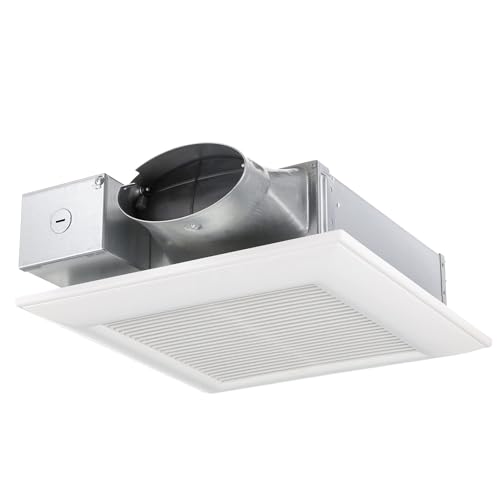
A built-in LED light saves a ceiling hole, and the lumen and color-temperature figures on the Gopper and Amico listings help judge whether it replaces a standalone fixture. Look for certification marks on the listing, such as UL, ETL, or Energy Star, and match them to local code. Wiring should be handled by a licensed electrician if there is any doubt, and the circuit should be switched safely. Budget fans tend to cut corners on duct dampers, motor mounting, and the quality of the grille.
The 7 Best Options
Broan-NuTone 50 CFM Modern Grille
This Broan-NuTone fan lists 50 CFM, 2.0 sones, and Energy Star status behind a modern grille. It is a baseline choice for small powder rooms and half baths where a familiar brand and a tidy ceiling look matter more than raw airflow, and where no shower produces steam.
- Strength: a recognizable brand and an Energy Star label in the title.
- Strength: a modern grille that looks neat on the ceiling.
- Trade-off: 2.0 sones is louder than most others here, and 50 CFM sits at the low end of what a small bath needs.
Skip it if the bathroom has a shower or tub that regularly fogs the mirror.
Amico 80 CFM, 1.0 Sones
The Amico 80 CFM is a ceiling-mounted retrofit fan with a 4 inch duct and a 7.6 by 7.3 inch size, and the listing says no attic access is needed. A 2-pack version is listed as UL certified, which suits two matching bathrooms or a rental turnover.
- Strength: no-attic-access installation suits remodels and finished ceilings.
- Strength: 1.0 sones at 80 CFM is a quiet, mid-range pairing for a typical full bath.
- Trade-off: there is no light, so a separate fixture is still needed.
Skip it if a combined fan-and-light unit is preferred.
Gopper 120 CFM With Light
Gopper pairs a 120 CFM motor with 1.0 sones, a 1000 lumens LED light, and a 10 by 10 inch panel. It is the highest airflow among the quiet models here and is billed as easy to install, which makes it a one-stop swap for an old fan-light combination in a busy family bath.
- Strength: the highest CFM in the group alongside a low sone figure.
- Strength: the LED light removes the need for a separate fixture.
- Trade-off: the larger panel may not fit older, smaller openings without trimming.
Skip it if the existing cutout is small or if a plain, light-free fan is preferred.
JOEAONZ 110 CFM
The JOEAONZ fan lists 110 CFM, 1.0 sones, and a metal housing designed for ceiling mounting with a large airflow capacity. It targets mid-size bathrooms where a steady shower habit makes airflow the priority, and the energy-saving wording points to a standard household motor.
- Strength: a metal housing is named in the title.
- Strength: 110 CFM at 1.0 sones is a strong airflow-to-noise balance.
- Trade-off: the title gives no cutout size, so measure before ordering.
Skip it if the bath is very small, where this much airflow is more than needed.
Panasonic FV-0510VS1 WhisperValue
Panasonic offers a Pick-A-Flow selector with 50, 80, and 100 CFM options in a slim 3-3/8 inch housing that can mount in the ceiling or a wall. The adjustable design suits buyers who are unsure of the final airflow, or who plan to use one model across several bathrooms of different sizes.
- Strength: selectable airflow lets one fan fit several rooms.
- Strength: the slim housing helps in shallow joist spaces and wall mounts.
- Trade-off: the maximum is 100 CFM, below the largest models here.
Skip it if a built-in light matters or if the bathroom is large with a separate shower enclosure.
Amico 80 CFM With Light
This Amico model combines 80 CFM, 0.9 sones, a 1000LM LED, and 5CCT color selection with an 8.8 by 8.8 inch ceiling opening. It is the quietest figure listed in the group, and the adjustable light color helps buyers who want warm light for evenings and cooler light for mornings.
- Strength: 0.9 sones is the lowest noise figure here.
- Strength: 5CCT lets buyers adjust light color temperature.
- Trade-off: 80 CFM suits small to mid-size baths but not large ones.
Skip it if the room needs more airflow than 80 CFM.
Amico 110 CFM, 1.0 Sones
The Amico 110 CFM lists a 9.4 by 9.4 inch ceiling opening, 1.0 sones, and ETL and FCC marks for household bath ventilation. It is the pick for a bathroom where steam lingers, but the owner wants the same quiet running as the smaller Amico models, with a separate vanity light already in place.
- Strength: higher airflow in a quiet package.
- Strength: certification marks are called out in the title.
- Trade-off: it has no built-in light.
Skip it if a single fan-and-light fixture is wanted.
Which One Fits Your Situation
A small powder room with no shower
The Broan-NuTone 50 CFM suits a space where a shower is not a concern and a basic fan will do. Pairing it with a short, straight duct run gets the most from a modest motor.
A finished ceiling with no attic access
The Amico 80 CFM is designed for that scenario, and the 2-pack version helps when two baths need the same part. Because installation reaches through the ceiling hole, the job can often be done without opening up the attic.
A family bathroom with a daily shower
The Gopper 120 CFM, or the Amico 110 CFM without a light, gives higher airflow while staying quiet by the listed numbers. In a bathroom where the shower runs hot and long, the extra airflow clears the mirror sooner, and a timer switch can keep the fan running after everyone leaves.
A bathroom that may change use over time
The Panasonic FV-0510VS1 can be set to 50, 80, or 100 CFM, which helps if the room is remodeled later. A thin housing also leaves room for insulation or wiring in a tight ceiling cavity.
Common Mistakes
- Choosing by CFM alone and ignoring the sone figure.
- Venting into the attic instead of through a roof or wall cap.
- Skipping the measurement of the ceiling opening and housing depth.
- Using a long, bent, or undersized duct, which cuts real airflow.
- Not leaving the fan running long enough after a shower to clear moisture; many households keep it on for 20 minutes or so, or use a timer.
Related guides
- Bathroom Makeup Organizer With Dustproof Lid
- Stackable Bathroom Storage Bins With Lids
- Widespread Bathroom Faucets 8 Inch
Frequently Asked Questions
How many CFM does a bathroom need?
For bathrooms up to about 100 square feet, a common guideline is one CFM per square foot, with a minimum of 50. Larger rooms, or ones with a tub and a separate shower, need more.
Is a lower sone number always better?
Lower is quieter, so for comfort, yes. The best choice is the quietest fan that still moves enough air for the room size.
Can a fan with a light replace a separate fixture?
It can, if the lumen figure on the listing is enough for the room. Many buyers keep a vanity light as well for mirror lighting, since a ceiling light alone can cast shadows on the face. Check that the light is rated for damp locations on the listing, and think about whether the fixture needs to sit over a shower enclosure.
Do these fans need a licensed electrician?
Wiring rules vary by location. If any part of the electrical work is unfamiliar, hire a licensed electrician and follow local code and the manufacturer’s instructions. A licensed pro can also confirm that the circuit and box can support a fan-and-light fixture.
FAQ
How many CFM does a bathroom need?
Is a lower sone number always better?
Can a fan with a light replace a separate fixture?
Do these fans need a licensed electrician?
More from Amazon
Programs that pair well with the guide above. Offers and eligibility are set by Amazon and may change.
Set up recurring deliveries of everyday items on eligible products. Terms and savings are set by Amazon.
Explore Subscribe & SaveCollect the home and kitchen items you want in one registry that guests can shop from.
Create a wedding registryFree shipping on eligible items, Prime Video and more. Eligible new members can start with a free trial.
Start a Prime free trialAudiobooks and podcasts to listen to on the go. Eligible new members can start with a free trial.
Try Audible freeAs an Amazon Associate we earn from qualifying purchases.