Key takeaways
- Municipal tap water that is safe but tastes strongly of chlorine.
- Small kitchens where a 10–16-inch appliance is the practical limit.
- People who want low purchase and replacement costs.
- Renters who need a filter that can move with them.
The best countertop water filters for most kitchens are compact carbon systems for affordable everyday improvement, while reverse-osmosis units are the better choice when you need broad contaminant reduction and have room for a larger appliance.
A countertop filter sits beside the sink rather than under it, so it can be a practical upgrade for renters, older kitchens, and households that do not want to modify plumbing. The right choice depends less on the brand name than on your water concerns, daily volume, available counter depth, and tolerance for refilling or filter costs.
Our top picks
 DREO Reverse Osmosis Water Filter Countertop
- 𝗘𝗳𝗳𝗶𝗰𝗶𝗲𝗻𝘁 𝗣𝘂𝗿𝗶𝗳𝗶𝗰𝗮𝘁𝗶𝗼𝗻, 𝗣𝗲𝗮𝗰𝗲 𝗼𝗳 𝗠𝗶𝗻𝗱: The DREO 7‑in‑1…
 Waterdrop CTF-01 Water Filter for Sink Faucet
- 𝐈𝐦𝐩𝐨𝐫𝐭𝐚𝐧𝐭 𝐍𝐨𝐭𝐞: This water filter for sink faucet…
- 𝐄𝐚𝐬𝐲 𝐈𝐧𝐬𝐭𝐚𝐥𝐥𝐚𝐭𝐢𝐨𝐧: The countertop water filter is easy…
- 𝐇𝐞𝐚𝐥𝐭𝐡 & 𝐏𝐮𝐫𝐞 𝐖𝐚𝐭𝐞𝐫 𝐢𝐧 𝐄𝐯𝐞𝐫𝐲 𝐒𝐢𝐩: Designed…
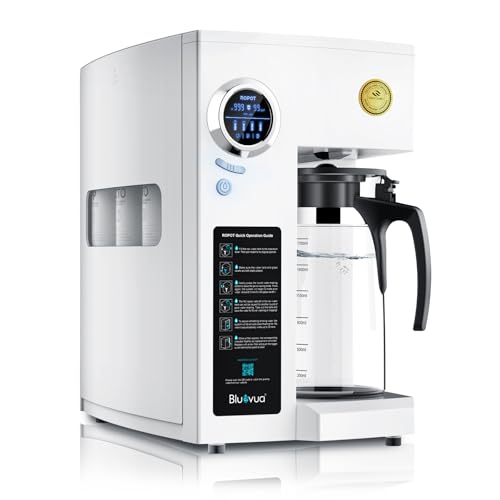 Bluevua RO100ROPOT Countertop Reverse Osmosis Water Filter
- The Bluevua RO100ROPOT-UV boasts a superior 6-stage filtration…
- COUNTERTOP FILTRATION + PREMIUM-QUALITY CARAFE: No plumbing or…
- POWER SAVING + WATER SAVING: The water system…
| Product | Key specs | |
|---|---|---|
| DREO Reverse Osmosis Water Filter Countertop | 𝗘𝗳𝗳𝗶𝗰𝗶𝗲𝗻𝘁 𝗣𝘂𝗿𝗶𝗳𝗶𝗰𝗮𝘁𝗶𝗼𝗻, 𝗣𝗲𝗮𝗰𝗲 𝗼𝗳 𝗠𝗶𝗻𝗱: The DREO 7‑in‑1… | Check price |
| Waterdrop CTF-01 Water Filter for Sink Faucet | 𝐈𝐦𝐩𝐨𝐫𝐭𝐚𝐧𝐭 𝐍𝐨𝐭𝐞: This water filter for sink faucet… 𝐄𝐚𝐬𝐲 𝐈𝐧𝐬𝐭𝐚𝐥𝐥𝐚𝐭𝐢𝐨𝐧: The countertop water filter is easy… 𝐇𝐞𝐚𝐥𝐭𝐡 & 𝐏𝐮𝐫𝐞 𝐖𝐚𝐭𝐞𝐫 𝐢𝐧 𝐄𝐯𝐞𝐫𝐲 𝐒𝐢𝐩: Designed… | Check price |
| Bluevua RO100ROPOT Countertop Reverse Osmosis Water Filter | The Bluevua RO100ROPOT-UV boasts a superior 6-stage filtration… COUNTERTOP FILTRATION + PREMIUM-QUALITY CARAFE: No plumbing or… POWER SAVING + WATER SAVING: The water system… | Check price |
 Bluevua RO100ROPOT Countertop Reverse Osmosis Water Filter Bluevua RO100ROPOT Countertop Reverse Osmosis Water Filter | COUNTERTOP FILTRATION + PREMIUM-QUALITY CARAFE: No plumbing or… POWER SAVING + WATER SAVING: The water system… Five levels of filtration, including a remineralization filter,… | Check price |
As an Amazon Associate we earn from qualifying purchases at no extra cost to you.
Quick picks by kitchen situation
| Kitchen or household situation | Best filter type | Why it fits | Allow approximately |
|---|---|---|---|
| Small apartment or limited counter space | Gravity-fed carbon or compact pitcher-style dispenser | No plumbing connection and modest footprint | 10–16 inches wide or deep; 0.5–1.5 gallons |
| Family of three or four | High-capacity carbon or countertop reverse osmosis | Fewer refills and enough output for cooking and drinking | 1.5–4 gallons; 15–20 inches of counter depth |
| Lead, fluoride, nitrate, or dissolved-solids concerns | Certified reverse osmosis system | Uses multiple stages, including a membrane, for broader reduction | 12–20 inches of width or depth; access to a drain may be needed |
| Renters who cannot alter the faucet | Gravity-fed dispenser or refillable countertop unit | Portable and usually requires no installation | Counter space plus a safe lifting area for refills |
| Hard water and frequent kettle scale | Reverse osmosis or demineralizing filter | Reduces more dissolved minerals than ordinary carbon | Extra room for wastewater or a collection container |
| Kids, pets, or heavy daily use | Sealed high-capacity dispenser with sturdy base | Less frequent cartridge handling and better spill resistance | At least 2 gallons of capacity and a stable 16–20-inch zone |
Carbon filtration: the sensible everyday choice
Activated carbon is the most common filtration method in countertop pitchers, faucet-connected units, and gravity-fed dispensers. It adsorbs many chemicals that affect taste and odor, including chlorine, and some filters are certified to reduce lead, mercury, pesticides, pharmaceuticals, or other specified contaminants.
Carbon systems are usually the least expensive to buy and operate. Replacement cartridges commonly cost about $10–$40 each, with replacement intervals ranging from roughly one to six months depending on the design and your water use. A large family may reach the rated gallon limit before the calendar interval.
The limitation is that carbon does not automatically remove everything dissolved in water. A basic carbon filter should not be treated as a solution for high fluoride, nitrate, arsenic, sodium, or total dissolved solids unless its certification specifically lists that contaminant. Look for performance data from NSF or ANSI standards rather than relying only on phrases such as “multi-stage” or “purifying.”
Best for
- Municipal tap water that is safe but tastes strongly of chlorine.
- Small kitchens where a 10–16-inch appliance is the practical limit.
- People who want low purchase and replacement costs.
- Renters who need a filter that can move with them.
Reverse osmosis: broader filtration with more space and upkeep
Reverse osmosis, or RO, pushes water through a semipermeable membrane after pre-filtration. It can reduce many dissolved contaminants, including lead, fluoride, nitrate, arsenic, and salts, when the particular system is certified for them. A remineralization stage may then add minerals back for taste.
Countertop RO units are often about 12–20 inches wide or deep and 14–18 inches tall. Many have an internal clean-water tank of approximately 0.5–1.5 gallons and may produce water in batches rather than instantly. Some models collect wastewater in a separate tank, while others require a temporary drain connection. Check whether the unit needs a power outlet, a faucet diverter, or space above the appliance for filling.
Replacement costs are higher: a complete set of pre-filters, membrane, and polishing filter may total about $50–$150 over a replacement cycle, although the parts are not all changed at the same time. Membranes often last longer than carbon cartridges when the incoming water is suitable and maintenance is timely.
RO is the stronger choice when a water report identifies a specific dissolved contaminant. It is not automatically the best choice for every household: it takes longer, occupies more counter space, creates reject water, and can be inconvenient if the clean-water tank is too small for your cooking routine.
Distillation and specialty filtration
Countertop distillers boil water and condense the vapor, leaving many minerals and contaminants behind. They can be useful where dissolved solids are the principal concern, but a cycle may take several hours and the boiling chamber needs regular descaling. Electricity use, heat, and a typical one-gallon-or-smaller batch size make distillation less convenient for a busy family.
Ultrafiltration systems use a very fine membrane and may reduce particles, bacteria, and some larger contaminants, but their performance varies considerably. They generally do not remove dissolved salts as broadly as RO. Ultraviolet features can help control microorganisms, yet UV does not remove lead, chlorine, or minerals. Treat each method as a specific tool rather than assuming an extra stage makes a filter universally better.
Compare the practical trade-offs
| Method | Typical capacity | Counter footprint | Typical replacement cost | Setup requirements |
|---|---|---|---|---|
| Basic carbon pitcher or dispenser | 0.5–3 gallons | Approximately 10–16 inches deep; vertical clearance for a lid | $10–$40 per cartridge | Fill manually; no tools or power |
| Faucet-connected carbon unit | Continuous while the faucet runs | Approximately 4–8 inches beside or in front of the faucet | $15–$50 per cartridge | Faucet diverter or compatible adapter; check faucet type |
| Gravity-fed stainless-steel or plastic dispenser | 1.5–4 gallons | Approximately 10–14 inches wide and 12–18 inches deep | $20–$60 per filter | Manual filling; strong, level surface required |
| Countertop reverse osmosis | 0.5–1.5 gallons per clean-water tank | Approximately 12–20 inches wide or deep and 14–18 inches high | $50–$150 for a multi-filter replacement set | Usually power; some require a drain, faucet adapter, or wastewater tank |
| Countertop distiller | About 0.5–1 gallon per cycle | Approximately 9–12 inches wide and 14–18 inches high | $20–$80 for cleaning or carbon components | Power outlet, ventilation, and regular descaling |
Measure the counter before choosing
Do not measure only the appliance’s advertised width. Leave at least 2 inches on the sides for cleaning and airflow, 3–4 inches behind a powered unit, and enough overhead clearance to remove the lid or tank. A 16-inch-deep filter can effectively need a 20-inch-deep working zone once a handle, power cord, or refill container is included.
For a small apartment kitchen with a 24-inch-deep counter, a 10-inch-deep dispenser leaves room for food preparation. A 19-inch-deep RO unit may leave only 5 inches in front, which is uncomfortable near a cooktop or sink. In a larger kitchen, place the filter close to the sink but not beside a burner, where heat and splashes can shorten its life.
Also account for weight. One gallon of water weighs about 8.3 pounds, before adding the container. A four-gallon dispenser can exceed 35 pounds when full. Use a level, load-bearing surface and avoid placing a heavy unit on a narrow overhang or an unstable rolling cart.
What to check before buying
- Contaminant certification: Match the listed certification to the contaminant you need reduced. “Reduces impurities” is not a sufficient specification.
- Rated capacity: Compare gallons, not just months. A cartridge rated for six months may last much less in a high-use household.
- Water pressure and temperature: RO systems can perform poorly with inadequate pressure or very cold water. Follow the manufacturer’s operating range.
- Replacement availability: Confirm that cartridges are easy to obtain and note whether different stages have different schedules.
- Noise and wastewater: Pumps, fans, and RO drainage matter in open-plan kitchens or small apartments.
- Cleaning access: Removable tanks and wide openings are easier to sanitize than narrow reservoirs.
Installation and maintenance reality
A gravity-fed or pitcher-style filter is ready after washing the container and flushing the first few batches. Faucet-connected carbon units are also simple, but adapter compatibility can be a problem with pull-down, spray, or designer faucets. Countertop RO systems may be plug-and-use, yet their tanks, tubing, and wastewater arrangements make setup more involved.
Replace cartridges by the stated gallon limit or schedule, whichever comes first. Wash reservoirs regularly, wipe spills promptly, and do not leave stagnant water sitting for extended periods. If your household has an infant, immunocompromised person, private well, or known water-quality issue, test the source water and select a system based on the results rather than taste alone.
Bottom line
Choose a compact carbon filter for better-tasting municipal water, a high-capacity dispenser for a busy family, and a certified countertop RO system for broader dissolved-contaminant reduction. The best choice is the one that fits your available counter with service clearance, produces enough water for your daily routine, and has replacement filters you can afford and remember to change.