The best digital food kitchen scales are the ones that combine 1-gram readability, a stable platform, a fast tare button, enough capacity for your largest mixing bowl, and a footprint that fits your countertop or drawer.
Our top picks
 Etekcity Food Kitchen Scale
- 𝗘𝗳𝗳𝗼𝗿𝘁𝗹𝗲𝘀𝘀 𝗪𝗲𝗶𝗴𝗵𝗶𝗻𝗴: Supports 5 units (oz/lb:oz/fl'oz/g/mL), tare function,…
- 𝗣𝗿𝗲𝗰𝗶𝘀𝗲 𝗥𝗲𝘀𝘂𝗹𝘁𝘀: Accurately weighs up to 11 lb/5…
- 𝗦𝗶𝗺𝗽𝗹𝗲 & 𝗖𝗼𝗺𝗽𝗮𝗰𝘁: The small and sleek scale…
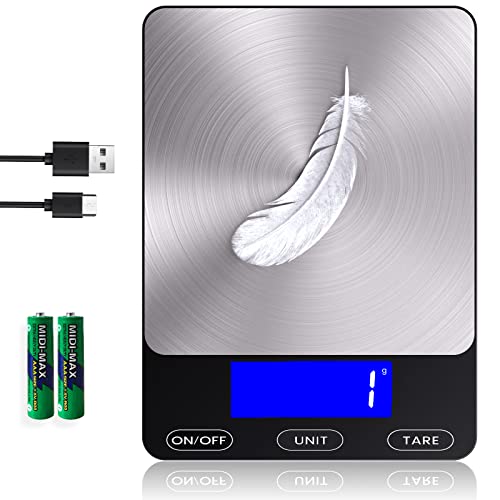 Food Scale -33lb Digital Kitchen Scale for
- 【Precise Weight Food Scale】Our Food Kitchen Scale equips…
- 【Pratical and Durable Kitchen Scale】5 commonly used measurement…
- 【Weight Control Scale -Easy Tare】 The Tare button…
 Nicewell Food Scale 22lb Digital Kitchen Scale
- 【PRECISE WEIGHT】 The digital food scale built-in four…
- 【MULTIFUNCTION LARGE SCALE】 9"x6.3" platform and Large lcd…
- 【PRACTICAL DESIGN】 The food scale is designed with…
| Product | Key specs | |
|---|---|---|
| Etekcity Food Kitchen Scale | 𝗘𝗳𝗳𝗼𝗿𝘁𝗹𝗲𝘀𝘀 𝗪𝗲𝗶𝗴𝗵𝗶𝗻𝗴: Supports 5 units (oz/lb:oz/fl'oz/g/mL), tare function,… 𝗣𝗿𝗲𝗰𝗶𝘀𝗲 𝗥𝗲𝘀𝘂𝗹𝘁𝘀: Accurately weighs up to 11 lb/5… 𝗦𝗶𝗺𝗽𝗹𝗲 & 𝗖𝗼𝗺𝗽𝗮𝗰𝘁: The small and sleek scale… | Check price |
| Food Scale -33lb Digital Kitchen Scale for | 【Precise Weight Food Scale】Our Food Kitchen Scale equips… 【Pratical and Durable Kitchen Scale】5 commonly used measurement… 【Weight Control Scale -Easy Tare】 The Tare button… | Check price |
| Nicewell Food Scale 22lb Digital Kitchen Scale | 【PRECISE WEIGHT】 The digital food scale built-in four… 【MULTIFUNCTION LARGE SCALE】 9"x6.3" platform and Large lcd… 【PRACTICAL DESIGN】 The food scale is designed with… | Check price |
 Etekcity 22lb Food Kitchen Scale Etekcity 22lb Food Kitchen Scale | 𝗠𝗮𝘅 𝗖𝗮𝗽𝗮𝗰𝗶𝘁𝘆: Weigh objects as heavy as 22… 𝗜𝗣𝗫𝟲 𝗪𝗮𝘁𝗲𝗿𝗽𝗿𝗼𝗼𝗳 𝗗𝗲𝘀𝗶𝗴𝗻: Features an IPX6 waterproof design,… 𝗧𝘆𝗽𝗲-𝗖 𝗥𝗲𝗰𝗵𝗮𝗿𝗴𝗲𝗮𝗯𝗹𝗲 𝗕𝗮𝘁𝘁𝗲𝗿𝘆: The scale features a rechargeable… | Check price |
As an Amazon Associate we earn from qualifying purchases at no extra cost to you.
Quick picks by cooking situation
| Cooking situation | Best scale type | Useful target specifications | Why it fits |
|---|---|---|---|
| Small apartment or narrow counter | Compact flat scale | 5–7 inch platform; under 1.5 inches tall | Stores in a drawer and leaves room beside a cutting board |
| Daily baking | General-purpose scale with a wide platform | 11-pound capacity; 1-gram increments; 7–9 inch platform | Handles mixing bowls while remaining precise for flour and yeast |
| Large batches, meal prep, or sourdough | High-capacity scale | 15–22-pound capacity; 1-gram increments | Accommodates heavy bowls, dough, and multiple ingredients |
| Children and frequent spills | Sealed stainless-steel-top scale | Removable or wipeable surface; raised buttons | Less vulnerable to flour, milk, and sticky ingredients |
| Renter with limited storage | Thin battery-powered scale | Less than 1.5 inches high; auto-off; AAA or coin-cell batteries | Easy to store without installing anything or dedicating counter space |
What accuracy do you actually need?
For most home cooking, a scale that reads in 1-gram increments is the best balance of precision, price, and convenience. It is accurate enough for flour, sugar, coffee, meat portions, and general meal preparation. A scale displaying 0.1 grams is useful for very small quantities of spices, baker’s yeast, salt, or coffee additives, but it does not automatically mean the scale is more accurate across its entire capacity.
Look for a scale with a stated capacity of at least 11 pounds and a resolution of 1 gram. A scale that claims 0.1-gram readings but can only weigh a few hundred grams may be less practical than a reliable 1-gram model. Accuracy can also suffer when a large bowl overhangs the weighing surface or when the scale is placed on a soft, uneven counter.
For repeatable results, place the scale on a hard, level surface, allow the display to settle, and do not press against the bowl while reading it. If you are weighing very light ingredients, keep the bowl centered rather than resting it partly on the countertop.
Head-to-head: compact, wide-platform, and high-capacity scales
Compact flat scales
Compact scales are usually 5–7 inches wide and easy to slide into a drawer. They suit small kitchens, coffee stations, and occasional baking. Their limitation is clearance: a wide mixing bowl may cover the display or overhang the platform enough to make the reading unstable.
Choose this style when storage matters more than bowl size. A slim model also works well on a 20–24-inch-deep countertop, where a larger scale may compete with appliances and prep space.
Wide-platform scales
A 7–9-inch platform is the most versatile choice for a typical household. It gives a large bowl room to sit flat while keeping the display visible. This is the category that includes popular general-purpose designs such as the Escali Primo and OXO Good Grips food scales.
Wide does not always mean bulky. Many are less than 2 inches tall and can be stored vertically in a cabinet organizer. Check the button placement, however: touch controls near the edge can be accidentally pressed when a large bowl is moved.
High-capacity scales
High-capacity models, including the My Weigh KD-8000 type, are useful for large dough batches, bulk meal preparation, and weighing ingredients directly in a heavy stainless-steel bowl. Capacities commonly range from 15 to 22 pounds.
The trade-off is size. These scales often occupy more counter depth, may have a raised display or protective cover, and can be inconvenient to store in a shallow drawer. For a small kitchen, confirm that the scale leaves at least 4 inches of clear working space in front of it so you can add ingredients without standing at an awkward angle.
Features that make a measurable difference
Tare response
Tare is the function that returns the display to zero after you place a bowl on the platform. A good tare button responds immediately and reliably without requiring repeated presses. This matters when adding several ingredients to one bowl: slow or inconsistent tare behavior interrupts the process and increases the chance of forgetting to reset the weight.
Physical buttons are often easier to activate with flour-dusted fingers than completely flat touch controls. If you prefer a seamless glass surface, look for clearly separated controls and a display that remains visible around the bowl.
Unit options
At minimum, choose a scale that switches among grams, ounces, pounds, and milliliters. Milliliter readings are convenient but are estimates based on water density; they are not equally accurate for oil, honey, flour, or other liquids. Grams remain the most dependable unit for recipe consistency.
A dedicated unit button is faster than cycling through several modes. If you follow recipes from different countries, a scale that remembers your last unit can save time, although this is less important than a readable display.
Platform material and cleanup
| Surface construction | Advantages | Trade-offs | Best for |
|---|---|---|---|
| Stainless steel | Resists stains, wipes clean, tolerates frequent use | Can show fingerprints; may feel cold or slippery | Busy cooks, children, and spill-prone kitchens |
| Tempered glass | Smooth, attractive, and easy to wipe | Can become slippery with condensation; edges need care | Modern kitchens and countertop storage |
| Plastic platform | Lightweight, generally affordable, less likely to scratch cookware | May retain oily residue or discolor over time | Budget buyers and occasional use |
Do not rinse a kitchen scale under the faucet unless the manufacturer specifically allows it. Wipe the platform with a damp cloth, then dry it. Flour can work into button seams, while sugar and syrup can harden around the platform edge, so a removable weighing tray is a practical advantage.
Storage and countertop fit
Before buying, measure the intended storage location rather than relying on the scale’s advertised footprint. A scale that is 8 inches wide may need 9–10 inches of cabinet clearance if its buttons or platform lip extend beyond the base. For drawer storage, allow roughly 2 inches of height so the scale can be lifted without catching on the drawer above it.
If it will remain on the counter, consider the visual and functional clearance around it. Leave at least 3 inches on each side for handling a bowl and approximately 6 inches in front for adding ingredients comfortably. A scale stored beside a stand mixer may need to be moved every time the mixer is used; a thin, flat design is easier to slide under a cabinet or stand upright in a narrow slot.
Battery, power, and durability considerations
Battery-powered scales are simplest for renters and can be stored anywhere. Coin-cell batteries keep the body slim, while AAA or AA batteries are easier to replace and may last longer in frequent use. USB-rechargeable models reduce disposable batteries but should be charged away from wet prep areas.
The parts most likely to become frustrating first are not usually the load cell itself. Button membranes can become sticky, the display may dim as batteries weaken, and inexpensive plastic feet can lose grip. Rubber feet are important: a scale that shifts while you add ingredients is effectively less precise, even if its sensor is accurate.
A removable stainless-steel tray, sealed controls, and a stable base generally justify paying more than the least expensive option. For most households, a reliable digital scale usually costs about $15–$35; wider or higher-capacity models commonly cost $30–$70, while rechargeable designs with premium construction may reach $80 or more.
How to choose the best digital food kitchen scale
- Choose 1-gram readability unless you regularly measure ingredients below 1 gram.
- Select at least 11 pounds of capacity for ordinary baking and meal preparation.
- Measure your bowl and storage space, then compare them with the platform dimensions.
- Prioritize a fast tare button and a display that remains visible beneath a bowl.
- Choose stainless steel or glass if spills and daily cleanup are major concerns.
- Check whether the auto-off timer is long enough for slow recipes and dough preparation.
- Confirm the scale sits level and leaves enough countertop clearance for comfortable use.
For most kitchens, the strongest all-around choice is a wide-platform, 11-pound scale with 1-gram increments, grams and ounces, physical tare controls, and a wipe-clean surface. Choose a compact model only when drawer space is tight, and move up to a 15–22-pound model when large bowls or batch cooking are part of your normal routine.