Key takeaways
- Best for first-time beginners and small kitchens: 3L to 5L all-stainless kit with clamp-style lid, silicone seals, and worm coil condenser. Usually $140–$280, light enough to use on a standard kitchen stove and easy to clean in a sink.
- Best for homesteaders and garden harvests: 10L to 12L stainless steel still with copper column or copper condenser coil. Usually $300–$550. Handles 1.5 to 2.5 lbs of lavender, rosemary, or peppermint per run without constant reloading.
- Best for high-oil plants and larger batches: 20L stainless boiler with removable plant basket, shotgun or large coil condenser, and tri-clamp connections. Usually $500–$900. Requires a dedicated burner and floor space for cooling water.
- Best for traditional hydrosol focus: Copper alembic-style still, typically 5L to 10L. Usually $250–$600. Excellent thermal conductivity and classic hydrosol aroma, but demands more careful cleaning to prevent oxidation.
The best essential oil steam distillation equipment sets for beginners in 2026 are 3L to 5L stainless steel kits with a coil condenser and silicone gaskets for easy learning, while serious home producers get the best value from 10L to 20L stainless steel column stills with copper vapor paths for higher yield and cleaner separation.
Our top picks
 VEVOR Lab Distillation Kit
- Large Capacity Lab Distillation Kit: Our distillation apparatus…
- 3.3 Borosilicate Glass: Upgraded to 3.3 borosilicate glass,…
- Standard Ground Joints: All joints are in the…
 LETIME Hydrosol Maker
- Your Creativity can be Expanded by KD5 Hydrosol…
- Best Hydrosol Maker Kit
- Affordable and High Quality Steam Distillation Kit
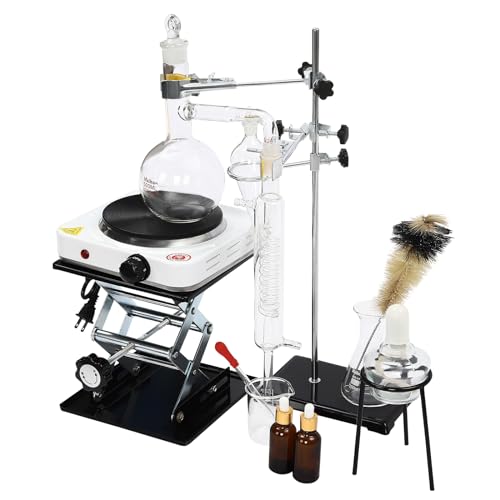 Essential Oil Distillation Equipment
- 【Selected Materials】The glassware is made of high quality…
- 【Stable Structure】The glassware kit firmly fixes the stand,…
- 【Professional Kit】The glass kit includes distillation flasks, serpentine…
| Product | Key specs | |
|---|---|---|
| VEVOR Lab Distillation Kit | Large Capacity Lab Distillation Kit: Our distillation apparatus… 3.3 Borosilicate Glass: Upgraded to 3.3 borosilicate glass,… Standard Ground Joints: All joints are in the… | Check price |
| LETIME Hydrosol Maker | Your Creativity can be Expanded by KD5 Hydrosol… Best Hydrosol Maker Kit Affordable and High Quality Steam Distillation Kit | Check price |
| Essential Oil Distillation Equipment | 【Selected Materials】The glassware is made of high quality… 【Stable Structure】The glassware kit firmly fixes the stand,… 【Professional Kit】The glass kit includes distillation flasks, serpentine… | Check price |
 Essential Oil Distillation Equipment Essential Oil Distillation Equipment | 【Selected Materials】The glassware is made of high quality… 【Stable Structure】The glassware kit firmly fixes the stand,… 【Professional Kit】The glass kit includes distillation flasks, serpentine… | Check price |
As an Amazon Associate we earn from qualifying purchases at no extra cost to you.
Which Set Should You Buy? Picks by Situation
If you want to match the equipment to how you will actually use it, start here:
- Best for first-time beginners and small kitchens: 3L to 5L all-stainless kit with clamp-style lid, silicone seals, and worm coil condenser. Usually $140–$280, light enough to use on a standard kitchen stove and easy to clean in a sink.
- Best for homesteaders and garden harvests: 10L to 12L stainless steel still with copper column or copper condenser coil. Usually $300–$550. Handles 1.5 to 2.5 lbs of lavender, rosemary, or peppermint per run without constant reloading.
- Best for high-oil plants and larger batches: 20L stainless boiler with removable plant basket, shotgun or large coil condenser, and tri-clamp connections. Usually $500–$900. Requires a dedicated burner and floor space for cooling water.
- Best for traditional hydrosol focus: Copper alembic-style still, typically 5L to 10L. Usually $250–$600. Excellent thermal conductivity and classic hydrosol aroma, but demands more careful cleaning to prevent oxidation.
How Still Capacity Changes Your Results
Capacity is not just about size, it determines run time, yield, and where you can safely operate the still.
A 3L still holds about 0.7 lbs of loosely packed plant material and yields roughly 2–5 ml of essential oil from a high-yield plant like lavender per 60 to 90 minute run. A 10L still holds 1.5 to 2.5 lbs and yields 8–15 ml in a 90 to 120 minute run. A 20L still holds 3.5 to 5 lbs and can produce 15–30 ml per run, but requires 2.5 to 3 hours including heat-up and cool-down.
For space planning, measure before you buy. A typical 5L tabletop kit is 14–16 inches wide and 18–22 inches tall when assembled, plus 10 inches of overhead clearance to lift the lid and plant basket. It fits on a 24-inch deep countertop with a heat source, but you need 36 inches of clear counter or cart space for the condenser, collection beaker, and cooling water bucket. A 20L floor unit is 20–24 inches in diameter at the base and 28–34 inches tall, weighs 22–33 lbs empty and over 55 lbs when loaded with water and botanicals, and needs a dedicated 30×30 inch heat-proof stand. Both sizes need a doorway of at least 28 inches if you plan to move the assembled boiler, and most 10L+ kits ship in a box weighing 18–32 lbs.
Stainless Steel vs. Copper: Construction Trade-Offs
The boiler material affects flavor, durability, maintenance, and which heat sources you can use.
| Feature | 304 Stainless Steel | Pure Copper | Stainless Boiler with Copper Column/Condenser |
|---|---|---|---|
| Heat conductivity | Moderate, heats evenly, slower initial heat-up | Very high, heats 25–30% faster, responsive to flame changes | Balanced, stainless retains heat, copper vapor path refines vapor |
| Durability and corrosion | Excellent, resists acids and salts, dishwasher-safe parts | Requires drying after each use, can develop verdigris if stored damp | Very good, only copper parts need extra care |
| Oil and hydrosol character | Neutral and clean, preserves bright top notes | Slightly rounder, softer sulfur compounds removed by copper | Clean with slightly reduced sulfurous off-notes |
| Maintenance | Rinse with warm water and mild detergent, occasional citric acid passivation | Wash, dry immediately, occasional vinegar-salt or citric rinse, never abrasive scrub | Split routine, stainless parts forgiving, copper parts hand-dried |
| Heat-source compatibility | Works on gas, electric coil, and induction if magnetic base | Gas and electric coil only, not induction | Depends on boiler base, usually gas, electric and induction |
| Typical lifespan | 10+ years with gasket replacement | 8–12 years with careful use, thinnest copper dents more easily | 10+ years, copper section may need replacement after 5–7 years of heavy use |
For most buyers, 304 food-grade stainless steel is the most forgiving. If you distill a lot of sulfur-heavy botanicals like some lavenders or brassica-family plants, the hybrid design gives you the benefit of copper where vapor contacts metal without the full maintenance burden of a copper boiler.
Condenser Design Matters More Than It Looks
The condenser determines whether you actually capture the oil you distilled.
Worm Coil Condenser
A copper or stainless coil sitting in a bucket of cold water. Very effective for beginners because it provides a long vapor path, up to 6–8 feet of coil in a 5L kit, and tolerates variable cooling water temperature. Requires 2–5 gallons of cooling water per run and a water pump or frequent ice changes. Easiest to assemble with two hose barbs.
Liebig Condenser
A straight tube-in-tube design where vapor travels through an inner tube and cooling water flows around it. More compact, typically 14–20 inches long, and easier to clean with a bottle brush. Needs consistent water flow at 0.5–1 gallon per minute. Preferred for 10L+ setups where a coil bucket would be too bulky.
Shotgun Condenser
Multiple small inner tubes inside a single jacket. The highest cooling efficiency and fastest throughput, often found on 20L professional-style sets. Cools aggressively even with warm tap water but is heavier, more expensive, and harder to fully dry after use.
For beginners, a coil or Liebig condenser with 1/2-inch inner diameter and silicone water hoses is the best balance of performance and simplicity. Avoid narrow 1/4-inch vapor tubes that clog with plant debris.
Seals, Connections, and Why They Leak
Leaks are the most common frustration and they ruin yield. There are three seal systems:
- Silicone gaskets with toggle clamps: Standard on modern stainless kits. Create a reliable steam-tight seal in seconds, reusable for 100+ runs, and withstand 212–250°F. Check that the gasket is 3–4mm thick food-grade silicone with no gaps at the seam.
- Traditional flour paste: Used on copper alembics without gaskets. You mix flour and water into a putty to seal the joint. Works well but takes 10 minutes to apply, must be reapplied each run, and can crack if overheated.
- PTFE tape and threaded fittings: For thermometer ports and condenser connections. Useful as a supplement, but should not be the primary boiler seal.
- Tri-clamp with silicone gasket: Found on 10L+ stainless column stills. Most secure and easiest to disassemble for cleaning, but adds cost.
Look for kits that include spare gaskets, at least four adjustable clamps, and a thermometer port with a 0–250°F thermometer. A loose-fitting lid that relies on weight alone will vent steam and lose oil.
Heat-Source Compatibility: Check Before You Buy
Not every still works on every stove, and this is where beginners get stuck with equipment they cannot use.
| Heat Source | Compatible Still Type | Notes on Performance |
|---|---|---|
| Induction cooktop (1200–1800W) | 304 stainless with flat magnetic base, 3L–12L | Precise control, fastest indoor option, boiler must be induction-ready. Will not work with pure copper. |
| Gas burner (5000–12000 BTU) | All copper and stainless, all sizes | Excellent control, open flame requires 18-inch clearance above still and ventilation. |
| Electric coil hot plate (1000–1500W) | Stainless and copper with flat bottom, 3L–10L | Works but cycles on/off, causes uneven steam. Choose a plate with 6-inch+ coil. Not ideal for 20L. |
| Outdoor propane burner (30000+ BTU) | 20L+ heavy-duty stainless | Needed for large volumes, heats 20L in 25–35 minutes. Never use indoors. Requires regulator and wind guard. |
If you rent or have an induction cooktop, filter specifically for induction-compatible stainless. If you have only an electric coil stove, use a stainless diffuser plate to prevent hot spots that scorch botanicals.
Cleanup and Beginner Assembly Realities
Assembly and cleanup determine whether you will actually use the equipment a second time.
A beginner-friendly 5L kit should assemble in 10–15 minutes without tools beyond a wrench for hose clamps. Look for pre-formed silicone hoses, clearly labeled inlet and outlet for cooling water, and a plant basket or sieve plate that lifts out in one piece. Kits that require you to cut tubing or apply sealant before the first run add an hour and often leak.
For cleanup, stainless steel with a removable plant basket cleans in 10 minutes: discard spent material, rinse boiler with hot water, wash condenser coil by flushing with hot water and a small amount of unscented detergent, then air dry completely. Copper requires hand drying immediately to prevent spotting and should not soak overnight. The first parts to wear are always the silicone gasket, which hardens after 12–18 months, and the cooling hoses, which kink or cloud. Buy kits that sell replacements separately.
Weight and storage matter in a home. A dry 10L boiler weighs 12–16 lbs, a 5L boiler 7–9 lbs. Both should store disassembled in a 18x18x16 inch cabinet space. If you live in a small apartment, a 3L kit that fits inside a kitchen cabinet between uses will be used far more often than a 20L floor still that needs permanent space.
Decision Matrix: Match Your Situation to the Right Set
| Your Situation | Best Capacity and Material | Why It Fits |
|---|---|---|
| Small apartment or renter, limited storage and ventilation | 3L–5L stainless, coil condenser, silicone seals | Light, induction-friendly, stores in a cabinet, runs on kitchen stove with 2-gallon water bucket |
| Home gardener with seasonal lavender, mint, or rosemary | 10L stainless with copper condenser | Processes a full harvest in 2–3 runs instead of 8–10, better oil separation from bulky material |
| Pets and kids at home | 8L–10L stainless with tri-clamp lid and locking clamps | Secure seal prevents steam burns, stable base resists tipping, no open flour paste to contaminate |
| Back pain or limited lifting strength | 5L stainless with lift-out basket and side handles | Loaded weight under 18 lbs, basket lets you remove spent plants without lifting the whole boiler |
| Focus on hydrosols and aromatherapy water | 5L–10L copper alembic or hybrid | Copper softens aroma, traditional shape produces balanced hydrosol-to-oil ratio |
What to Expect for Cost and Longevity
In 2026, entry-level 3L to 5L stainless sets usually run $140–$280, mid-range 10L to 12L stainless and hybrid sets $300–$550, and professional 20L column sets $500–$900. Copper alembics of similar size typically cost $20–$80 more than stainless equivalents due to material thickness. Budget an extra $30–$60 for a submersible water pump, food-grade collection jars, and replacement gaskets. A well-maintained stainless boiler lasts well over a decade, the copper condenser coil or insert may need replacement after 5 to 7 years of frequent use, and the gasket set should be replaced annually if you distill monthly.
FAQ
Can I use a pressure cooker as a distillation boiler? No. Pressure cookers are designed to hold pressure, while steam distillation must vent freely through the condenser. Using one risks overpressure and produces off-aromas from rubber seals not rated for prolonged essential oil exposure.
How much water do I put in the boiler? Fill to just below the plant basket or sieve plate, typically 1 to 1.5 liters for a 5L still and 2.5 to 4 liters for a 10L still. The plant material should be suspended in steam, not boiled submerged, for true steam distillation.
Do I need a separate essential oil separator? For hydrosol-focused runs, a Florentine flask or pipette separator makes collection much easier because oil floats on top of hydrosol. Small kits often include a simple glass separator, larger kits may require buying one separately in 100ml or 250ml size.