Key takeaways
- Compare the best oven gloves in five-finger designs: aramid, silicone and neoprene pairs with maker heat figures, cuff lengths, grip and care tips.
A mitt turns your hand into a paddle. That is fine for sliding out a sheet pan, but it is clumsy when you need to grip a narrow Dutch oven handle, turn a skewer, or steady a hot grate while you work with the other hand. Oven gloves fix that problem by giving every finger its own sleeve, so you keep the dexterity of a bare hand while a heat-resistant shell stands between your skin and the metal. The trade-off is coverage and complexity: gloves come in more materials, more cuff lengths and more heat figures than mitts, and the numbers on the box need careful reading.
This guide covers five-finger gloves only; mitt and pot holder sets are a separate category. The picks below span the three glove families that matter: woven aramid fabric, solid silicone, and neoprene. Every temperature quoted is a figure stated by the maker in its own listing, given for brief contact rather than sustained holding. If heat builds through the glove, put the pan down.
Disclosure: As an Amazon Associate, we earn from qualifying purchases made through links on this page, at no extra cost to you.
How to Choose Oven Gloves
Match the material to the job
Aramid gloves, like the Grill Armor and Grill Heat Aid picks below, are woven from the same family of fibres used in protective workwear: they stay flexible, resist cuts as well as heat, and breathe better than rubber shells. Their weakness is water: a soaked fabric glove passes heat and steam to the skin, so aramid belongs on dry work such as baking, grilling and handling cast iron. Silicone gloves, like the GEEKHOM pick, are waterproof and wipe clean, which suits messy oven work and draining pots. Neoprene gloves, like the RAPICCA and Aillary picks, add a sealed surface over a long sleeve, the combination to pick for fryers, smokers and greasy meat.
Read the heat figure with care
Makers state heat figures for short contact, and the safe holding time shrinks fast as temperature climbs. One listing in this guide spells the point out in a table: at its top figure the glove buys well under twenty seconds, while at boiling-water temperatures it buys more than a minute. Treat the headline number as a ceiling for a quick grab, not a long carry. A glove certified to EN407 has passed a standard set of lab tests for thermal hazards, which makes its figures easier to compare across brands.
Check cuff length and fit
Gloves in this guide run from about 10 inches to 14 inches. A 10-inch glove covers the hand and wrist and feels nimble, which suits baking and stovetop work. A 14-inch sleeve reaches up the forearm and earns its keep in a deep oven, over a smoker, or at a fryer. Most of these gloves are one size, so hand size matters: very small hands swim in long-fingered aramid gloves, and very large hands can find snug silicone shells tight across the knuckles. Ambidextrous designs that fit either hand are a small convenience when you grab a glove in a hurry.
Weigh grip, lining and care
Look for a silicone pattern across the whole palm and fingers, not a few decorative stripes: full coverage is what keeps a greasy roasting pan from rotating in your hand. Inside, a cotton lining adds insulation and absorbs sweat, and it is the layer that decides whether a glove feels clammy after ten minutes. Care splits the group too: some aramid gloves go in the washing machine, while neoprene pairs are usually hand wash only.
The 5 Best Oven Gloves
1. Grill Armor EN407 Oven Gloves

Grill Armor builds this pair on M-Aramid and P-Aramid fibres, the woven materials behind its EN407 certification and its maker-stated heat figure of 932 degrees Fahrenheit. Silicone covers the gripping surface in broad strips, so a casserole dish or a Pyrex handle stays put instead of sliding, and the same aramid weave adds cut and puncture resistance that plain cloth cannot match. The 100 percent cotton lining keeps the inside comfortable, and at 10 by 5 inches the gloves cover the hand and wrist without the bulk of a long sleeve, which keeps them nimble for everyday baking and stovetop lifting. They are machine washable, and the maker offers a limited lifetime warranty after registration. The honest limits: the fingers run long on smaller hands, and like every fabric glove they must stay dry, since a wet aramid glove loses its protective value around steam.
Specs
- Outer material: M-Aramid and P-Aramid with silicone grip
- Lining: 100 percent cotton
- Maker-stated heat figure: 932 degrees Fahrenheit (500 degrees Celsius)
- Certification: EN407
- Dimensions: 10 x 5 in
- Care: Machine wash
- Set contents: 1 pair (2 gloves)
2. RAPICCA BBQ Gloves, 14 Inch XL
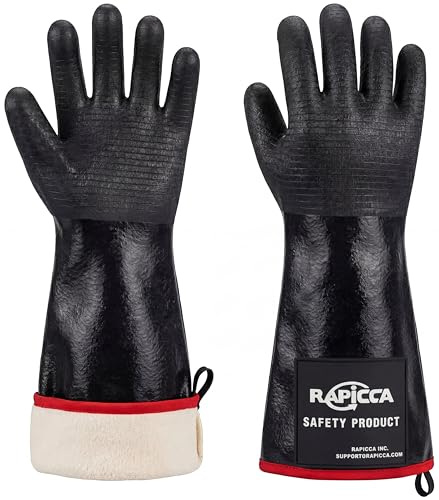
The RAPICCA pair is the wet-work specialist here. A food-grade neoprene coating seals the whole glove against water, oil and grease, and the 14-inch sleeve guards the forearm when you reach across a smoker or work a fryer. The maker states a heat figure of 932 degrees Fahrenheit, the palm carries a textured pattern for grip on slippery meat and metal, and Kevlar stitching holds the seams together under strain. A cotton lining sits against the skin. This is the pair to pick when the hazard is as much hot liquid and spatter as hot metal: draining a turkey fryer pot, turning ribs by hand, or pulling a brisket off the grate. Neoprene asks for hand washing, and the XL sizing runs generous, so smaller hands should expect a loose fit.
Specs
- Model: RAPICCAGrillgloves14
- Outer material: Food-grade neoprene coating, textured palm
- Lining: Cotton
- Maker-stated heat figure: 932 degrees Fahrenheit
- Length: 14 in
- Size: XL
- Stitching: Kevlar thread
- Weight: 380 g
- Care: Hand wash only
3. GEEKHOM Silicone Grilling Gloves

GEEKHOM takes the opposite route from the fabric pairs: a solid food-grade silicone shell over a cotton lining, in a dual-layer build that is waterproof from fingertip to cuff. The maker-stated heat figure is 446 degrees Fahrenheit, well below the aramid and neoprene picks, and that lower ceiling defines the glove. For ordinary oven work it is ample: baking trays, casserole dishes, oven racks and cast iron all live below that figure in normal use, and in return you get the easiest cleanup in this guide, since sauce and grease rinse off the sealed surface instead of soaking into cloth. The cuff runs 13.7 inches, longer than most silicone gloves. The fingers run short on larger hands, and the shell should be kept away from open flame.
Specs
- Outer material: Food-grade silicone
- Lining: Cotton
- Design: Dual layer, waterproof
- Maker-stated heat figure: 446 degrees Fahrenheit (230 degrees Celsius)
- Length: 13.7 in
- Grip: Textured non-slip silicone surface
- Care: not published
4. Grill Heat Aid Extreme Heat Resistant Gloves

Grill Heat Aid weaves its gloves from para-aramid and meta-aramid fibres and adds silicone grip stripes across the palm and each finger, a layout aimed at control: turning skewers, adjusting grates and handling tools all ask for fingertip precision more than raw insulation. The maker states a heat figure of 932 degrees Fahrenheit with EN407 certification, and a cotton lining keeps the inside comfortable. Two practical details stand out: each glove fits either hand, so there is no left and right to sort in the drawer, and the pair is machine washable, which fabric gloves cannot always claim. The snug cut that gives the dexterity also makes the gloves slower to pull on and off, and coverage ends at the wrist, so deep-oven reaching belongs to the longer pairs in this guide.
Specs
- Material: Para-aramid and meta-aramid fibres with silicone grip stripes
- Lining: Cotton
- Maker-stated heat figure: 932 degrees Fahrenheit
- Certification: EN407
- Fit: One size, either hand
- Length: not published
- Care: Machine washable
5. Aillary Waterproof Pit Grill Gloves
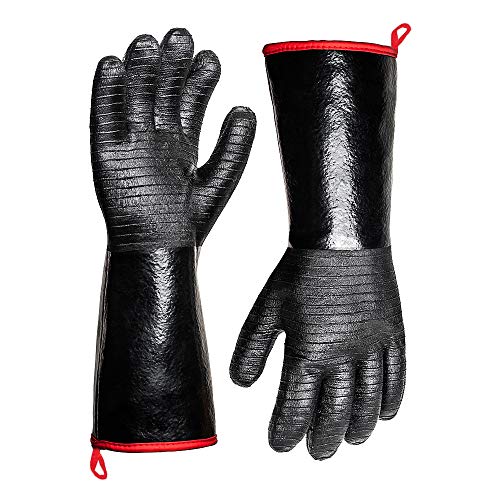
Aillary coats its five-finger gloves in food-grade neoprene over a cotton lining, with a textured palm for greasy work and a 14-inch sleeve for forearm coverage. The maker states a heat figure of 932 degrees Fahrenheit and, unusually, publishes the contact times behind the number: under 15 to 17 seconds at the top figure, stretching to more than a minute near boiling-water temperatures. That honesty is useful, because it shows how every glove in this guide behaves, even the ones that print only the headline figure. The pair weighs 12 ounces, light enough for long smoker sessions, and the sealed surface wipes clean after handling sauced meat. It suits cooks who split time between oven and grill and want one long, waterproof pair for both. As with the RAPICCA pair, the thick neoprene shell is not the tool for delicate baking tasks where a thinner fabric glove gives better feel.
Specs
- Model: mdk-397
- Outer material: Food-grade neoprene coating, textured palm
- Lining: Cotton
- Maker-stated heat figure: 932 degrees Fahrenheit (500 degrees Celsius)
- Length: 14 in
- Weight: 12 oz
- Care: not published
Comparison Table
| Glove | Material | Maker heat figure | Length | Care |
|---|---|---|---|---|
| Grill Armor EN407 | Aramid with silicone grip | 932 degrees Fahrenheit | 10 in | Machine wash |
| RAPICCA BBQ Gloves | Neoprene over cotton | 932 degrees Fahrenheit | 14 in | Hand wash only |
| GEEKHOM Silicone | Silicone over cotton | 446 degrees Fahrenheit | 13.7 in | not published |
| Grill Heat Aid | Aramid with silicone stripes | 932 degrees Fahrenheit | not published | Machine washable |
| Aillary Pit Gloves | Neoprene over cotton | 932 degrees Fahrenheit | 14 in | not published |
FAQ
Are oven gloves better than oven mitts?
Neither wins outright. Gloves give each finger its own sleeve, so gripping handles, turning food and adjusting racks is easier and safer than with a paddle-shaped mitt. Mitts are quicker to pull on, simpler to share between cooks, and often come in sets with pot holders. Many kitchens keep both: gloves for grill and cast iron work, mitts for quick baking tasks.
What do the heat figures on oven gloves actually mean?
They are figures stated by the maker for brief contact, not for holding a hot pan indefinitely. The time you can safely hold an object drops sharply as its temperature climbs toward the stated figure, which is why one listing in this guide quotes under twenty seconds at its top number but more than a minute near the temperature of boiling water. Use the figure to compare gloves, and always set the pan down if heat builds.
Can oven gloves protect against steam and hot liquids?
Only the sealed designs can. Neoprene and silicone gloves shed water and block steam, so they suit draining pots, fryers and smokers. Woven aramid gloves offer no such protection: once the fabric is wet, it conducts heat and can let steam reach the skin. Whatever the material, a glove should go on dry and come off if it gets soaked.
How should oven gloves be washed?
Follow the label on the pair you buy, because the group splits. The aramid picks in this guide are machine washable, the RAPICCA neoprene pair is hand wash only, and silicone shells rinse clean under the tap. Let any glove dry fully before its next use, since a damp lining turns to steam against hot metal.
When should oven gloves be replaced?
Replace a pair when the lining feels thin or compressed, when silicone cracks or peels, when the grip pattern wears smooth, or when you can feel heat arriving sooner than you used to on the same tasks. Scorched patches, torn seams and stiffened fabric all mean the insulation has broken down, and a glove that lets heat through quickly encourages you to hold on longer than you should.
Conclusion
For most home kitchens, the Grill Armor pair is the balanced default: certified aramid protection, a full silicone grip and machine-washable care in a nimble 10-inch glove. Choose the RAPICCA or Aillary gloves when water, oil and forearm coverage matter, the GEEKHOM gloves when easy cleanup and oven-only work are the priority, and the Grill Heat Aid gloves when fingertip control is the deciding factor. Whichever pair you pick, confirm the size, the cuff length and the stated heat figure on the listing before you order, and keep the gloves dry in use.
FAQ
Are oven gloves better than oven mitts?
What do the heat figures on oven gloves actually mean?
Can oven gloves protect against steam and hot liquids?
How should oven gloves be washed?
When should oven gloves be replaced?
More from Amazon
Programs that pair well with the guide above. Offers and eligibility are set by Amazon and may change.
Set up recurring deliveries of everyday items on eligible products. Terms and savings are set by Amazon.
Explore Subscribe & SaveCollect the home and kitchen items you want in one registry that guests can shop from.
Create a wedding registryFree shipping on eligible items, Prime Video and more. Eligible new members can start with a free trial.
Start a Prime free trialAudiobooks and podcasts to listen to on the go. Eligible new members can start with a free trial.
Try Audible freeAs an Amazon Associate we earn from qualifying purchases.