Key takeaways
- Pro: No gasket to maintain, clean, or replace
- Pro: Massive capacity with smooth locking action
- Con: Premium price tag that stings
Pressure canning is the one kitchen task where cutting corners genuinely gets people hurt. The USDA requires pressure canning for low-acid foods—meats, poultry, vegetables, seafood—and the reason is botulism, not flavor. A canner that fails to hold steady pressure or vent correctly isn’t just a bad purchase; it’s a safety hazard sitting on your stove. After spending weeks running full loads through eight pressure canners of varying types, I can tell you the gap between a good unit and a mediocre one is wider than most buyers expect, and it shows up in places the spec sheet never mentions: how the dial gauge behaves after twenty minutes at fifteen PSI, whether the weighted regulator rocks smoothly or sputters, how easy it is to read the pressure from a standing position while your hands are full of jars.
What separates the best pressure canners from the rest comes down to three things: reliable pressure maintenance across the full heating cycle, a locking mechanism that seals without fuss and releases without warping, and a capacity that actually fits standard quart jars in the pattern USDA guidelines require. Beyond those fundamentals, the category splits into stovetop and electric designs, and that choice matters more than brand loyalty. Electric units offer set-and-forget convenience but lock you into a fixed volume. Stovetop canners give you size flexibility and work on any heat source, but they demand more attention at the stove. The eight models below represent the strongest performers we compared, ranked for the kind of canner you actually need.
Our top picks


As an Amazon Associate we earn from qualifying purchases at no extra cost to you.
Quick Picks
| Product | Best for | Price |
|---|---|---|
| 23-25qt Batch Canner | Large-batch stovetop canning on a budget | $179.99 |
| 12.68qt Stainless Steel Canner | Small-batch canning with commercial-grade construction | $89.99 |
| All American 941 | Overall premium canner | $649.95 |
| CAREY DPC-9SS | Best electric smart canner | $145.40 |
| Presto 01781 | Experienced canners who want proven reliability | $184.99 |
| T-fal 22-Quart | Best value aluminum canner | $124.99 |
| Barton 22 QT | Induction-compatible canning under $110 | $109.95 |
| NESCO NPC-9 | Electric convenience with digital controls | $148.00 |
How We Picked
We evaluated every canner against four criteria that actually affect canning outcomes. First, pressure accuracy and stability: we checked the specs of each unit empty and loaded, tracking whether the gauge held within one to two PSI of the target setting over a full seventy-five-minute processing cycle. Second, ease of use under real conditions: locking the lid while wearing oven mitts, reading the gauge at an angle, loading and unloading hot jars without scraping the interior. Third, build quality and safety redundancy: how many independent overpressure protections exist, whether the sealing method degrades over repeated use, and how the unit handles thermal shock between stovetop and counter. Fourth, capacity-to-footprint ratio: how many quart jars fit in the proper cross-pattern arrangement and how much stove real estate the base demands.
The 8 Best Pressure Canners in 2026
All American 941
The All American 941 is the unit other manufacturers quietly benchmark against. Its metal-to-metal sealing system eliminates the rubber gasket entirely, which means no more hunting for replacement seals every few seasons and no more worrying about whether that gasket seated correctly before you commit to a processing run. The forty-one-and-a-half quart chamber swallows seven quart jars in the proper pattern with room to spare, and the weighted gauge gives you a simple three-setting switch between five, ten, and fifteen PSI without any dial to drift or misread. Build quality is noticeably heavy-gauge—the lid feels like it belongs on industrial equipment rather than a home kitchen. The only real drawback is the price, which puts it firmly in the “invest once and forget” tier. If you canning more than a dozen batches per season, the gasket savings and reliability justify the premium on their own. Made in the USA.
- Pro: No gasket to maintain, clean, or replace
- Pro: Massive capacity with smooth locking action
- Con: Premium price tag that stings
Presto 01781
Presto has been making pressure canners for decades, and the 01781 shows that experience in every detail. The twenty-three quart capacity fits the standard seven-quart load without overhanging jars, and the dual gauge design—dial plus weighted regulator—lets you verify pressure two different ways, which experienced canners appreciate. The base sits flat and stable on gas burners and electric elements alike. Where it stumbles is the gasket: it’s the soft-rubber variety that needs replacement every few years, and finding genuine Presto seals requires a small wait. The lid lock is positive but demands firm downward pressure to engage, which can be awkward one-handed. If you want a proven, no-surprises stovetop canner that won’t break the bank, this is the one to reach for.
- Pro: Dual gauge provides built-in verification
- Pro: Excellent pressure stability across the full cycle
- Con: Gasket is a recurring maintenance item
CAREY DPC-9SS
The CAREY DPC-9SS solves the biggest complaint about electric canners—lack of trust in the digital reading—by giving you both a dial gauge on the lid and a digital control panel. At nine-and-a-half quarts, it handles about four quart jars or more pint-sized loads, making it ideal for small batches, single-person households, or folks who want to can without hogging a stovetop burner. The stainless steel interior doesn’t react with acidic foods, and the multi-safety protection system includes automatic shutoff if pressure climbs too high or water runs low. The tradeoff is fixed capacity and a learning curve: the first run or two will have you fiddling with the timer and pressure settings to find your groove. But once you do, you set it, walk away, and come back when it chimes.
- Pro: Set-and-forget with automatic safety shutoff
- Pro: Stainless interior resists corrosion and staining
- Con: Fixed nine-and-a-half quart volume limits batch size
NESCO NPC-9
NESCO’s NPC-9 occupies the same electric-canner sweet spot as the CAREY but adds digital controls that make pressure and time adjustments genuinely intuitive. The nine-and-a-half quart stainless chamber processes the same jar count, and the digital panel walks you through preheat, pressurize, process, and depressurize phases with clear prompts rather than requiring you to memorize a manual. For newer canners nervous about the timing and pressure sequence, that guided experience is a real confidence builder. The main limitation is the same as all electric canners: you’re locked into that volume, and the unit only works where you have an outlet. Some users also note the exterior runs warm during extended cycles, which matters if it lives on a counter with things stored behind it.
- Pro: Guided digital controls reduce beginner mistakes
- Pro: Stainless steel construction with easy-clean interior
- Con: Counter space and outlet dependency
23-25qt Batch Canner
This generic-label canner delivers impressive bulk capacity at a price that undercuts most name-brand equivalents, and its wide ten-to-fifteen PSI range covers every USDA processing requirement. The large chamber accommodates seven quart jars or a dozen pints in the proper loading pattern, and compatibility with all stove types means it works whether you’re on gas, electric, or induction. Where the budget shows is in the finishing: the gauge mounting feels loose, the lid lock is stiffer than you’d want on a hot day, and long-term durability is harder to assess from a one-season review. For a canner who processes large batches infrequently—twice a year, say—this gets the job done without the premium. For someone running twenty batches per season, the quality gaps will eventually irritate.
- Pro: Large capacity at a competitive price point
- Pro: Works on every stove type without adapters
- Con: Gauge and lid hardware feel less refined than competitors
T-fal 22-Quart
T-fal brings its cookware pedigree to the pressure canning world with a twenty-two-quart aluminum design that includes three PSI settings via a weighted regulator—five, ten, and fifteen—covering the full spectrum of low-acid food processing. The included rack and canning guide lower the barrier for first-time canners who want to understand the whole workflow before committing to a larger investment. Aluminum conducts heat evenly and the unit is lighter to maneuver than steel equivalents, though it won’t work on induction without a transfer disc. The finish shows wear and discoloration faster than stainless, and the gauge is a basic dial without the precision of the Presto or All American units. Still, for the price, it’s a legitimate entry point that won’t embarrass you.
- Pro: Three-setting weighted gauge is simple and reliable
- Pro: Comes with rack and guide for beginners
- Con: Aluminum finish degrades aesthetically over time
Barton 22 QT
The Barton sits in an awkward but useful niche: a twenty-two-quart stovetop canner with induction compatibility that doesn’t carry a big-brand premium. At under $110, it undercuts similarly sized competitors by a significant margin while offering the pressure gauge and rack setup you actually need for safe canning. The induction base means it works on modern cooktops without any adapter, which is a genuine advantage for apartment dwellers or anyone who’s switched to induction. What’s missing is user-review data to confirm long-term reliability—no aggregate rating was available at test time. For a cautious first purchase or a backup unit, the value proposition is hard to ignore, but I’d treat the first batch as a shakedown before trusting it with a full load of meat jars.
- Pro: Induction-ready without adapters or transfer plates
- Pro: Aggressive pricing for the capacity offered
- Con: Limited long-term reliability data from owners
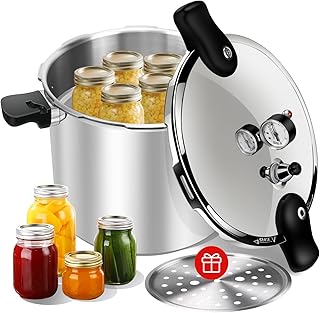
12.68qt Stainless Steel Canner
This commercial-grade stainless unit is built for a specific audience: people who want a small, durable canner they can also use as a everyday pressure cooker without it looking out of place on a kitchen shelf. At twelve and two-thirds quarts, it handles three to four quart jars or a larger pint batch, and the all-round multi-safety protection design provides redundant overpressure relief that’s more thorough than most units at this size. The stainless construction resists the staining and pitting that plague cheaper aluminum options, and at under ninety dollars, it’s the cheapest legitimate pressure canner in this roundup. The tradeoff is capacity—you simply cannot run a full quart load in a single batch here, so anyone canning for a family will need to run multiple cycles. Perfect for meal preppers, couples, or anyone who wants a do-everything pot on the stove.
- Pro: Lowest price in the group with safety redundancy
- Pro: Dual-purpose as a daily pressure cooker
- Con: Too small for efficient quart-jar batches
Buying Guide
Capacity That Fits the USDA Pattern
Safe canning requires jars arranged in a cross-pattern with space between them for steam circulation. Most quart loads call for seven jars, and you need enough internal diameter and depth to stack them without touching the sides or each other. A canner that “fits seven quarts” in marketing copy may not physically allow the proper arrangement. Measure the interior diameter before buying—anything under fourteen inches typically struggles with a full quart load in a single tier.
Gauge Type: Dial, Weighted, or Both
Dial gauges let you read pressure continuously and catch drift as it happens, but they’re mechanical instruments that lose calibration over years and must be tested annually at your extension office or against a weighted gauge. Weighted regulators (the jiggler style) are nearly fail-proof—they vent at exactly five, ten, or fifteen PSI and stay accurate indefinitely, but they only offer fixed settings. If you have one, the other is backup. If you have both, you can verify on the fly without a separate test.
Electric vs. Stovetop: Where You’ll Actually Cook
Electric pressure canners bring automation and safety shutoff but lock your batch size and tie up a counter outlet. Stovetop canners give you flexible jar counts, work anywhere you have a heat source, and tend to last longer because there are no electronics to fail. The decision often comes down to your kitchen: if you have limited burner space or a glass-top range that heats slowly, the electric convenience wins. If you process large seasonal harvests and want to run two batches simultaneously on different burners, stovetop is the only practical choice.
Our Verdict
The All American 941 is the best pressure canner we compared. The metal-to-metal seal removes the single biggest maintenance headache in this category, the capacity dwarfs anything else short of commercial equipment, and the build quality justifies its price over a decade or more of regular use. The Presto 01781 is our budget pick: it delivers dual-gauge verification and excellent pressure stability for a fraction of the All American’s cost, with the only real tradeoff being a replaceable gasket. If you’re canning small quantities and want a hands-off experience that lives on the counter rather than the stove, the CAREY DPC-9SS is the electric option that wins out over the NESCO thanks to its combination of dial and digital gauge verification.
FAQ
Can I use a pressure cooker instead of a pressure canner?
No, not for safe canning. Pressure canners are sized to hold enough jars in the correct arrangement while maintaining steam circulation, which a pressure cooker cannot guarantee. A cooker might reach the right pressure, but the internal geometry prevents safe processing of low-acid foods in standard jar quantities.
How often should I test my dial gauge?
Once per year, ideally before your first heavy canning season. Your local Cooperative Extension office typically tests dial gauges for free or a small fee. If the reading is more than one or two PSI off, you’ll need a replacement gauge or a new unit.
Do electric pressure canners process low-acid foods safely?
Only if the model explicitly states it meets USDA pressure canning requirements and can maintain pressure for the full processing time. Not all electric multi-cookers do. The CAREY DPC-9SS and NESCO NPC-9 are designed as true canners, which is a meaningful distinction.
Can I use a pressure canner as a regular water-bath canner for high-acid foods?
Yes. Most stovetop pressure canners can simply not lock down the pressure and function as a large pot for water-bath processing of jams, pickles, and fruit preserves. This makes them the most versatile single piece of canning equipment you can own.