Key takeaways
- Lead-acid batteries: Usually lower initial cost, but they are heavy, require ventilation during charging, and need regular watering and charge discipline.
- Lithium-ion batteries: Higher purchase cost, faster opportunity charging, less routine maintenance, and more usable energy during a shift.
- Onboard chargers: Convenient where a dedicated charging room is unavailable, but verify outlet requirements and charging time.
- Removable battery systems: Useful when a spare battery can keep a second shift operating, though lifting and storage procedures must be planned.
Best Ride-On Floor Scrubbers for Large Spaces
The best ride on floor scrubbers for large warehouses and commercial facilities are selected by cleaning path, usable tank capacity, runtime, turning space, floor type, and charging arrangements—not by brush width alone.
A ride-on scrubber is usually the right choice when a facility has several thousand square feet of hard flooring, long aisles, or cleaning labor that would be inefficient with a walk-behind machine. For most buyers, a mid-size battery scrubber with a 28–36 inch cleaning path offers the best balance of productivity and maneuverability. Larger 40–50 inch machines are faster in open distribution centers but can become awkward around racks, columns, doors, and congested production areas.
Our top picks
 Battery Powered Ride-On Commercial Floor Scrubber Machine
- 22” Cleaning Width for Maximum Coverage
- High Cleaning Efficiency
- Long-Lasting Battery Life
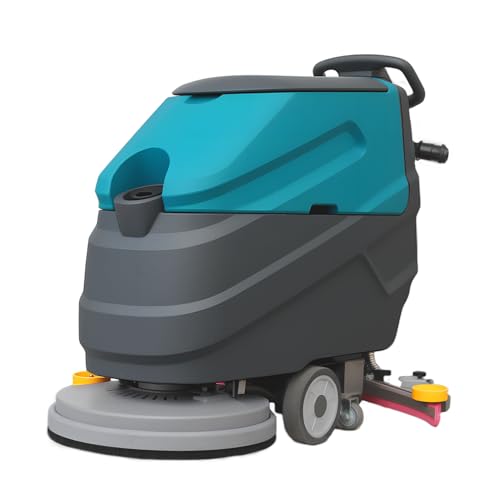 KARHDIR Walk-behind Floor Scrubber Machine
- Efficient Cleaning Coverage: 22" cleaning width and 31.5"…
- Versatile Floor Compatibility: Ideal for a variety of…
- Ample Tank Capacity: Equipped with a 15.9-gallon solution…
 Purilitzs 22" Ride-On Commercial Floor Scrubber Machine
- 【Effortless Ride-On Drive & 1450W Triple Motor Power】:…
- 【49,600 Sq.Ft/h Coverage & Long 3-5 Hour Runtime】:…
- 【22" Scrub Path & 33" Squeegee for 1-Pass…
| Product | Key specs | |
|---|---|---|
| Battery Powered Ride-On Commercial Floor Scrubber Machine | 22” Cleaning Width for Maximum Coverage High Cleaning Efficiency Long-Lasting Battery Life | Check price |
| KARHDIR Walk-behind Floor Scrubber Machine | Efficient Cleaning Coverage: 22" cleaning width and 31.5"… Versatile Floor Compatibility: Ideal for a variety of… Ample Tank Capacity: Equipped with a 15.9-gallon solution… | Check price |
| Purilitzs 22" Ride-On Commercial Floor Scrubber Machine | 【Effortless Ride-On Drive & 1450W Triple Motor Power】:… 【49,600 Sq.Ft/h Coverage & Long 3-5 Hour Runtime】:… 【22" Scrub Path & 33" Squeegee for 1-Pass… | Check price |
 SUNMAX 22" Walk-Behind Commercial Floor Scrubber Machine SUNMAX 22" Walk-Behind Commercial Floor Scrubber Machine | Built for Large Commercial Hard-Floor Cleaning Up to 5 Hours of Cordless Cleaning 22-Inch Scrubbing Path with 31-Inch Water Recovery | Check price |
As an Amazon Associate we earn from qualifying purchases at no extra cost to you.
Quick picks by facility situation
| Facility situation | Recommended scrubber type | Useful specification target | Why it fits |
|---|---|---|---|
| Warehouse with wide, open aisles | Large battery ride-on | 40–50 inch path, 30–50 gallon tanks | High coverage with fewer refills and fewer turns |
| Retail store or school | Compact or mid-size ride-on | 28–36 inch path, 15–30 gallon tanks | Fits standard doors and works around fixtures |
| Food or light manufacturing facility | Heavy-duty cylindrical or disc scrubber | 28–40 inch path, adjustable water flow | Handles embedded soil while limiting solution waste |
| Shopping center or airport concourse | Quiet electric ride-on | 32–42 inch path, low-noise operation | Provides productive cleaning without excessive disruption |
| Facility with elevators or tight service corridors | Compact ride-on | Under 32 inches wide where possible | Reduces clearance problems and simplifies transport between floors |
Head-to-head: the specifications that decide productivity
Cleaning path width
The cleaning path determines how much floor the machine covers in one pass. A 28-inch machine is easier to steer through retail aisles and around shelving, while a 40-inch machine can cover open warehouse lanes substantially faster. The wider machine is not automatically more productive if operators must make repeated corrective turns or leave uncleaned strips beside obstacles.
As a practical planning example, a 36-inch path covers 3 feet per pass. A theoretical 30,000-square-foot facility would require about 10,000 linear feet of travel before allowing for overlaps, turns, obstacles, and docking. At a travel speed of 3 miles per hour, the mathematical minimum is roughly 38 minutes, but real cleaning time can be two or more times longer. A reasonable planning factor is 60–75% of the advertised theoretical productivity.
Tank capacity and water consumption
Solution tanks commonly range from about 15 to 50 gallons, with recovery tanks sized similarly or slightly larger. Larger tanks reduce refill stops, but they also add weight and increase the machine’s turning and braking demands. A full 30-gallon water tank weighs approximately 250 pounds before adding batteries, the operator, and the machine itself.
Check the machine’s adjustable flow controls rather than choosing capacity alone. A scrubber that meters solution according to speed can clean a warehouse efficiently without carrying unnecessary water. In a facility with drains nearby, smaller tanks may be perfectly adequate; in a large building where the nearest fill station is several hundred feet away, tank capacity has a much greater effect on daily productivity.
Runtime and charging
Battery ride-ons commonly provide approximately 2.5–5 hours of practical scrubbing per charge, depending on battery chemistry, brush pressure, floor soil, travel speed, vacuum use, and operator habits. Advertised runtime often assumes favorable conditions, so plan around the lower end when the machine will work on heavily soiled concrete or use high water recovery.
- Lead-acid batteries: Usually lower initial cost, but they are heavy, require ventilation during charging, and need regular watering and charge discipline.
- Lithium-ion batteries: Higher purchase cost, faster opportunity charging, less routine maintenance, and more usable energy during a shift.
- Onboard chargers: Convenient where a dedicated charging room is unavailable, but verify outlet requirements and charging time.
- Removable battery systems: Useful when a spare battery can keep a second shift operating, though lifting and storage procedures must be planned.
Before buying, identify a ventilated, dry charging location with the correct electrical supply. A machine that technically runs for a full shift is not productive if it cannot be recharged before the next scheduled cleaning period.
Maneuverability and clearance
Measure the building, not just the machine. Record the narrowest doorway, elevator opening, aisle, ramp, and turning area. A scrubber may fit through a 36-inch door while still being difficult to turn inside a 40-inch aisle once its recovery squeegee or side brushes are considered.
For comfortable operation, allow roughly 6–12 inches of clearance on each side of the machine in straight aisles. If the operator must make a 90-degree turn at the end of an aisle, the required space can be substantially greater than the machine’s published turning radius. Compact ride-ons often have a tighter turning radius and better visibility, while large front-steer machines reward open layouts.
Also check maximum ramp grade, ground clearance, seat position, and the operator’s line of sight over the brush deck. A low seat can improve stability, but it may make it harder to see floor debris or the front edge of the machine. Adjustable steering columns and suspension seats are worthwhile in facilities where operators work several hours at a time.
Floor compatibility: disc, cylindrical, or orbital?
| Brush system | Best for | Limitations |
|---|---|---|
| Disc brush | Finished concrete, vinyl composition tile, sealed concrete, and smooth commercial floors | Less effective on deep grout lines and heavily textured surfaces |
| Cylindrical brush | Textured concrete, grout lines, entrance areas, and floors with loose debris | May require more brush maintenance and can be less aggressive on broad smooth floors |
| Orbital or square-head system | Low-chemical cleaning, finish removal, and some specialized hard-floor work | Usually less suitable as an all-purpose warehouse scrubber |
Match pad or brush material to the floor manufacturer’s care instructions. Aggressive stripping pads can damage coatings, decorative concrete, resilient tile, or polished surfaces. For polished concrete, use an appropriate low-abrasion pad and conservative water flow. For textured safety flooring, cylindrical brushes may provide better contact than a standard disc deck.
What productivity numbers really mean
Manufacturers often publish theoretical coverage in square feet per hour. Those figures generally assume continuous forward travel and do not fully represent turning, refilling, emptying the recovery tank, moving around people, or cleaning edges. A useful comparison is productive coverage after interruptions.
For example, a mid-size scrubber with a 32-inch path may be rated for a high theoretical coverage figure, yet deliver approximately 20,000–35,000 square feet per practical hour in a moderately open building. A large machine may reach approximately 30,000–50,000 practical square feet per hour in an open warehouse, but much less in a rack-filled facility. Ask vendors for an estimated time for your actual floor plan, including refill and charging pauses.
Durability, service, and ownership details often missed
Look for a protected drive system, corrosion-resistant recovery tank, accessible filters, durable squeegee blades, and a brush deck that can tolerate occasional contact with racks or dock plates. The parts that commonly wear first are squeegee blades, brush or pad drivers, vacuum hoses, casters, tires, and batteries. Easy access matters because preventive maintenance is more likely to happen when it takes minutes rather than requiring a service appointment.
Operator training also affects lifespan. Excessive brush pressure, driving with a full recovery tank, leaving dirty water in the machine, and charging batteries incorrectly can reduce performance quickly. Budget for replacement squeegees and consumable brushes as well as periodic battery service. General market pricing varies widely, but commercial ride-on scrubbers commonly range from approximately $8,000–$35,000 or more, depending on size, battery system, automation, and included accessories.
A buying checklist for 2026
- Measure every doorway, elevator, aisle, ramp, and charging-room entrance.
- Choose the narrowest cleaning path that still meets the required daily coverage.
- Compare practical runtime, not only the manufacturer’s maximum runtime.
- Calculate how many tank refills are acceptable during one cleaning shift.
- Confirm the brush system and pad options for every floor material in the building.
- Check operator weight limits, seat adjustment, visibility, and emergency controls.
- Verify charger voltage, ventilation requirements, charge time, and battery replacement cost.
- Request service intervals, parts availability, warranty coverage, and a facility-specific productivity estimate.
For most mixed commercial facilities, a compact or mid-size battery ride-on with a 28–36 inch path is the safest all-around choice. Choose a 40–50 inch model when the building has long, open lanes and enough turning room to use its width continuously. The best ride on floor scrubbers are the ones that complete the required area with minimal refilling and charging interruptions while still fitting the building’s tightest spaces and protecting its floors.