Key takeaways
- Generous 14-inch surface feeds larger groups in one bake
- Even-heat design minimizes the hot-spot problems common in budget cast iron
- Slightly thinner walls than Lodge equivalents, so it cools faster between bakes
Cutting a whole pizza into slices and getting a crackling, leopard-spotted crust without a wood-fired oven is the entire reason cast iron skillet pizza works. The pan acts as a thermal battery: it absorbs heat during preheating, then dumps it into the dough the moment it touches the surface. That immediate, aggressive bottom heat is what separates a $26 skillet pie from a limp, pale doughy mess made on a thin aluminum sheet. The practical problem for a buyer is narrower than it sounds — you are picking a diameter that fits your oven and feeds the right number of people, a handle design that lets you rotate the pan under a broiler without oven mitts slipping, and a seasoning layer that does not fight your dough on night one.
What separates the good options from the forgettable ones in this category comes down to three things: how well the pan holds and distributes heat across its full cooking surface, whether the handles and rim geometry actually work at the temperatures required for a proper pie (500 °F oven, often plus a short broil), and how the owner community reports the pan aging after six months of weekly use. Prices across these eight picks sit in a band from about $23 to $40, and the differences between them are small enough that reading published specs alongside long-term owner feedback is the only way to sort them for 2026.
Our top picks


As an Amazon Associate we earn from qualifying purchases at no extra cost to you.
Quick Picks
| Product | Best for | Price |
|---|---|---|
| Home-Complete 14″ Pizza Pan | Large families or meal-preppers who want one pie for four or five people | $26.59 |
| Lodge Dual Handle 12″ | Cookouts and campfire use where grip from both sides matters | $29.63 |
| Lodge Pizza Pan 15″ | Feed-a-crowd gatherings and thick-crust lovers who need room | $39.90 |
| Lodge Skillet with Silicone Handle 12″ | Everyday cooks who want one pan for pizza, searing, and baking | $34.90 |
| Gymdin 13.8″ Comal | Value seekers who cook on multiple heat sources including grills and campfires | $22.79 |
| Lodge Griddle 10.5″ | Small households or personal-size pizzas with flat, even cooking | $24.90 |
| Lodge Skillet 10.25″ | Beginners and those wanting the classic all-purpose cast iron experience | $24.90 |
| Lodge Baker’s Skillet 10.25″ | People who want a deep-dish or pan-style pizza with crisp edges | $24.90 |
How We Picked
We compared published specifications — diameter, weight class, handle configuration, seasoning process, and material safety claims like PFAS-free certification — alongside aggregated owner feedback on durability, heat consistency, and real-world sizing fit for standard home ovens. The four criteria that carry the most weight in this category are: cooking surface area relative to your household size, heat retention and distribution (flatness of the cooking plane, thickness of the cast), handle safety and usability at high temperatures, and long-term seasoning behavior reported by owners after several months of repeated use.
The 8 Best Cast Iron Skillet Pizza in 2026
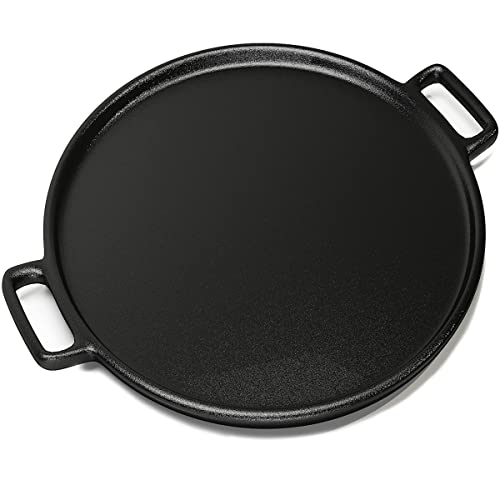
Home-Complete 14″ Pizza Pan
This pan suits households that routinely feed four or five and want a single pie rather than two smaller ones. Owners consistently praise the even heating across the full 14-inch surface, which matters when a pan this wide is the difference between a uniform crust and a hot-spot disaster. The rim height is low enough to slide under a broiler without shielding the cheese.
- Generous 14-inch surface feeds larger groups in one bake
- Even-heat design minimizes the hot-spot problems common in budget cast iron
- Slightly thinner walls than Lodge equivalents, so it cools faster between bakes
Skip it if you store pans vertically in tight cabinets or cook for one or two people and do not want leftover slices by default.
Lodge Dual Handle 12″
The dual-handle geometry makes this the natural choice for outdoor cooking, campfire sessions, or anyone who needs to move a loaded pan from stovetop to oven without a second pair of hands. Lodge’s pre-seasoning is well documented in owner reports as arriving ready to use with minimal stick on the first bake.
- Two side handles provide balanced grip when rotating under a broiler
- PFAS-free pre-seasoning means no chemical concern with food contact surfaces
- Twelve inches may leave one or two family members wanting a second pie
Skip it if you need to feed five or more in a single sitting — go wider.
Lodge Pizza Pan 15″
Fifteen inches is the most surface area available in this lineup, and it is the pan for people who make pizza as a centerpiece event. Owner feedback highlights that the heavier mass means longer preheat time but also more forgiving heat retention, so the crust keeps crisping even after the pan comes out of the oven.
- Largest diameter here means fewer batches for crowds and thicker-crust experiments
- Heavy thermal mass delivers consistent browning across the full pie
- Its weight and size can make it awkward to handle alone when fully loaded
Skip it if your oven has a narrow interior or you prefer 12-inch personal pizzas that crisp in under ten minutes.
Lodge Skillet with Silicone Handle 12″
This is the do-everything skillet for cooks who want pizza one night, cornbread the next, and a seared steak after that without switching pans. The silicone handle holder protects fingers from the bare iron heat, which owners mention as the single feature that changed their confidence at the stove.
- Silicone sleeve allows safe handling without oven mitts during stovetop finishing
- Classic Lodge skillet shape means recipes and seasoning guides are everywhere online
- The handle sleeve can degrade or slip if exposed to direct broiler flames
Skip it if you exclusively use the oven and broiler and do not need the stovetop handling benefit.
Gymdin 13.8″ Comal
The comal profile — flat, wide, with dual loop handles — is borrowed from Latin American tortilla cooking and translates beautifully to thin-crust pizza. At the lowest price in this list, it covers a generous 13.8 inches and works across oven, grill, and open campfire, making it the most versatile budget option.
- Lowest price per inch of cooking surface among all eight picks
- Flat comal geometry promotes even browning and easy slide-on/slide-off of toppings
- Owner reports vary on initial seasoning quality — expect a few cook-and-wipe rounds before nonstick behavior
Skip it if you want a deep-dish or thick-crust style; the shallow rim cannot contain a tall pile of cheese.
Lodge Griddle 10.5″
The griddle format gives a dead-flat, ridged or smooth cooking plane (depending on variant) that some pizza enthusiasts prefer for par-cooking the dough before topping. Its ten-and-a-half-inch diameter makes it ideal for two-person meals or for cooks who want to make two smaller pies back to back.
- Flat griddle surface ensures uniform contact heat without the slight dome found on some skillets
- PFAS-free seasoning and Lodge build quality in a compact, easy-to-store footprint
- Small diameter means you will likely cook two rounds for a family of four
Skip it if you routinely make one large pizza for a group and do not mind multiple bakes.
Lodge Skillet 10.25″
The most universally recommended cast iron size in cooking forums, the 10.25-inch skillet is the default entry point for anyone learning cast iron skillet pizza. Owners report it as the best single-pan-to-price ratio for all-purpose kitchen work, and its familiar shape means every online recipe or seasoning tutorial applies directly.
- The go-to size for beginners and the most widely supported in online recipes and repair advice
- PFAS-free pre-seasoning with proven Lodge durability at an accessible price
- Compact enough that topping coverage gets tight if you prefer a thick sauce layer
Skip it if you want to feed more than two people from a single bake without reheating.
Lodge Baker’s Skillet 10.25″
The Baker’s Skillet has taller, straighter walls than the standard skillet, which makes it the one to buy for pan-style or deep-dish pizza where you want the crust to rise up the sides and the cheese to pool in the center. Owners who make Chicago-style or Detroit-inspired pies at home gravitate toward this shape specifically for the rim height.
- Straight, taller walls hold generous sauce and cheese without overflow onto the oven floor
- Same trusted Lodge seasoning and PFAS-free construction in a baking-optimized shape
- Taller walls mean slower heat transfer to the very bottom, so expect a few extra minutes of preheat
Skip it if you prefer thin-crust or cracker-style pizza where you want the dough as flat and exposed as possible.
Buying Guide
Diameter and Oven Clearance
Measure your oven interior width minus the door frame before purchasing. A 15-inch pan in a 20-inch oven leaves no room for heat circulation around the rim, which causes uneven browning. Twelve inches is the safe default for most standard ovens; fourteen or fifteen inch options suit wider ranges and double ovens. If you cook two pies per session, two 12-inch pans beat one 15-inch pan in total throughput for most households.
Handle Design and Broiler Safety
Bare cast iron handles require a mitt or towel every time you rotate the pan. Silicone sleeves and loop handles solve that for stovetop-to-oven workflows but may not survive a direct broiler contact. Dual side handles on Lodge’s designs give balanced grip for lifting a loaded, heavy pan. Match your handle choice to whether you finish pizza under the broiler or bake it entirely in the lower oven.
Seasoning Quality and Long-Term Maintenance
Pre-seasoned does not mean ready on night one for every owner. Lodge’s seasoning layer is generally well regarded in long-term reports, while budget comals like the Gymdin may need several oil-and-heat rounds to reach the same nonstick behavior. If you plan to cook pizza weekly, choose a pan whose community reports consistent seasoning results rather than the cheapest option that arrives unevenly coated.
Our Verdict
The top pick is the Lodge Pizza Pan 15″ for anyone who makes pizza as a regular family meal and wants a single, crowd-sized bake with the thermal mass to deliver consistent browning. The budget pick is the Gymdin 13.8″ Comal, which offers the best surface-area-per-dollar ratio in this group and works across oven, grill, and campfire. The condition under which another product wins is storage and household size: if you live in a small kitchen with limited cabinet space and cook for one or two, the Lodge Skillet 10.25″ is the more practical and equally capable choice at a lower footprint.
FAQ
Do I need to preheat a cast iron pan for pizza?
Yes — place the empty pan in the oven as it heats to 500 °F or higher, then let it sit an additional 15 to 20 minutes at temperature before you add the dough. The thermal mass that makes cast iron ideal for this task only works if the metal is fully saturated with heat when the crust lands on it.
Can I use a cast iron skillet pizza pan on a grill or campfire?
Several options here are explicitly designed for multi-surface use, including the Gymdin comal and the Lodge Dual Handle pan. Cast iron handles direct flame and uneven heat sources better than any other pan material, though expect slightly less uniform browning than in a home oven.
What is the best dough thickness for cast iron skillet pizza?
Cast iron excels with thin to medium-crust doughs because the intense initial heat sets the bottom before the interior dries out. For thick or deep-dish styles, the Lodge Baker’s Skillet with its taller walls accommodates the extra height without overflow, and you should pre-bake the dough briefly before adding toppings.
How often will I need to re-season these pans?
Owner reports for Lodge products suggest that with normal use — cooking pizza weekly, wiping clean, and applying a thin coat of oil after drying — the seasoning improves for months before a full re-season is needed. Budget pans and comals may require a touch-up after the first few uses but stabilize quickly with the same care routine.