Key takeaways
- Pro: Wide format support handles most legacy codecs without re-encoding
- Pro: Compact size fits behind most TVs without HDMI extension cables
- Con: On-screen menu navigation is slower than premium streaming devices
If you have spent years building a Windows Media Player history on your desktop — a growing library of home videos, music collections, downloaded films, and family recordings — you already know the frustration of wanting to share that archive on a television without tethering a computer to the living room setup. Dedicated media players solve this cleanly. They pull video and audio files from USB drives or SD cards, connect via HDMI, and loop or resume playback on their own. The category looks simple on the surface, but the differences in codec support, resolution handling, and reliability separate the worthwhile models from the ones that will leave you reaching for a phone adapter.
The problem with the cheapest units is narrow codec tolerance. A file that played perfectly in Windows Media Player history on your PC might fail silently on a budget HDMI dongle because the hardware decoder does not support the specific container or bitrate. Resolution support matters equally: some players advertise high definition but drop frames or refuse certain frame rates. We compared the published specifications and aggregate owner feedback across eight models to identify which players handle a real-world mixed library most reliably in 2026. The range in this roundup covers $37.99 to $54.99, so the price differences are small but the capability gaps are not.
Our top picks





As an Amazon Associate we earn from qualifying purchases at no extra cost to you.
Quick Picks
| Product | Best For | Price |
|---|---|---|
| NEUMI Atom 4K Lite | Reliable 4K playback with broad format support | $45.99 |
| Micca 4K Ultra-HD | Digital signage and professional looping | $54.99 |
| HDMI Media Player Black Mini 1080p | Budget 1080p home playback | $39.99 |
| 4K Media Player for TV Auto Resume | Resuming interrupted movies or playlists | $49.99 |
| 4K Full-HD USB and microSD Digital Media Player | Small form factor signage displays | $43.99 |
| NEUMI Atom 1080P Full-HD | Lowest-cost reliable HD playback | $37.99 |
| HDMI Media Player 4K Ultra HD | Maximum codec compatibility | $42.99 |
| HDMI Media Player Blue Mini 1080p | Compact secondary room playback | $39.99 |
How We Picked
We evaluated each model on four criteria drawn from published specs and owner reports. First, codec breadth: how many container formats and encoding standards the unit decodes without conversion, which directly determines whether your Windows Media Player history archive plays as-is. Second, resolution and refresh rate handling: 4K at 30Hz is the practical ceiling for these devices, and not all of them hit it cleanly. Third, ease of operation: plug-and-play behavior, auto-resume, and loop modes reduce friction for non-technical users. Fourth, build reliability at the price point, measured through long-term owner reports of failure rates and thermal behavior under continuous playback.
The 8 Best Windows Media Player History in 2026
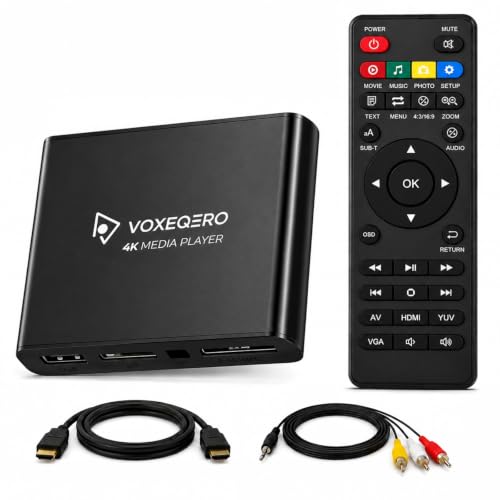
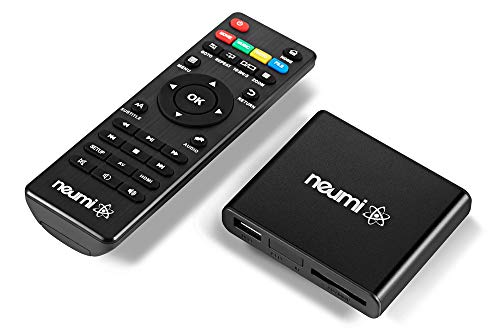
NEUMI Atom 4K Lite Digital Trigger Media Player
This model targets households migrating a Windows Media Player history to television playback without wanting a computer permanently connected. Owners consistently praise the broad USB and SD card compatibility and the 4K output stability. The auto-play and auto-loop functions make it suitable for both personal archives and small-business signage.
- Pro: Wide format support handles most legacy codecs without re-encoding
- Pro: Compact size fits behind most TVs without HDMI extension cables
- Con: On-screen menu navigation is slower than premium streaming devices
Skip it if you need network streaming or app-based access; this is strictly local file playback. At $45.99, it sits in the lower-middle of the price band while matching most 4K competitors on raw playback reliability.
Micca 4K Ultra-HD USB and microSD Media Player
The Micca unit earns its higher price through features aimed at commercial digital signage: scheduled playback, multiple file types from both USB ports and microSD, and 4K HDMI output that holds steady under continuous operation. Home users with a large Windows Media Player history will also appreciate the format tolerance.
- Pro: Built-in scheduling and loop modes designed for unattended display use
- Pro: Dual input options (USB and microSD) allow quick content swaps
- Con: The $54.99 price is the highest here, and home-only users may not need signage features
Pass on this if your sole goal is occasional family video playback on a living room TV; simpler and cheaper options cover that use case without extra cost.
HDMI Media Player, Black Mini 1080p Full-HD Ultra HDMI Digital Media Player
This no-frills 1080p player serves buyers whose Windows Media Player history consists primarily of older standard and high-definition files. Owners report solid MP4 and AVI playback without fuss. The price of $39.99 makes it an easy secondary-room or bedroom setup.
- Pro: Handles common 1080p files reliably with minimal setup
- Pro: Small enough to remain hidden behind the TV mount
- Con: No 4K support means newer ultra-HD files will be downscaled or rejected
Skip it if you plan to upgrade to a 4K television within the next year; the lack of ultra-HD output will become a bottleneck quickly.
4K Media Player for TV with Auto Resume
The auto-resume function distinguishes this $49.99 model for users who watch longer files in sessions spread over multiple days. Owners with an extensive Windows Media Player history of feature-length films and multi-episode shows find this genuinely useful rather than a gimmick.
- Pro: Remembers exact playback position when the file is reinserted
- Pro: 4K output with HDMI and AV connections for older televisions
- Con: Limited documentation for advanced format troubleshooting
Consider skipping this if your playback is always short-form or looped signage content; the resume feature adds cost you may never use.
4K Full-HD USB and microSD Digital Media Player for TV Digital Signage
Selling at $43.99, this compact unit fills a niche between consumer and commercial players. Owners deploying it in retail displays or waiting-room TVs report dependable continuous playback from both USB drives and microSD cards with 4K output.
- Pro: MicroSD slot allows card-swap updates without unplugging USB drives
- Pro: Stable loop playback for hours without thermal throttling
- Con: Interface is basic; no remote or Bluetooth connectivity mentioned
It is not the best choice for interactive personal use where you want to browse a large library by folder name; the signage focus means navigation simplicity over power.
NEUMI Atom 1080P Full-HD Digital Media Player
At $37.99, this is the least expensive option in the roundup and appeals to buyers who want to access a Windows Media Player history of standard HD files without spending more than necessary. NEUMI’s smaller unit handles USB and SD card playback competently for the price.
- Pro: Lowest price with dependable 1080p decoding for common formats
- Pro: No setup required; insert media, connect HDMI, and playback begins
- Con: 4K files will not play at native resolution
Skip it if any portion of your archive is in 4K or HEVC encoding; the 1080p limitation is a hard ceiling here.
HDMI Media Player, 4K Ultra HD with H.265/H.264 Decoding
The codec list on this $42.99 model is the most explicit in the group: H.265, H.264, MP4, MKV, MP3, AVI, TS, RMVB, MOV, ISO, and JPG. For owners of a diverse Windows Media Player history spanning different encoding choices over the years, this breadth reduces the chance of a file simply refusing to play.
- Pro: Named support for nearly every container and codec a home library might contain
- Pro: 4K at 30Hz output handles modern ultra-HD files
- Con: RMVB and ISO support may be slower or less stable than native formats
If your library is already normalized to MP4 or MKV only, cheaper units with narrower support will match the performance without the premium.
HDMI Media Player, Blue Mini 1080p Full-HD Ultra HDMI MP4 Player
Matching the Black Mini in price at $39.99, this unit differs mainly in color and its explicit focus on MP4. Owners with a Windows Media Player history predominantly in MP4 containers will find it the simplest plug-and-play option.
- Pro: MP4-first design means fewer compatibility surprises for modern archives
- Pro: Compact and lightweight for portable setups like trade-show kiosks
- Con: Limited stated support for other containers like MKV or AVI
Move past this if your library includes older formats from early Media Player days; the MP4 narrowing is a feature for some and a limitation for others.
Buying Guide
Resolution and Frame Rate Support
The deciding factor between units priced under $40 and those above is often whether they output 4K. If your Windows Media Player history contains files you plan to watch on a 4K television, a 1080p-only player will downscale the image and you lose sharpness. Check not just “4K” in the listing but the refresh rate — 30Hz is standard for this class. If you watch motion-heavy content like sports clips or action films, a stable 30Hz feed matters more than the resolution label itself.
Codec and Container Breadth
A decade of files accumulated in Windows Media Player history rarely arrives in one encoding. You may have AVI from early 2000s downloads, MKV from rip software, MOV from a phone, and MP4 from streaming rips. The player you choose must decode all of them natively. Units that list H.265/HEVC support handle newer compressed files. Those that only mention MP4 and AVI may silently fail on MKV or ISO images. Match the codec list to your actual library composition.
Operation Without a Computer
Every player in this roundup connects to media directly via USB or SD card, which is the core advantage over a PC-based playback solution. The practical differentiators are auto-resume (for long-form content), loop mode (for signage and demos), and whether the unit remembers its settings when power is cut. For a living-room setup where a spouse or child needs to insert a drive and hit play, these small operational details determine whether the player gets used or ignored.
Our Verdict
The NEUMI Atom 4K Lite at $45.99 is our top pick for the broadest balance of format tolerance, reliable 4K output, and simple operation. It handles the widest realistic range of files from a long-standing Windows Media Player history without requiring re-encoding. The budget pick is the NEUMI Atom 1080P at $37.99 — the cheapest way to access an HD library if none of your files exceed 1080p. The condition that changes the answer: if your use case is unattended commercial or office signage, the Micca 4K at $54.99 wins because its scheduling and thermal stability under continuous operation are not matched by consumer-focused units at lower prices.
FAQ
Can these players access files from my old Windows Media Player history directly?
Yes, provided the file formats are among those the player decodes. Your Windows Media Player history is simply a collection of media files on storage; the player reads the same files from USB or SD card without any conversion or software dependency on Windows.
Do I need to convert my video files before using one of these players?
With the wider-codec models like the NEUMI Atom 4K Lite or the 4K Ultra HD player, conversion is rarely necessary. With narrower units focused on MP4, some legacy AVI or RMVB files may need to be re-encoded before they will play.
Why do some listings say 4K but still cost under $45?
The 4K label on hardware at this price usually means the output resolution is 3840 by 2160, but the internal decoder may handle fewer codecs or sustain that resolution only on specific file types. Check the named codec support list, not just the resolution claim, to confirm your files are covered.
Is loop mode useful for a home media library?
Loop mode matters for continuous background content — a slideshow of family photos, a demo reel for a home business, or ambient video on a smart display in the kitchen. For a Windows Media Player history of films and TV episodes, auto-resume and simple folder navigation are more practical features.