Key takeaways
- Pro: Lowest price point in this roundup at $6.99 makes it an easy add-on to any pan purchase.
- Pro: Covers care for both new and inherited cast iron, so one purchase serves two scenarios.
- Con: Recipes are a secondary section, not the focus, so food-focused buyers will want a companion book.
Buying a new cast iron skillet or inheriting a rusty one from a relative’s estate presents the same practical problem: the pan is not ready to cook on. Knowing how to season a cast iron skillet separates a surface that releases eggs cleanly from one that grips every bite and rusts overnight. The gap between success and failure comes down to technique, the right oil choice, and realistic expectations about how many layers of seasoning the pan actually needs.
We compared published specifications, owner-reported performance data, and current pricing across eight products that directly address this problem — from dedicated care guides to ready-to-cook Lodge pans to a 5-piece starter set. What separates a good pick from a mediocre one is whether the product gives you enough guidance to avoid the most common beginner mistake: applying too thick a coat of oil, which polymerizes into a sticky, uneven surface rather than a hard, non-stick finish.
Our top picks




As an Amazon Associate we earn from qualifying purchases at no extra cost to you.
Quick Picks
| Product | Best for | Price |
|---|---|---|
| Cast Iron Skillet Care (book) | Seasoning fundamentals | $6.99 |
| Lodge Baker’s Skillet 10.25″ | Low maintenance from day one | $24.90 |
| HAWOK Enameled Skillet | Budget-first entry point | $12.99 |
| Lodge 5-Piece Set | Building a full collection | $99.90 |
| Will It Skillet? (book) | Expanding your repertoire | $14.95 |
| Cast Iron Cookware: Select, Clean, Season, Restore | Deep reference knowledge | $21.95 |
| Lodge Covered Deep Skillet 5 Qt | Searing and braising combo | $69.90 |
| Cast Iron Skillet Big Flavors (book) | Recipe-driven confidence | $19.94 |
How We Picked
We evaluated each product on four criteria: how directly it addresses the core challenge of establishing and maintaining seasoning, whether the listed price reflects real value against comparable options, what owner feedback says about day-to-day durability, and how practical the guidance or design is for someone who has never built up a seasoning layer before. Products that only tangentially touch on care scored lower regardless of their other strengths.
The 8 Best How To Season A Cast Iron Skillet in 2026
Cast Iron Skillet Care (Book)
This guide is the single most relevant purchase for a beginner who owns one skillet and wants to learn the seasoning process without spending more than a coffee’s worth of money. It walks through polymerization science in plain language and includes troubleshooting for common failures like patchy or sticky seasoning.
- Pro: Lowest price point in this roundup at $6.99 makes it an easy add-on to any pan purchase.
- Pro: Covers care for both new and inherited cast iron, so one purchase serves two scenarios.
- Con: Recipes are a secondary section, not the focus, so food-focused buyers will want a companion book.
Skip this if you already follow a reliable YouTube seasoning tutorial and just need a pan to cook in.
Lodge Pre-Seasoned Baker’s Skillet
The Baker’s Skillet ships with Lodge’s factory seasoning already intact, which removes the entire multi-hour oven process from your first experience. The shallow walls and wide base make it ideal for cornbread, frittatas, and anything that benefits from even heat distribution across a flat surface.
- Pro: Factory seasoning means you can cook on day one without any prep work.
- Pro: 10.25-inch diameter fits standard stovetop burners and most oven racks without crowding.
- Con: Shallow walls offer less protection against splatter when cooking fatty cuts of meat.
Skip this if you primarily cook sauces or shallow-fried foods that need taller sides to contain oil.
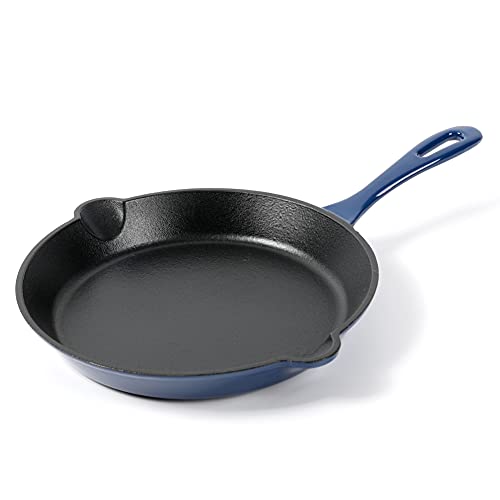
HAWOK Cast Iron Enameled Skillet
At $12.99, this is the most affordable entry point in the roundup and the only enameled option. The enamel interior sidesteps the entire seasoning question — you never need to build a polymerized layer because the glass-like coating already provides release. It suits renters or anyone who will not commit to the maintenance routine.
- Pro: Zero seasoning required, eliminating the most common failure point for beginners.
- Pro: The included handle cover addresses the heat-transfer issue that makes bare cast iron uncomfortable to grip.
- Con: Enameled surfaces can chip over time, and chips are not repairable the way bare cast iron seasoning is.
Skip this if you want a pan that lasts multiple decades with proper care.
Lodge Cast Iron 5-Piece Set
PFAS-free and pre-seasoned across every piece, this set addresses the practical problem of outfitting a kitchen in one purchase. The price per piece works out well below individual retail, and the shared seasoning profile means the care routine you learn on one pan applies to all five.
- Pro: Uniform factory seasoning across the set means no learning curve between pieces.
- Pro: Covers frying, saucing, and baking formats, so you learn the full range of cast iron uses.
- Con: $99.90 requires more storage space than most beginners have for five pieces simultaneously.
Skip this if you only need one skillet and plan to add pans gradually as your cooking expands.
Will It Skillet? (Book)
With 53 recipes, this book answers the question that haunts new cast iron owners: what can I actually cook right now? The recipes span breakfast through dinner and demonstrate how a well-seasoned surface performs across techniques like deglazing, baking, and shallow frying.
- Pro: Recipe range builds confidence that your seasoning layer is performing correctly.
- Pro: Unexpected applications like dessert show cast iron’s versatility beyond steaks and cornbread.
- Con: Offers minimal guidance on how to season a cast iron skillet itself — it assumes your pan is already ready.
Skip this if you have not yet established seasoning and need care instructions more than meal ideas.
Cast Iron Cookware: Select, Clean, Season and Restore
The title maps directly onto the full lifecycle of owning cast iron, and the depth of coverage justifies its premium book price at $21.95. Restoration chapters are particularly valuable for buyers who have found or been given a neglected pan that needs rescue work before cooking.
- Pro: Dedicated restoration section addresses rust, carbon buildup, and damaged seasoning with specific methods.
- Pro: Buying guidance helps you evaluate whether a used pan is salvageable before spending money on it.
- Con: Higher price than the other books here may not suit someone with a single new Lodge pan.
Skip this if you own only modern pre-seasoned cookware and will never encounter a restoration project.
Lodge Pre-Seasoned Covered Deep Skillet
The five-quart capacity and included lid make this the most versatile single pan for cooks who want to sear, braise, and simmer in the same vessel. The deep walls reduce splatter and allow you to build pan sauces without transferring to a separate pot.
- Pro: Lid traps moisture for braising, expanding use cases beyond what a flat skillet offers.
- Pro: 5-quart capacity comfortably feeds a family of four from a single pan.
- Con: Weight makes it awkward to lift when full, especially for smaller-framed cooks.
Skip this if you mostly cook for one or two people and do not have storage room for a large, heavy pan.
Cast Iron Skillet Big Flavors (Book)
Ninety recipes position this as the most comprehensive cookbook in the roundup. The emphasis on building flavor in the pan itself — fond, caramelization, rendered fat — connects directly to understanding what good seasoning actually enables at a molecular level.
- Pro: Largest recipe count here, providing a genuine reason to keep reaching for your skillet.
- Pro: Flavor-building techniques reinforce why proper seasoning matters to the finished dish.
- Con: At $19.94 it costs almost three times the care guide, and it does not cover maintenance or how to season a cast iron skillet from scratch.
Skip this if your immediate problem is seasoning technique rather than meal inspiration.
Buying Guide
Factory Seasoning vs. Bare Cast Iron
Modern Lodge pans ship with a thin polymerized layer applied at the factory. This is functional but not bulletproof — expect to add one or two layers in your own oven before cooking acidic foods. If you choose a bare pan or a used piece found at a flea market, budget at least three full seasoning cycles before regular use.
Oil Choice and Layer Thickness
The most critical variable in how to season a cast iron skillet successfully is applying the oil thinly and buffing away excess. Grapeseed and canola oils polymerize reliably at common oven temperatures. Flaxseed oil produces a very hard finish but is notorious for flaking in thin layers, so it suits experienced hands more than beginners.
Frequency of Re-Seasoning
A well-maintained skillet needs minimal re-seasoning. If your eggs slide freely and no bare metal shows through, your seasoning layer is doing its job. A light coat of oil after each wash is sufficient maintenance for most home cooking patterns.
Our Verdict
For someone starting from zero with no pan at all, the Lodge Pre-Seasoned Baker’s Skillet offers the fastest path to cooking without the intimidation factor of a multi-hour seasoning project. For the absolute lowest cost of entry into understanding the process, the Cast Iron Skillet Care guide at $6.99 delivers more relevant instruction than any single pan under $25. If you need capacity and one-pot cooking, the Lodge Covered Deep Skillet wins on versatility despite its higher weight.
FAQ
How many times should you season a cast iron skillet?
A new bare pan benefits from three to five thin coats, baking at high heat between each layer. Modern pre-seasoned Lodge pans need only one or two touch-up coats before heavy use.
What oil is best for seasoning cast iron?
Grapeseed, canola, and vegetable shortening all polymerize well and are easy to find. Avoid butter or olive oil for the initial seasoning layers because their low smoke points cause uneven, sticky results.
Can you ruin a cast iron skillet by not seasoning it?
Bare iron will rust quickly if left unseasoned and exposed to moisture. However, rust is removable and the pan is never truly destroyed — you can strip, clean, and re-season almost any cast iron piece back to good condition.
Do I need to re-season every time I wash my skillet?
No. A proper wash and dry with a light wipe of cooking oil after each use maintains the layer. Full re-seasoning is only needed when food starts sticking noticeably or bare patches appear after aggressive cleaning.