Key takeaways
- Small apartment: Start with a 6–8-inch-deep wall shelf or cabinet. Check the door swing and the path past the toilet before buying a deeper unit.
- Renters: Consider a freestanding frame only after checking tank clearance and stability. If you use a wall unit, get permission and use fixings that suit the wall; adhesive alone is not a safe substitute for rated support.
- Children or pets: Prefer a wall-secured unit, store heavy items low, and avoid placing breakable containers near the edge. Anchor tall furniture according to the manufacturer’s instructions.
- Comfort-height toilet: Shop by a minimum 26-inch clearance above the seat, then confirm the tank and lid also clear the frame.
- Limited reach: Put daily-use items on a shelf that can be reached without leaning over the toilet. Avoid tall, deep cabinets that put essentials out of comfortable reach.
What's inside
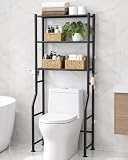
The best over the toilet storage ideas start with one measurement: the distance from the floor to the underside of the shelf or cabinet’s lowest crossbar. For a typical toilet, allow about 24 inches above the seat; for a comfort-height toilet, allow about 26 inches. Then check the product’s inside depth, its feet and crossbar placement, and whether it can be anchored safely.
Toilet dimensions vary, so treat these as planning clearances—not guarantees. Measure your own toilet with the lid open and closed, and compare those measurements with the unit’s actual frame and shelves rather than its overall height alone.
As an Amazon Associate we earn from qualifying purchases at no extra cost to you.


Measure before choosing a style
A standard toilet seat is commonly around 15–17 inches above the floor; comfort-height seats are generally around 17–19 inches. Many freestanding étagère units have a lower shelf or crossbar that can collide with the tank, lid, or user’s head even when the listed overall height looks suitable.
| Measurement | Planning range | Why it matters |
|---|---|---|
| Clearance above a standard-height seat | At least 24 in.; 26 in. is more forgiving | Helps keep a low shelf or crossbar from crowding the seated user |
| Clearance above a comfort-height seat | At least 26 in.; 28 in. is more forgiving | Comfort-height seats raise the user and reduce usable space below the frame |
| Open space above tank | Measure from floor to tank top, then add 2–3 in. | Provides room for the lid to lift and for the frame to clear the tank |
| Useful shelf depth | About 6–8 in. for small items; 9–12 in. for towels or larger bottles | Deeper shelves hold more but can project into the room or obstruct access |
| Side clearance | Allow roughly 1–2 in. per side where possible | Makes installation easier and reduces rubbing against walls or trim |
Measure the toilet’s widest point, including the tank, and the distance from the wall to the front of the bowl. For a freestanding unit, also check the distance between its feet and the position of its rear support bar. A frame can be wide enough on paper yet fail to straddle a toilet with a broad tank or a side-mounted water supply.
12 over the toilet storage ideas, matched to the space
Freestanding étagères: choose these when the floor plan allows
- Compact étagère with a high lower shelf: A practical fit for a standard toilet if the lowest shelf clears the seat by at least 24 inches and the tank by 2–3 inches. Look for a narrow, 6–8-inch shelf depth when the bathroom is tight.
- Comfort-height étagère: Choose a frame with at least 26 inches of seat clearance and verify the crossbar—not just the shelf—sits above the toilet lid.
- Open three-tier étagère: Works for towels and baskets in a bathroom with enough floor space. Shelves around 8–10 inches deep provide useful storage without the projection of a cabinet.
- Étagère with adjustable shelves: Best when bottles vary in height. Check that adjustment holes do not force the lowest shelf into the tank’s clearance zone.
- Metal-frame étagère: A lighter-looking option for a small room. Confirm the frame has a wall-anchor provision; tall, narrow freestanding units can wobble if loaded unevenly.
- Cabinet-style étagère: Choose this for concealed supplies, but check the door swing and handle projection. A deep cabinet can make a narrow bathroom feel cramped even if its frame fits the toilet.
Ladder shelves: better for flexible, lighter storage
- Shallow leaning ladder shelf: Useful where a deep cabinet would obstruct movement. Measure the shelf depth at the front edge and the ladder’s floor footprint; its feet may extend farther into the room than the shelves.
- Wall-secured ladder shelf: A better choice than an unsecured leaner for a home with children or pets. Attach it to appropriate wall structure, and keep heavy items on the lowest shelf.
- Ladder shelf with baskets: Suits small toiletries and spare rolls. Check basket height against the shelf spacing and confirm the lowest basket does not hang into the required toilet clearance.
Wall-mounted units: the most adaptable for tight floors
- Single floating shelf: Best for a few light items when floor space is scarce. Mount it above the tank with enough room for the lid to open; use fasteners suited to the wall and the shelf’s expected load.
- Two-shelf wall unit: Adds capacity without legs around the toilet. Keep the lower shelf high enough for the seated user and place frequently used items within easy reach.
- Shallow wall cabinet: Choose this when you want covered storage but have limited projection. A depth around 6–8 inches is often easier to live with than a deep cabinet; confirm door clearance and wall-anchor requirements.
Head-to-head: étagère, ladder shelf, or wall unit?
| Type | Typical usable depth | Best fit | Main drawback |
|---|---|---|---|
| Étagère cabinet or open frame | About 6–12 in. | Renters who want storage without drilling, if the floor and toilet clearances work | Legs or crossbars may conflict with the tank; tall frames can wobble |
| Ladder shelf | About 6–10 in. | Bathrooms needing a lighter, open look and flexible shelf spacing | Angled sides and feet use floor space; many models need wall restraint |
| Wall-mounted shelf or cabinet | About 6–10 in. | Small bathrooms where keeping the floor clear matters most | Requires suitable wall fixing and careful placement around plumbing |
For the best over the toilet storage, choose the style that clears the toilet without reducing safe access—not simply the one with the most shelves. In a narrow bathroom, a shallow wall-mounted unit usually preserves floor space. If drilling is not allowed, a freestanding étagère may be more convenient, provided its feet and supports fit around the toilet. A ladder shelf is a middle ground when you want open storage and can secure it to the wall.
Choose by household and bathroom constraints
- Small apartment: Start with a 6–8-inch-deep wall shelf or cabinet. Check the door swing and the path past the toilet before buying a deeper unit.
- Renters: Consider a freestanding frame only after checking tank clearance and stability. If you use a wall unit, get permission and use fixings that suit the wall; adhesive alone is not a safe substitute for rated support.
- Children or pets: Prefer a wall-secured unit, store heavy items low, and avoid placing breakable containers near the edge. Anchor tall furniture according to the manufacturer’s instructions.
- Comfort-height toilet: Shop by a minimum 26-inch clearance above the seat, then confirm the tank and lid also clear the frame.
- Limited reach: Put daily-use items on a shelf that can be reached without leaning over the toilet. Avoid tall, deep cabinets that put essentials out of comfortable reach.
Materials, stability, and assembly realities
| Material | Advantages | Trade-offs in a bathroom |
|---|---|---|
| Solid wood | Can be refinished; often feels substantial | May swell, warp, or mark if water sits on the finish; usually heavier to move |
| Engineered wood | Often affordable and available in white finishes | Exposed edges and screw points can be vulnerable to moisture; wipe spills promptly |
| Powder-coated metal | Open, relatively light appearance and easy-to-wipe surfaces | Coating damage can expose metal to rust; check joints and feet for wobble |
Before assembly, check the packaged unit’s dimensions and weight against your stairs, bathroom doorway, and available turning space. Assemble large frames near their final location when possible. Tighten fasteners after positioning, level the feet on uneven tile, and use the supplied anti-tip hardware when required. Do not assume a shelf’s capacity applies to the whole unit: follow the maker’s limits for each shelf and for total load, and keep heavy bottles low.
White over the toilet storage can make a small room feel visually lighter, while black over the toilet storage creates stronger contrast against pale tile or painted walls. Either finish can show dust, water spots, or scratches; finish color does not indicate moisture resistance. Prioritize sealed surfaces, stable joints, cleanable edges, and the correct clearance before choosing a color.
Final fit check before you buy
- Record seat height, tank height, tank width, and the toilet’s projection from the wall.
- Confirm at least 24 inches of seat clearance for a standard toilet or 26 inches for a comfort-height toilet; allow more if the frame feels close.
- Check shelf depth, leg spacing, crossbar position, lid movement, and any nearby shutoff valve or plumbing.
- Decide whether the unit needs wall anchoring, and verify the wall can support the installation.
- Choose a realistic load and leave room to clean behind and beneath the storage.