Key takeaways
- For chlorine reduction: Choose a filter with clear, relevant performance data and a replacement cartridge you can get at a reasonable ongoing cost.
- For sediment: Check that the product identifies its particle-filtering stage and replacement guidance; a basic screen may be enough for visible debris.
- For scale: Do not pay extra for a shower filter expecting it to remove hardness. Consider a water-softening system if mineral deposits are the core problem.
- For low pressure: Favor a design with a published flow rating and avoid an unnecessarily fine or undersized sediment stage.
- For a rental: A reversible, screw-on filter is usually the simplest option, provided the added length and fittings suit the shower.
Best shower head water filter for hard water: choose by what you need to reduce
The best shower head water filter for hard water is a replaceable-cartridge filter with documented chlorine reduction, a published flow rate, and media suited to your water; if your main problem is mineral scale, a shower filter alone is unlikely to solve it. Most shower filters can reduce chlorine and some sediment, but they generally do not remove the dissolved calcium and magnesium that make water hard.
That distinction matters: chlorine can contribute to odor and may affect how hair and skin feel, while hardness minerals leave deposits on showerheads, glass, and fixtures. Before buying, check your water utility’s annual report or use a hardness test strip. Then compare filter media, flow impact, cartridge cost, and fit—not just claims on the package.
Our top picks
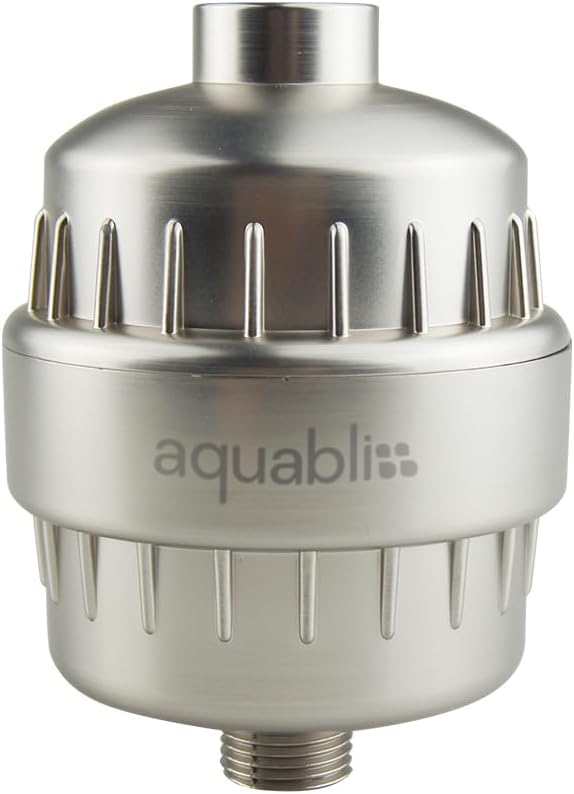
 Aquabliss SF100 Daily Revitalize Shower Filter
- Set Name: SF100
- Item Dimensions D x W x H: 3.3"D x 3.3"W x 4.7"H
- External Testing Certification: UL
 FEELSO Shower Head with Shower Filter
- Installation Type: Screw-In
- Flow Rate Description: 1.8 Gallons Per Minute
- Number of settings: 5
 Aquabliss SF100 Daily Revitalize Shower Filter
- Product Benefits: Reduces Chlorine
- Material Type: Ceramic
| Product | Key specs | Amazon rating | |
|---|---|---|---|
| Aquabliss SF100 Daily Revitalize Shower Filter | Set Name: SF100 Item Dimensions D x W x H: 3.3"D x 3.3"W x 4.7"H External Testing Certification: UL | 4.4★ | Check price |
| FEELSO Shower Head with Shower Filter | Installation Type: Screw-In Flow Rate Description: 1.8 Gallons Per Minute Number of settings: 5 | 4.6★ | Check price |
| Aquabliss SF100 Daily Revitalize Shower Filter | Product Benefits: Reduces Chlorine Material Type: Ceramic | 4.4★ | Check price |
 weAQUA Heavy Duty 2-Pack Shower Filter for weAQUA Heavy Duty 2-Pack Shower Filter for | Get more with this performance-driven double pack Marketing gimmicks like energy and ceramic balls are… High quality, laboratory tested and certified filtration media… | 4.4★ | Check price |
As an Amazon Associate we earn from qualifying purchases at no extra cost to you. Ratings are shown as listed on Amazon.
Quick picks by situation
| Your situation | What to look for | Likely trade-off |
|---|---|---|
| Chlorine odor is the main concern | A shower filter with published chlorine-reduction data and a stated test method | Cartridges need timely replacement; reduction can vary with temperature and flow |
| Visible grit or rust-colored particles appear | A sediment screen or staged filter that specifies particle size | Fine filtration can reduce flow sooner as the media loads with debris |
| White scale quickly returns on fixtures | A properly sized water softener or other treatment designed for hardness | Usually more installation, space, and ongoing cost than a shower filter |
| Renting or avoiding plumbing changes | A screw-on inline filter with standard ½-inch shower connections | Added length can make a fixed showerhead sit lower or project farther out |
Filter media: what each type can—and cannot—do
| Media or stage | Typical role | Hard-water limitation |
|---|---|---|
| Activated carbon | Can reduce chlorine and some compounds that affect taste or odor; performance depends on the carbon, contact time, and conditions | Does not remove dissolved calcium and magnesium in the way a water softener does |
| KDF-type copper-zinc media | Used in some filters to help reduce free chlorine under specified conditions | Not a substitute for hardness treatment; claims should be supported by test data |
| Calcium sulfite | Can be used for chlorine reduction, including in warm-water applications, depending on design | Does not make hard water soft |
| Mesh or sediment stage | Captures particles above a specified size, such as visible grit | Does not remove dissolved hardness minerals or chlorine |
Some products combine media in layers, but “multi-stage” is not a performance standard. Look for the exact contaminant named, the percentage reduction, test conditions, and whether the claim applies at the flow rate and water temperature you will use. A filter’s result for free chlorine, for example, does not automatically establish reduction of chloramine or other contaminants.
Flow rate, cartridge life, and the real replacement cost
A filter adds resistance to the water path. A clean, well-sized cartridge may have little noticeable effect, but flow can fall as sediment accumulates or media becomes exhausted. Compare the stated flow rate with your existing shower’s output, and treat advertised cartridge life as an estimate: gallons, water quality, shower duration, and temperature all affect it.
| Check before purchase | Useful number or calculation |
|---|---|
| Rated flow | Compare the filter’s gallons-per-minute rating with your showerhead’s rating; the lower-rated component can limit output |
| Monthly water use through the filter | At 2.0 gallons per minute for 8 minutes daily, one shower uses about 16 gallons; two daily showers use about 960 gallons in 30 days |
| Estimated cartridge interval | If a cartridge is rated for 10,000 gallons, 960 gallons per month works out to roughly 10 months before adjusting for actual conditions |
| Annual replacement budget | Multiply the replacement-cartridge price by the number needed per year; compare that with the initial filter price |
For a simple cost comparison, divide the replacement price by the cartridge’s stated gallon capacity, then multiply by your estimated monthly use. This gives an approximate monthly media cost—not a guarantee of service life. Replace the cartridge sooner if the manufacturer’s limit is reached, flow noticeably drops, or the instructions call for a shorter interval in your water conditions.
Compatibility with standard shower arms
Many inline shower filters are designed for standard ½-inch NPT shower connections, but confirm the thread type and installation directions before ordering. Most install between the shower arm and showerhead: remove the head, clean the threads, fit the supplied washer, and hand-tighten the filter and head. Avoid overtightening, which can damage fittings or washers. Use thread-sealing tape only if the manufacturer recommends it.
Measure the available space as well as checking the thread. An inline unit adds length—often several inches, depending on its design—so a fixed showerhead may end up lower or farther from the wall. If the existing showerhead already sits close to a wall, shelf, or enclosure, verify the filter’s dimensions and the resulting clearance. A handheld model may need a compatible hose connection and can add weight to a wall-mounted bracket.
How to make the choice
- For chlorine reduction: Choose a filter with clear, relevant performance data and a replacement cartridge you can get at a reasonable ongoing cost.
- For sediment: Check that the product identifies its particle-filtering stage and replacement guidance; a basic screen may be enough for visible debris.
- For scale: Do not pay extra for a shower filter expecting it to remove hardness. Consider a water-softening system if mineral deposits are the core problem.
- For low pressure: Favor a design with a published flow rating and avoid an unnecessarily fine or undersized sediment stage.
- For a rental: A reversible, screw-on filter is usually the simplest option, provided the added length and fittings suit the shower.
Bottom line
The best shower head water filter is the one that targets a verified concern without creating an unacceptable flow drop or replacement burden. For chlorine or sediment, compare media and documented reduction claims, cartridge capacity, and annual replacement cost. For hard-water scale itself, a showerhead filter is usually the wrong tool: test the water and look at treatment designed to reduce calcium and magnesium.