Key takeaways
- Variable speed: The most useful upgrade for mixed furniture materials and finish-sensitive work.
- Reliable tracking: Reduces edge damage and makes long, straight passes easier.
- Easy belt release: A quick-release lever saves time when changing grits or replacing a worn belt.
- Usable dust port: A port that accepts a shop-vac hose is preferable to a small bag alone.
- Low vibration: Improves control and reduces fatigue during large tabletop projects.
- Replaceable platen and brushes: These parts commonly wear before the motor, especially in a busy workshop.
The best belt sander for woodworking depends on the furniture surface: choose a 3 × 21-inch variable-speed model for most tables, cabinets, and benchtops; a 4 × 24-inch sander for fast stock removal on large panels; or a compact 3 × 18-inch tool when control and maneuverability matter more than sanding speed.
Our top picks

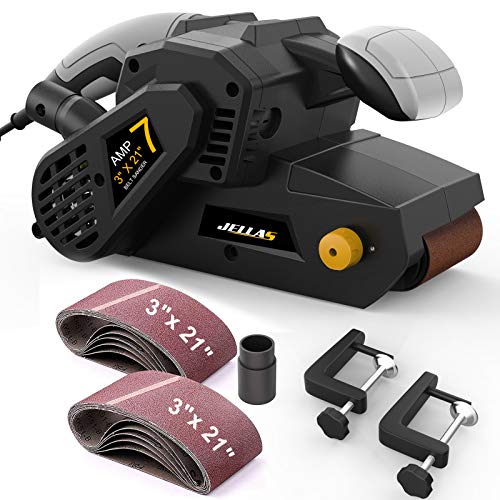

As an Amazon Associate we earn from qualifying purchases at no extra cost to you. Ratings are shown as listed on Amazon.
Best belt sanders for woodworking by situation
| Woodworking situation | Best configuration | Why it fits | Typical market range |
|---|---|---|---|
| Furniture repairs, cabinet sides, and general shop work | 3 × 21 inches, 7–9 amps, variable speed | Balances reach, control, and availability of sanding belts | Usually $100–$250 |
| Large dining-table tops and wide hardwood panels | 4 × 24 inches, 10–12 amps | Removes material quickly and leaves fewer overlapping passes | Usually $180–$350 |
| Small parts, narrow shelves, and occasional DIY use | 3 × 18 inches, approximately 6 amps | Lighter and easier to reposition on smaller workpieces | Usually $60–$150 |
| Veneer, softwood, or finish-sensitive furniture | Variable-speed 3 × 21-inch model | Lower belt speed reduces the risk of burning and gouging | Usually $150–$300 |
Head-to-head: the belt sizes that matter
3 × 21 inches: the most versatile choice
A 3 × 21-inch belt offers a useful compromise for furniture making. It is wide enough to flatten a tabletop efficiently but narrow enough to work on cabinet doors, shelves, stair components, and desk panels. Replacement belts are widely available in coarse grits such as 40 or 60 and finer grits such as 100 or 120.
For a 30-inch-wide tabletop, a 3-inch sanding path requires roughly ten adjacent lanes before allowing for a small overlap. That makes technique important: keep the tool moving, overlap each pass, and sand diagonally only when substantial leveling is needed. A 3 × 21-inch sander is usually the safest recommendation for one general-purpose woodworking tool.
4 × 24 inches: fast, powerful, and tiring
The larger belt covers 33 percent more width than a 3-inch belt and is well suited to large solid-wood panels. Models such as the Makita 9403 use an 11-amp motor and are designed for rapid stock removal. The trade-off is size: many 4 × 24-inch sanders weigh around 12 pounds or more, compared with approximately 6–10 pounds for many 3 × 21-inch tools.
That extra weight helps keep the sander stable on a broad tabletop, but it becomes tiring on cabinet faces or vertical furniture parts. It can also make it harder to stop at the edge without rounding it over. A 4 × 24-inch tool is a strong choice for a dedicated shop that regularly flattens wide boards, not necessarily for occasional furniture touch-ups.
3 × 18 inches: compact but less forgiving
A 3 × 18-inch sander is easier to carry and can be convenient for small benches, shelves, and repair work. Its shorter belt and smaller footprint make it easier to control in a confined workspace. However, it covers less surface per pass and may remove material less aggressively, especially on dense hardwood.
Motor power and belt speed: do not compare amps alone
Motor ratings commonly range from about 6 to 12 amps. Higher amperage generally supports heavier stock removal, but it also adds weight, noise, vibration, and the possibility of removing too much material before you notice. For furniture, a smooth-running 7–9-amp motor is often more useful than the most powerful motor available.
Belt speed is normally stated in feet per minute. A high-speed sander may run around 1,500–1,640 feet per minute, while variable-speed models may cover approximately 690–1,440 feet per minute. High speed is useful for leveling rough solid wood, but lower speed is preferable for pine, end grain, veneer, painted surfaces, and final blending.
Examples of established configurations include the Makita 9403, a high-power 4 × 24-inch model; the Makita 9404, a variable-speed 4 × 24-inch model; the Bosch 1274DVS, a variable-speed 3 × 21-inch model; and the Metabo HPT SB8V2, a variable-speed 3 × 21-inch model. Availability can vary, so compare the actual belt speed, weight, warranty, and dust-port design rather than relying on the brand name alone.
Dust collection is a furniture-quality issue
A belt sander produces a large volume of dust. A fabric dust bag is convenient for short jobs, but a shop vacuum connected to the tool is usually better for indoor work and for preserving the finish on nearby cabinetry. Look for a standard dust port or an included adapter that fits your vacuum hose without a loose connection.
Dust collection is not only about cleanup. Fine dust can scratch a surface beneath the belt and can clog the belt’s abrasive coating, reducing cutting performance. Even with extraction, wear a properly fitted respirator or suitable dust mask, use hearing protection, and avoid sanding finishes that may contain hazardous coatings without checking the product information.
Tracking, flatness, and ease of handling
Tracking adjustment
A good belt sander should keep the belt centered with small adjustments. Automatic tracking is convenient, but it does not replace setup. Before touching the workpiece, run the tool briefly and adjust the tracking knob so the belt stays centered without rubbing the housing. A belt that walks sideways can damage the edge of a tabletop or wear against the tool frame.
Base flatness and edge control
The sanding platen should remain flat and should not have a damaged edge that digs into the work. Because belt sanders remove material quickly, start with the tool already moving and lift it before stopping. Do not park a running sander in one place. On a tabletop, keep the tool level and use long, overlapping passes beyond the panel’s edge to reduce visible dips.
Weight and grip layout
Weight is helpful when flattening a horizontal panel because you can guide the tool without pressing down. It becomes a disadvantage when sanding a cabinet side, the face of a door, or a piece positioned above shoulder height. A front handle that can be held with the wrist neutral is more valuable than an unusually aggressive motor for many furniture projects.
Allow at least 30 inches of clear working width around a table assembly area so the cord and dust hose do not pull the sander sideways. For a 4 × 24-inch model, allow additional room at both ends of the workpiece because the longer tool is harder to turn around in a crowded 10 × 12-foot workshop.
Material and furniture-specific trade-offs
| Workpiece material | Recommended starting approach | Main risk |
|---|---|---|
| Solid hardwood | 3 × 21 or 4 × 24 inches; 60–80 grit at moderate to high speed | Uneven passes can create hollows that are difficult to remove |
| Softwood such as pine | 3 × 18 or 3 × 21 inches; 80–100 grit at a lower speed | Edges and earlywood can sand away faster than dense grain |
| Engineered wood or plywood | Variable-speed 3 × 21 inches; light pressure and fine grit | Thin veneer can be removed rapidly at edges |
| Painted or previously finished furniture | Use a slower speed and confirm the coating is safe to abrade | Clogged belts, heat, and potentially hazardous dust |
Features worth paying for
- Variable speed: The most useful upgrade for mixed furniture materials and finish-sensitive work.
- Reliable tracking: Reduces edge damage and makes long, straight passes easier.
- Easy belt release: A quick-release lever saves time when changing grits or replacing a worn belt.
- Usable dust port: A port that accepts a shop-vac hose is preferable to a small bag alone.
- Low vibration: Improves control and reduces fatigue during large tabletop projects.
- Replaceable platen and brushes: These parts commonly wear before the motor, especially in a busy workshop.
How to choose without overbuying
Choose a 3 × 21-inch variable-speed belt sander if you build or restore a variety of furniture. Choose a 4 × 24-inch model if your priority is flattening wide solid-wood panels and you are comfortable handling a heavier tool. Choose a 3 × 18-inch model for lighter, occasional work where compact handling matters more than speed.
Whichever size you select, treat the belt sander as a shaping and leveling tool, not a final-finishing tool. Follow it with a random-orbit sander or hand sanding, inspect the surface with a straightedge and raking light, and spend extra time on the edges where a belt sander can remove material fastest.