Key takeaways
- Compare the best water filter pitchers for daily use, with capacity, filter life and certification details for Brita, ZeroWater and LifeStraw picks.
As an Amazon Associate we earn from qualifying purchases.
A filter pitcher is the simplest way to improve the taste of tap water at home: fill it at the sink, park it in the fridge, and pour. The five water filter pitchers in this guide cover the main shapes that shape a purchase — a standard family pitcher, a large spigot dispenser, an advanced membrane pitcher, a five-stage pitcher with a water quality meter, and a compact six-cup model for small fridges and fridge doors.
One boundary applies to every pitcher here. A pitcher filter only reduces the substances its certification names, for the exact filter fitted. Ordinary carbon pitcher filters are not purifiers, and no pitcher in this guide should be treated as making microbiologically unsafe water safe. The LifeStraw model below is the exception in one specific sense: its maker prints bacteria and parasite protection claims for its membrane microfilter, and those claims are reported here exactly as the maker prints them, not extended.
This article contains affiliate links, and we may earn a commission when you buy through them at no extra cost to you.
Quick Answer
For most households, the Brita Everyday 10-Cup with its long-life Elite filter is the straightforward pick, and the Brita UltraMax dispenser suits families who refill often. The LifeStraw Home adds a membrane microfilter stage, the ZeroWater ZP-010 filters in five stages and includes a TDS meter, and the Brita Metro 6-Cup fits small fridges and single users.
Brita Everyday 10-Cup Water Filter Pitcher with Elite Filter

The Everyday is Brita’s standard family pitcher: a BPA-free, 10-cup body with a flip-top lid that fills under the tap without removing the cover. The version listed here ships with one Brita Elite filter rather than the short-life Standard cartridge, which stretches the change interval to 120 gallons, or about six months for most households, as Brita prints it.
Brita’s listing title states WQA and NSF/ANSI certification, and the maker’s description for the Elite filter names lead, chlorine taste and odour, cadmium, mercury, benzene and asbestos among the substances it reduces. Those claims belong to the Elite cartridge; fitting a Standard cartridge instead changes both the claims and the change interval, which drops to 40 gallons or about two months.
Specs
- Capacity: 10 cups
- Filter included: 1 Brita Elite filter
- Filter life: 120 gallons or about 6 months, as printed
- Certification: WQA and NSF/ANSI certified, as printed in the listing title
- Substances reduced (maker wording): lead, chlorine taste and odour, cadmium, mercury, benzene, asbestos
- Dimensions: 10.7 x 5.4 x 10.1 in
- Material: BPA-free plastic
See the Brita Everyday 10-Cup on Amazon
Brita UltraMax 27-Cup Filtered Water Dispenser

The UltraMax is the large-capacity option: a 27-cup dispenser that lives on a fridge shelf and pours through a spigot instead of being lifted. For households that go through several pitchers a day, that removes the refill-and-wait cycle almost entirely, and the slim tank shape is built to slide onto a shelf rather than stand on a counter.
It ships with one Brita Standard filter, rated by Brita at 40 gallons or about two months, and a sticker filter indicator on the lid tracks the change date. Brita’s wording for the Standard filter covers chlorine taste and odour plus cadmium, copper and mercury reduction. Note that the lead-reduction claims in Brita’s range belong to the Elite cartridge, not the Standard one fitted here, although the dispenser accepts both.
Specs
- Capacity: 27 cups
- Filter included: 1 Brita Standard filter
- Filter life: 40 gallons or about 2 months, as printed
- Filter indicator: sticker indicator
- Substances reduced (maker wording): chlorine taste and odour, cadmium, copper, mercury
- Dimensions: not stated
- Material: BPA-free plastic
See the Brita UltraMax 27-Cup on Amazon
LifeStraw Home 10-Cup Water Filter Pitcher
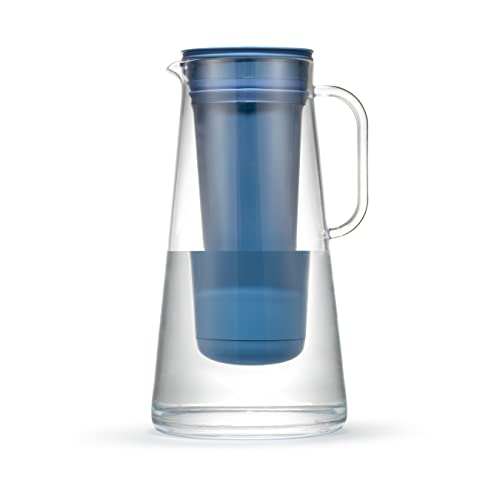
The LifeStraw Home is the advanced-filtration pick, built around two filter parts that change on different schedules. A membrane microfilter handles the first stage, and an activated carbon and ion exchange filter handles the second. LifeStraw prints that the membrane microfilter lasts 264 gallons, or about one year, while the carbon filter lasts 40 gallons, or about two months.
The Amazon listing title states that the pitcher is designed for everyday protection against bacteria, parasites, microplastics, lead, mercury and PFAS, and those words are the maker’s, printed for this model. That makes this the one pitcher here whose maker publishes bacteria and parasite claims; readers who need that level of protection should read the maker’s published lab documentation for this exact model rather than relying on any summary, including this one.
Specs
- Capacity: 10 cups (2.4 litres)
- Filters included: 1 membrane microfilter, 1 activated carbon and ion exchange filter
- Filter life: membrane microfilter 264 gallons or about 1 year; carbon filter 40 gallons or about 2 months, as printed
- Maker-stated protection: bacteria, parasites, microplastics, lead, mercury, PFAS, as printed in the listing title
- Dimensions: 7 x 7 x 14 in
- Material: BPA-free plastic
- Model number: LSH10PLWH1
See the LifeStraw Home 10-Cup on Amazon
ZeroWater 10-Cup Ready-Pour 5-Stage Water Filter Pitcher (ZP-010)
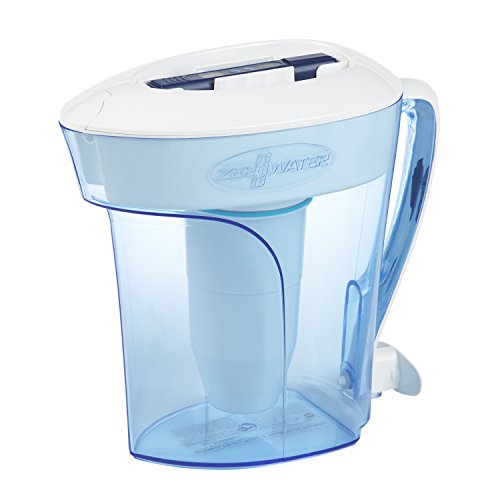
ZeroWater takes a different approach: a five-stage ion exchange filter, and a TDS meter in the box so the change decision is based on a reading rather than a calendar. The Amazon listing title states IAPMO certification to reduce lead, chromium and PFOA/PFOS, and the pitcher is the 10-cup Ready-Pour model with a sealed lid and a pour-through spout, so filtered water can be poured while the top reservoir is still filtering.
ZeroWater does not print a fixed gallon life for its filter, because life depends on the dissolved solids in the local supply. The maker’s instruction is to test the filtered water with the included meter and change the filter when the reading reaches the level printed in its guidance. Households on high-TDS water should expect shorter filter life than the calendar-based brands above.
Specs
- Capacity: 10 cups
- Filter included: 1 five-stage ion exchange filter, plus a TDS meter
- Filter life: not stated in gallons; change guided by the included TDS meter, as printed
- Certification: IAPMO certified to reduce lead, chromium and PFOA/PFOS, as printed in the listing title
- Dimensions: 11.63 x 5.93 x 11 in
- Material: BPA-free plastic
- Model number: ZP-010
See the ZeroWater 10-Cup ZP-010 on Amazon
Brita Metro 6-Cup Water Filter Pitcher

The Metro is the compact pick: a slim, small 6-cup pitcher shaped for fridge doors, dorm fridges and one-person households where a 10-cup body crowds the shelf. The listed version is the black Metro with a BritaPlus filter and Brita’s SmartLight indicator, an electronic light on the lid that signals when the filter is due instead of relying on a sticker or a date written on a calendar.
The BritaPlus cartridge is Brita’s standard-class filter for pitchers, rated at 40 gallons or about two months, with the maker’s wording covering chlorine taste and odour and the reduction of copper, cadmium and mercury. Six cups is roughly three large glasses per fill, so this is a pitcher for steady personal use rather than family meals.
Specs
- Capacity: 6 cups
- Filter included: 1 BritaPlus filter
- Filter life: 40 gallons or about 2 months, as printed
- Filter indicator: SmartLight electronic indicator
- Substances reduced (maker wording): chlorine taste and odour, copper, cadmium, mercury
- Dimensions: not stated
- Material: made without BPA, as printed
See the Brita Metro 6-Cup on Amazon
How to Choose
Start with capacity, because it decides how often the pitcher leaves the fridge. A 6-cup pitcher suits one person; a 10-cup pitcher is the family standard; a 27-cup dispenser removes refilling almost entirely but claims a full fridge shelf and pours only through its spigot.
Then match the filter to the claim you actually need. Certification belongs to the cartridge, not the jug: the same Brita body carries different reduction claims with a Standard, BritaPlus or Elite cartridge fitted, so read the claim for the exact filter in the box. Where a maker names a standard, such as the NSF/ANSI wording in Brita’s listing titles or the IAPMO certification in ZeroWater’s, that wording applies only to the substances listed beside it.
Filter life is the running cost and the chore. Calendar-based filters run 40 gallons for standard cartridges and 120 gallons for long-life ones like the Elite. The LifeStraw splits the difference with a yearly membrane and a two-month carbon filter. ZeroWater replaces the calendar with a meter reading, which is honest but means life varies with your tap water.
Finally, pick an indicator you will actually obey. A sticker works if someone writes the date; an electronic SmartLight or a TDS meter removes the guesswork. And hold the safety line: none of these pitchers turns unsafe water safe, and only the LifeStraw’s maker prints bacteria and parasite claims, for its membrane filter specifically.
Who Should Skip
Skip pitchers entirely if your water has a known contamination problem that a pitcher filter is not certified to address; that calls for a system certified for that substance, or guidance from your water utility. Skip the large UltraMax if your fridge shelves are shallow, and skip the compact Metro if more than two people drink from it daily, since it will live at the sink being refilled. Anyone under a boil-water notice should follow the notice, not a pitcher purchase: with the exception of the specific membrane claims LifeStraw prints for its own model, these products are taste and certified-reduction devices for water that is already treated and safe to drink.
FAQ
Do water filter pitchers make unsafe tap water safe to drink?
No. A pitcher filter reduces only the substances named in the certification for the exact cartridge fitted. It does not disinfect water. The LifeStraw Home is the partial exception: its maker prints bacteria and parasite protection claims for its membrane microfilter, and those claims should be read on the maker’s documentation for that model.
How often do pitcher filters really need changing?
It follows the cartridge, not the jug. Standard-class cartridges from Brita and PUR-style systems run about 40 gallons or two months; long-life cartridges such as the Brita Elite run 120 gallons or about six months; ZeroWater instead directs users to change on a TDS meter reading, so life varies by supply.
Does the pitcher or the filter carry the certification?
The filter. The same pitcher body can hold cartridges with different certified claims, so a lead-reduction claim printed for an Elite cartridge does not transfer to a Standard cartridge in the same jug. Check the claim against the exact filter in the box before buying.
Will a 27-cup dispenser fit in a standard fridge?
The UltraMax is designed to sit on a fridge shelf and pour through a spigot, but shelf depth and height vary. Measure the shelf and compare it with the maker’s current listing dimensions before ordering, since the listing checked for this guide did not print them.
Final Verdict
For a family fridge, the Brita Everyday 10-Cup with the Elite filter is the low-effort default: long filter life and the broadest maker-stated reduction list of the carbon pitchers here. Heavy drinkers should step up to the UltraMax dispenser, careful buyers who want measurement over calendars should pick the ZeroWater, the LifeStraw Home is the advanced option with the maker’s membrane claims, and the Metro covers small fridges without giving up an electronic change reminder.
Product and ASIN Reference
| Product | ASIN |
|---|---|
| Brita Everyday 10-Cup Water Filter Pitcher with Elite Filter | B0B3BM3Z94 |
| Brita UltraMax 27-Cup Filtered Water Dispenser | B0H27546VD |
| LifeStraw Home 10-Cup Water Filter Pitcher | B0BBSHHC7W |
| ZeroWater 10-Cup Ready-Pour 5-Stage Water Filter Pitcher (ZP-010) | B0073PZ6O0 |
| Brita Metro 6-Cup Water Filter Pitcher | B0DG63C2M5 |
FAQ
Do water filter pitchers make unsafe tap water safe to drink?
How often do pitcher filters really need changing?
Does the pitcher or the filter carry the certification?
Will a 27-cup dispenser fit in a standard fridge?
More from Amazon
Programs that pair well with the guide above. Offers and eligibility are set by Amazon and may change.
Set up recurring deliveries of everyday items on eligible products. Terms and savings are set by Amazon.
Explore Subscribe & SaveCollect the home and kitchen items you want in one registry that guests can shop from.
Create a wedding registryFree shipping on eligible items, Prime Video and more. Eligible new members can start with a free trial.
Start a Prime free trialAudiobooks and podcasts to listen to on the go. Eligible new members can start with a free trial.
Try Audible freeAs an Amazon Associate we earn from qualifying purchases.