A water softener and a water filter solve different problems. A conventional ion-exchange softener primarily addresses hardness minerals that produce scale and soap residue. A filter uses a particular medium or membrane to reduce specified particles, chemicals, microorganisms, or dissolved substances. Neither label alone guarantees that water is safe or that a system removes every concern.
Start with a certified laboratory test and information from the water supplier or local health authority. Treatment should match measured conditions. Private-well owners also need a testing and maintenance plan because water quality can change.
Our top picks




As an Amazon Associate we earn from qualifying purchases at no extra cost to you.
Begin with our home water quality testing guide, then verify treatment claims in the NSF certified drinking-water treatment unit database. Certification applies to named models and reduction claims, not every contaminant.
What a Water Softener Does
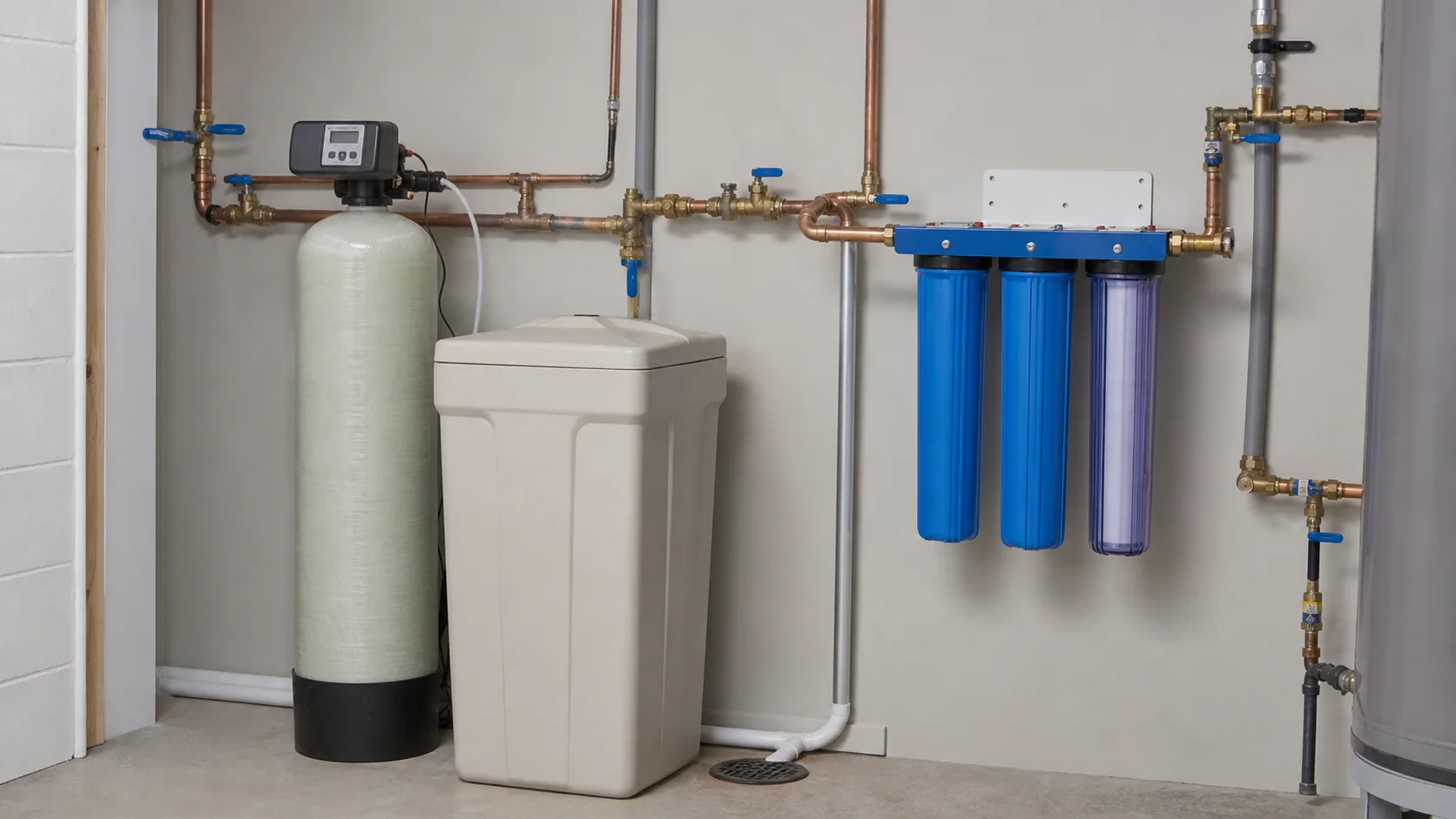
A common salt-based softener passes water through resin that exchanges calcium and magnesium ions for sodium or potassium ions. Reducing hardness can limit scale on fixtures and heating elements, improve soap performance, and make mineral spotting easier to manage.
A softener is not a general purifier. It does not reliably remove sediment, microorganisms, most organic chemicals, or every metal. Some specialized ion-exchange resins target other substances, but their performance and maintenance differ from ordinary softening.
The unit periodically regenerates with brine. That uses salt, water, and a drain connection. Local restrictions may apply to brine discharge. Softened water can contain added sodium, an important consideration for people on sodium-restricted diets or for certain plants and appliances; discuss health questions with an appropriate professional.
What a Water Filter Does
“Water filter” is a broad category. Sediment filters capture particles above a specified size. Activated carbon may reduce chlorine-related taste and odor and certain organic chemicals, depending on the product. Specialized media can address iron, sulfur, or other targets. Reverse osmosis uses a membrane and pretreatment to reduce a wider range of dissolved substances at a point of use. Ultraviolet treatment can inactivate certain microorganisms when water is sufficiently clear and the system is maintained.
No filter removes everything. Capacity, flow, contact time, incoming concentration, temperature, and maintenance affect results. Use performance claims tied to recognized certification standards for the exact contaminant and model, not vague terms such as “pure.”
Compare the Problems They Solve
Hard-water signs include scale on heating elements, mineral crust around fixtures, reduced soap lather, and spotting. These signs suggest testing for hardness, not an automatic need for carbon filtration. Chlorine taste, sediment, lead, arsenic, nitrate, bacteria, and volatile compounds are separate concerns requiring specific tests and treatment.
Some visible stains have multiple causes. Orange staining may involve iron; black staining can involve manganese; rotten-egg odor may arise from hydrogen sulfide or plumbing conditions. A water-treatment professional should interpret laboratory results before equipment is sized.
When a Home May Need Both
A household can have hard water and an unrelated contaminant or aesthetic issue. In that case, treatment stages may be combined. Typical order depends on the contaminants and equipment: sediment control may protect downstream devices; iron treatment may be needed before a softener; a softener can protect a reverse-osmosis membrane from scale. There is no universal sequence.
Each stage adds pressure loss and maintenance. Oversized “whole-house” combinations can reduce flow or create stagnant media if poorly selected. Have the design consider peak flow, pipe size, pressure, backwash requirements, drain availability, electrical service, and septic implications.
Point-of-Entry vs Point-of-Use Treatment
Point-of-entry equipment treats most water entering the home. It makes sense for hardness, sediment, or a concern affecting showers and appliances. Point-of-use equipment treats one tap, commonly drinking and cooking water. It may be more efficient for a contaminant relevant mainly to ingestion.
Reverse-osmosis systems produce a concentrate stream and require periodic filters and membrane service. Carbon filters can support microbial growth or release captured substances after capacity is exceeded. UV lamps need replacement and clean sleeves. A treatment system that is not maintained may perform worse than expected.
Testing and Product Selection
For municipal water, review the current consumer confidence report and test at the tap when plumbing-related contaminants are suspected. For a private well, use a certified lab and follow local health recommendations for routine and event-driven testing. Test after flooding, repairs, changes in taste or odor, or nearby land-use events.
Match test results to certified reduction claims. Certification does not mean a device removes all contaminants; it verifies specific claims and material or structural requirements under defined conditions. Compare service flow, capacity, replacement cost, waste stream, space, and bypass design.
Maintenance and Limitations
Softener resin, brine tanks, injectors, and valves need inspection. Filters need replacement on schedule or based on monitored capacity. Disinfect components as directed, and use approved replacement parts. Keep a log of salt additions, pressure changes, cartridges, service, and post-treatment test results.
Do not use taste, clarity, or a handheld total-dissolved-solids meter as proof of safety. Clear water can contain harmful contaminants, while harmless minerals can increase readings. Boil-water advisories and confirmed microbial contamination require instructions from public-health authorities; a standard softener or carbon filter is not a substitute.
Questions to Ask a Water-Treatment Provider
Ask the provider to identify the laboratory result that each proposed stage addresses. Request the exact model, applicable certification, rated service flow, pressure loss, treatment capacity, replacement interval, and conditions that can shorten media life. A proposal should explain why the equipment is sized for the home’s peak demand rather than simply offering the largest unit.
Clarify ongoing requirements: salt or chemical use, backwash volume, cartridge availability, sanitizing procedure, electrical consumption, noise, drain route, and service access. Ask what happens during a power outage and whether untreated water can be bypassed for irrigation or maintenance. For a private well, confirm that the pump and pressure tank can support required backwash flow.
Obtain a sampling plan for confirming performance after installation. Some contaminants need testing at a specific time or after a defined volume has passed. Warranty coverage should state which water conditions are excluded. Be cautious when a recommendation is based only on a salesperson’s visual demonstration or a total-dissolved-solids reading. A defensible treatment plan links certified testing, equipment claims, installation conditions, and scheduled verification.
Also ask how untreated outdoor taps, refrigerator lines, humidifiers, boilers, and other equipment will be connected. Softened or filtered water is not automatically appropriate for every use. Irrigation may waste treatment capacity, while some appliances have their own water-quality limits. The installer should identify every branch, provide a clearly labeled bypass, and leave adequate room for media replacement and drain service. Document baseline pressure before installation and compare it under peak flow afterward. Unexpected pressure loss, frequent regeneration, unusual taste, or shortened cartridge life should trigger review of sizing and incoming water rather than an automatic upgrade to more equipment.
Frequently Asked Questions
Does a water softener filter drinking water?
It exchanges hardness ions but is not a broad drinking-water filter. Additional treatment should be based on testing and certified contaminant-reduction claims.
Will a carbon filter soften water?
No. Standard activated carbon does not significantly remove calcium and magnesium hardness.
Can I choose treatment based on water spots?
Spots suggest minerals but do not identify all water-quality conditions. Test hardness and any health-related concerns before choosing equipment.
Is bottled water necessary after installing a softener?
Not automatically. Drinking-water decisions depend on source quality, household health needs, and test results—not simply the presence of a softener.
Should treatment water be retested?
Yes. Post-treatment testing confirms performance, and periodic testing helps detect exhausted media, maintenance problems, or source changes.