Key takeaways
- Fixed-volume tanks: The water level changes the overall resistance. A low fill is easier; a higher fill feels heavier and more connected through the stroke.
- Adjustable-resistance tanks: Internal baffles or chambers alter how much water is engaged. This is useful when different users share the rower.
- Noise: Expect a rhythmic swish, chain or belt movement, seat rollers, and foot-strap sounds. A water rower is quieter than many air rowers at moderate effort, but it is not silent.
- Resistance feel: Water resistance builds as stroke speed increases. It does not provide the same constant load at the beginning of every pull as some magnetic machines.
The best water rowing machines for most homes are the WaterRower A1 for a quieter, furniture-like machine, the First Degree Fitness Apollo Pro V for adjustable resistance and heavy use, and the Ergatta Rower for households that want guided workouts and interactive training.
Water rowers are appealing because their resistance feels progressive: the harder and faster you pull, the more resistance the tank creates. They also produce a soft, rhythmic swishing sound rather than the sharper mechanical noise of many air rowers. The trade-off is that a water tank adds length, weight, and maintenance compared with compact magnetic models.
Our top picks

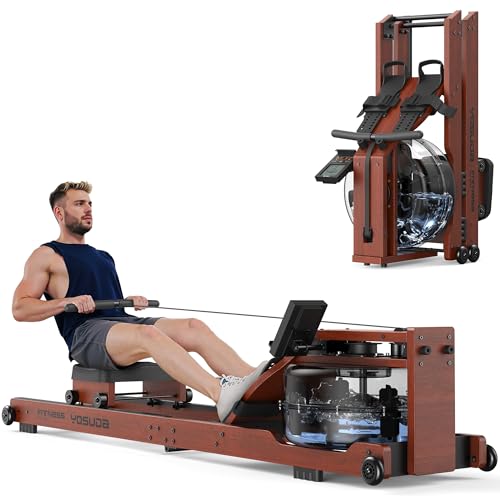

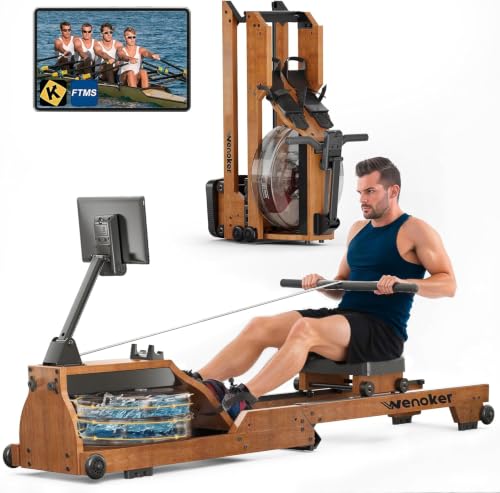
As an Amazon Associate we earn from qualifying purchases at no extra cost to you. Ratings are shown as listed on Amazon.
Best water rowing machines by home situation
| Home situation | Best fit | Why it works | Watch out for |
|---|---|---|---|
| Small apartment or multipurpose room | WaterRower A1 | About 83 inches long, relatively slim, and designed for upright storage | Its basic monitor has fewer training features than app-focused rowers |
| Family members with different fitness levels | First Degree Fitness Apollo Pro V | Adjustable tank resistance lets users change the feel without changing rowing technique | Usually heavier and more expensive than entry-level water rowers |
| Guided workouts and progress tracking | Ergatta Rower | Interactive programming, games, and performance data on a large screen | Requires a subscription for its full training experience |
| Traditional design and occasional workouts | WaterRower Classic | Wood construction, quiet operation, and a refined appearance for a visible living space | Costs more than simpler models and still needs roughly seven feet of rowing clearance |
| Budget-conscious buyer | Entry-level water-resistance rower | Usually provides the natural water feel for about $300–$600 | Check welds, seat rollers, monitor quality, warranty, and upright-storage stability carefully |
Head-to-head comparison: what separates the leading types?
WaterRower A1: best for a quieter, simpler home gym
The WaterRower A1 is a sensible choice when the rowing motion matters more than advanced technology. Its footprint is approximately 83 inches long by 20–22 inches wide, depending on the configuration. The tank produces the familiar water sound, while the basic performance monitor focuses on essentials such as time, stroke rate, distance, and intensity.
Its main advantage is ease of ownership. There are fewer electronics to maintain, and the machine can be stood vertically when not in use. The A1 is particularly suitable for a guest room, office, or living area where a large commercial-style console would be distracting. It is less suitable if several people want built-in coaching, workout challenges, or detailed performance analytics.
WaterRower Classic: best-looking option for a visible room
The Classic uses a wooden frame and is intended to look more like household furniture than gym equipment. Oak, ash, and walnut versions may differ by market and availability, so confirm the exact wood and finish before ordering. The wood frame can blend into a room with cabinetry or natural furniture, but appearance should not be confused with light weight: a tank rower remains awkward to move regardless of whether its frame is wood or metal.
The Classic generally uses a more capable monitor than the A1, but it is still a performance machine rather than a large touchscreen trainer. Choose it when quiet operation, appearance, and long-term simplicity are more important than connected classes.
First Degree Fitness Apollo Pro V: best for adjustable resistance
First Degree Fitness machines use a variable-resistance tank. On models such as the Apollo Pro V, the user can adjust the tank setting so the stroke feels lighter and quicker or heavier and more demanding. This differs from a conventional fixed-volume tank, where the water level changes the resistance but is less convenient to adjust repeatedly.
An Apollo Pro V is a strong option for a couple or family sharing one rower. A beginner can select a lighter setting, while a stronger athlete can increase the load. The frame is typically around 83 inches long and about 20 inches wide, though dimensions vary by model and region. Its monitor offers more training information than the simplest rowers, but it may not provide the same integrated coaching experience as a subscription-based screen system.
Ergatta Rower: best for interactive training
The Ergatta Rower combines a WaterRower-built frame and tank with a large display and software built around games, interval sessions, and performance progression. It suits people who are more likely to exercise when the workout provides visible goals and feedback.
Allow additional clearance for the screen and for users to step around the machine. The display and connected electronics also make this a more complicated purchase than a basic rower. A subscription is normally required for the full Ergatta experience, so include that recurring cost in the comparison. Without the software, the machine can still be used for rowing, but much of its value is unused.
Tank capacity, resistance feel, and noise
Tank capacity is not a simple quality score. A larger tank can create a fuller, more substantial sound and may support a stronger resistance sensation, but the rower will also hold more water and weigh more. Many home water rowers use tanks in the approximate range of 4–5 gallons, while exact capacity depends on the tank design and fill level.
- Fixed-volume tanks: The water level changes the overall resistance. A low fill is easier; a higher fill feels heavier and more connected through the stroke.
- Adjustable-resistance tanks: Internal baffles or chambers alter how much water is engaged. This is useful when different users share the rower.
- Noise: Expect a rhythmic swish, chain or belt movement, seat rollers, and foot-strap sounds. A water rower is quieter than many air rowers at moderate effort, but it is not silent.
- Resistance feel: Water resistance builds as stroke speed increases. It does not provide the same constant load at the beginning of every pull as some magnetic machines.
Room-size and clearance guide
A rower that is 83 inches long needs more than an 83-inch rectangle. For comfortable use, plan for at least 12 inches of clearance on each side, 24 inches at the front for mounting and foot adjustment, and 24–36 inches behind the seat if the room layout permits. A practical minimum zone is therefore about 9 feet long by 4 feet wide; 10 by 12 feet is much more comfortable, especially if the room also contains a cabinet, sofa, or exercise mat.
| Measurement | Practical target | Why it matters |
|---|---|---|
| Rower length | Approximately 79–86 inches | Common range for full-size home water rowers |
| Clearance beside frame | 12 inches per side minimum | Prevents elbows, hands, and feet from feeling confined |
| Clearance at front | 24 inches | Allows safer mounting and adjustment of footrests |
| Ceiling height for upright storage | Machine height plus 3–6 inches | Prevents the tank or monitor from contacting the ceiling |
| Desk or table use | Desk surface commonly 28–30 inches high | Check that the stored or parked rower does not block drawers, chairs, or walkways |
Storage, moving, and durability realities
Most full-size water rowers can be stored upright, but “folding” is not the same as becoming small. In the vertical position, a rower may still occupy roughly 20–25 inches of floor depth, and its height can exceed 80 inches. Measure the ceiling, door trim, light fixtures, and sprinkler clearance before choosing an upright storage location.
Moving one through a home is usually a two-person task. A filled tank can add more than 30 pounds, and the complete machine commonly weighs roughly 60–110 pounds depending on construction and accessories. Emptying the tank before carrying it upstairs or through a narrow doorway reduces strain and lowers the chance of spilling water. Measure the narrowest doorway, not just the front door; a hallway turn can be more restrictive than the doorway itself.
The parts most likely to need attention are the seat rollers, foot straps, handle grip, chain or belt, and tank seals. Keep the rail clean, avoid dragging the seat into its end stops, and use the water-treatment product specified by the manufacturer. Wood frames can be durable, but they should not be left in damp rooms or placed directly on wet flooring. Metal frames tolerate bumps better, while wood usually integrates more naturally with living-room furniture.
How to choose the right water rower
- Measure the entire exercise zone. Mark the rower length on the floor with painter’s tape, then add side and front clearance.
- Decide whether multiple users need adjustable resistance. If so, prioritize a variable-resistance tank such as the type used by First Degree Fitness.
- Choose the monitor last. A basic monitor is sufficient for distance, time, and stroke-rate workouts; a connected screen makes sense only if guided training will be used consistently.
- Check the user limit and inseam range. Do not assume a longer rail automatically supports every tall user or that a high weight limit guarantees a comfortable seat.
- Plan delivery and storage before ordering. Confirm box dimensions, assembly requirements, warranty coverage, and whether the tank must be filled after the machine reaches its final position.
Bottom line
Choose the WaterRower A1 when you want a compact-feeling, quiet, uncomplicated rower; choose the WaterRower Classic when the machine will remain visible in a carefully furnished room; choose the First Degree Fitness Apollo Pro V when users need adjustable resistance; and choose the Ergatta Rower when software-led training is the deciding factor. In every case, measure for the full rowing motion, not merely the machine’s listed footprint.