
Key takeaways
- Ask how long routine cleaning takes and which parts must be removed.
- Check whether seals, scraper blades, and gaskets are readily available as replacement parts.
- Confirm whether the machine has a drain, and where wash water can be disposed of.
- Include labor, mix waste, water, and downtime in the operating-cost comparison.
Best Commercial Ice Cream Machines: Choose by Output, Format, and Space
The best commercial ice cream machine for your operation is the one that matches its busiest-hour demand, serving format, available electrical service, and cleaning capacity—not simply the machine with the highest advertised output. A soft-serve freezer suits continuous cone service, while a batch freezer gives more control over flavors and texture; countertop models save floor space but generally cannot keep pace with a busy shop.
Compare the Main Machine Types
| Machine type | Typical planning output | Best suited to | Main trade-off |
|---|---|---|---|
| Countertop soft-serve freezer | About 2–6 gallons per hour | Cafés, food trucks, and low-volume dessert menus | Compact footprint, but limited recovery during a rush |
| Floor-standing soft-serve freezer | About 6–20 gallons per hour, depending on model and conditions | Ice cream shops, quick-service restaurants, and steady cone sales | Higher output requires more floor space, power, and cleaning time |
| Batch freezer | About 2–6 gallons per batch, often frozen in roughly 8–15 minutes | Gelaterias and shops rotating multiple flavors or premium recipes | Each batch requires operator attention; output is not continuous |
These are broad planning ranges, not guaranteed production figures. Actual output varies with mix temperature, recipe, draw temperature, room conditions, and whether the machine is air- or water-cooled. Ask manufacturers for output under conditions that resemble your operation.
Our top picks
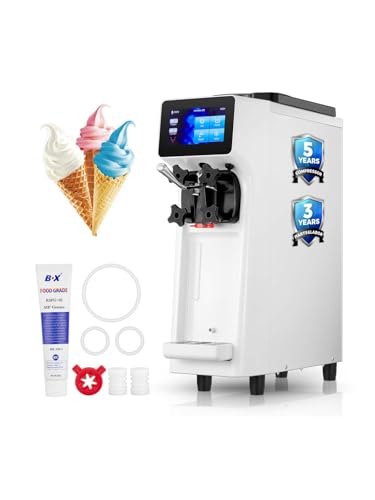


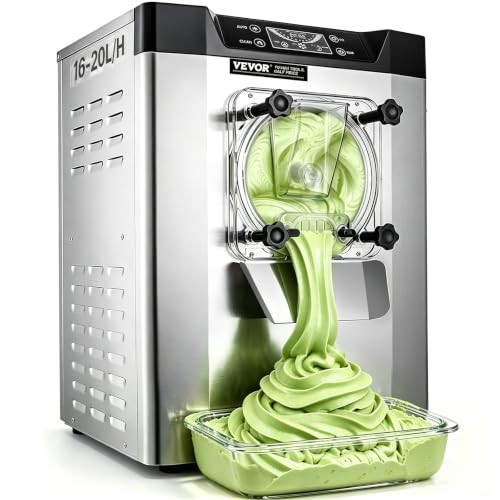
As an Amazon Associate we earn from qualifying purchases at no extra cost to you. Ratings are shown as listed on Amazon.
Choose for Your Rush, Not Your Daily Average
Estimate servings during the busiest 30–60 minutes, then convert that demand into product volume. A 4-ounce serving means one gallon provides about 32 portions before accounting for overrun, waste, and imperfect serving sizes. If you expect 80 servings in a peak hour, plan for at least 2.5 gallons of usable product per hour, with a margin for real service conditions.
For soft serve, confirm both hourly production and recovery: how quickly the machine restores product temperature after repeated draws. For batch-frozen ice cream, calculate how many batches you can make before opening and during service. A batch freezer may deliver excellent flavor variety but still be the wrong fit if every order must be made on demand.
Soft Serve or Batch Freezing?
Pick soft serve for fast, repeatable service
Soft-serve machines dispense product continuously from a refrigerated cylinder. They suit limited menus, high cone volume, and operations where consistent portioning matters. Many models offer one or two flavors, sometimes with a twist option. That simplicity can speed service, but a dedicated machine may be needed for each additional flavor or mix.
Check whether the model has overnight hold or pasteurization features, and understand the required cleaning schedule. Such features can reduce the frequency of full disassembly in some operations, but they do not remove the need to follow the manufacturer’s food-safety and sanitation instructions.
Pick a batch freezer for flavor range and recipe control
Batch freezers freeze and mix a measured amount at a time. They are a better match for rotating flavors, custards, gelato-style products, and recipes where texture is central to the menu. The trade-off is production planning: finished product may need hardening in a separate freezer, and the operator must manage batches, cleaning between recipes, and storage.
Do not compare a batch freezer’s batch size directly with a soft-serve machine’s hourly rate. A batch machine may need additional time for loading, unloading, cleaning, and hardening before the product is ready to serve.
Fit, Ventilation, and Electrical Service
Measure the installation area before choosing a model. A machine’s listed width and depth do not include the room needed for ventilation, opening panels, loading mix, or cleaning. The figures below are practical layout allowances for planning, not manufacturer installation specifications; confirm final clearances in the equipment manual.
| Planning item | Useful starting allowance | Why it matters |
|---|---|---|
| Countertop unit width | About 20–30 inches | Leaves room for the unit plus nearby work space |
| Floor unit width | About 24–36 inches | Allows a realistic equipment bay before service and access space |
| Rear or side service access | Plan for at least 6–12 inches where the manual permits | Access varies by model; some units require more for airflow or maintenance |
| Route to installation point | Measure the narrowest doorway and turn | A machine may fit the room but not the path through the building |
Commercial machines can weigh several hundred pounds, especially floor-standing models. Check shipping weight, door widths, ramps, floor loading, and whether a liftgate or professional rigging is needed. Avoid moving a machine by its handles or dispensing head; use the manufacturer’s approved handling points.
Electrical requirements vary substantially. Smaller units may use a standard commercial outlet, while larger freezers can require 208–230 volts, dedicated circuits, or three-phase service. Verify voltage, phase, amperage, plug type, and breaker requirements from the exact specification sheet before purchase. Have a qualified electrician confirm the site can support the load; an adapter does not make an incompatible circuit safe.
Cleaning and Ownership Costs
Cleaning is not an occasional chore: it affects food safety, labor, and how much of the machine’s capacity is available for sales. Soft-serve units typically require regular disassembly and sanitizing of product-contact parts, with the schedule depending on the machine’s holding and pasteurization system. Batch freezers also need cleaning between runs, particularly when changing flavors or handling allergens.
- Ask how long routine cleaning takes and which parts must be removed.
- Check whether seals, scraper blades, and gaskets are readily available as replacement parts.
- Confirm whether the machine has a drain, and where wash water can be disposed of.
- Include labor, mix waste, water, and downtime in the operating-cost comparison.
Scraper blades, seals, and moving components are common wear items. Strong local service support and available parts can matter more than a small difference in purchase price, especially during peak season.
Which Machine Fits Your Operation?
| Your situation | Best starting point | Check before buying |
|---|---|---|
| Small café adding one dessert item | Countertop soft-serve freezer | Peak-hour recovery, counter depth, and electrical supply |
| Busy shop selling a few core flavors | Floor-standing soft-serve freezer | Hourly demand, ventilation, cleaning labor, and circuit capacity |
| Shop built around rotating flavors | Batch freezer with suitable hardening and storage capacity | Batch cycle, batch size, production schedule, and freezer space |
| Food truck or tight service area | Compact countertop unit, if demand is modest | Machine weight, secure transport, generator or site power, and airflow |
| Mixed menu with both cones and scoops | Separate equipment may be justified | Whether sales volume supports the extra footprint, cleaning, and investment |
Buying Checklist
- Translate the busiest hour into gallons, not just daily sales.
- Choose continuous soft serve or batch production based on how customers order.
- Measure the equipment bay, ventilation space, doorways, and delivery route.
- Confirm the exact electrical specification with an electrician.
- Compare cleaning time, sanitation requirements, and replacement-part access.
- Ask for realistic output conditions and local service coverage in writing.
The right choice is usually the smallest machine that reliably handles peak demand while fitting the site’s power, space, and labor constraints. Oversizing adds cost and cleaning burden; undersizing creates queues and inconsistent product. Match the format and capacity to the way your customers actually buy.


