Key takeaways
- After every use: remove loose kernels, empty the crumb tray, wipe the cabinet interior, and clean oil from the kettle exterior.
- Regularly: wipe glass panels with a soft cloth and mild detergent; clean the scoop, tray, and removable accessories separately.
- For the kettle: follow the manual’s oil-removal procedure. Some kettles allow a small amount of water to be heated briefly, while others require hand wiping only.
- Avoid: abrasive pads, excess water near electrical controls, spray cleaner inside the cabinet, and leaving salt or caramel residue overnight.
Best Popcorn Machines for Home and Events
The best popcorn machines depend on three numbers: kettle capacity, expected servings per hour, and the counter or cart space available; for most homes, a 2–4 oz countertop machine is the practical choice, while events usually need an 8–12 oz commercial-style kettle or multiple machines.
Quick picks by situation
| Situation | Best machine type | Useful capacity | Why it fits |
|---|---|---|---|
| Occasional movie nights | Compact countertop popper | 2–4 oz kettle | Small footprint, lower power demand, easier storage |
| Family room or regular entertaining | Full-size countertop cabinet | 4–6 oz kettle | Good balance of batch size and serving speed |
| Birthday parties and school events | Commercial-style cabinet or cart | 8 oz kettle | Produces several batches without constant refilling |
| Fundraisers, venues, and concessions | Heavy-duty commercial machine | 8–12 oz kettle | Designed for sustained, high-volume production |
| Very limited storage | Hot-air popper | No kettle | Lightweight and simple, but lacks the traditional cabinet presentation |
How kettle capacity translates into servings
Kettle size is usually stated in ounces of unpopped corn. A 4 oz kettle does not mean the machine produces only 4 oz of finished popcorn; the kernels expand substantially when popped. For planning purposes, one finished serving is commonly around 1 to 1.5 oz, depending on the cup or bag size and how generously it is filled.
Our top picks
 VEVOR Commercial Popcorn Machine
- Powerful Heating, High Yield: This commercial popcorn machine…
- Simple Operation, Lasting Warm: 3 fantastic switches control…
- Durable Structure, Effortless Cleaning: This countertop popcorn machine…
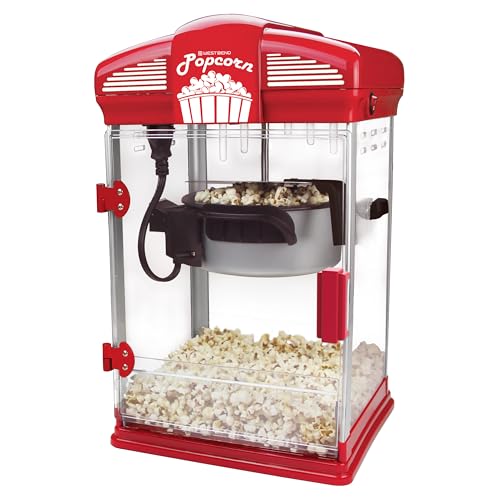 West Bend Stir Crazy Movie Theater Popcorn
- Pop up to 4 quarts of fresh, delicious…
- The stainless steel popcorn kettle features a nonstick…
- A patented quick-release lever tilts the kettle to…
 Nostalgia Popcorn Maker Machine
- Whether movie time or snack time, this vintage…
- All Nostalgia popcorn kits work with this popcorn…
- The stainless steel kettle holds 8 ounces of…
| Product | Key specs | |
|---|---|---|
| VEVOR Commercial Popcorn Machine | Powerful Heating, High Yield: This commercial popcorn machine… Simple Operation, Lasting Warm: 3 fantastic switches control… Durable Structure, Effortless Cleaning: This countertop popcorn machine… | Check price |
| West Bend Stir Crazy Movie Theater Popcorn | Pop up to 4 quarts of fresh, delicious… The stainless steel popcorn kettle features a nonstick… A patented quick-release lever tilts the kettle to… | Check price |
| Nostalgia Popcorn Maker Machine | Whether movie time or snack time, this vintage… All Nostalgia popcorn kits work with this popcorn… The stainless steel kettle holds 8 ounces of… | Check price |
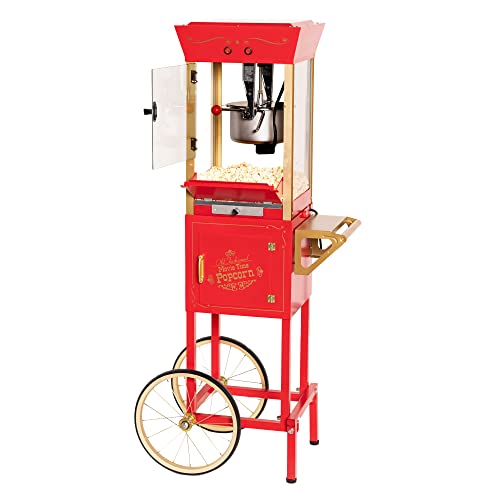 Nostalgia Popcorn Maker Machine Nostalgia Popcorn Maker Machine | Whether movie time or snack time, this vintage… All Nostalgia popcorn kits work with this popcorn… The stainless steel kettle holds 8 ounces of… | Check price |
As an Amazon Associate we earn from qualifying purchases at no extra cost to you.
| Kettle size | Approximate finished popcorn per batch | Practical serving range | Best use |
|---|---|---|---|
| 2 oz | About 6–8 cups | 4–6 small servings | One or two people, compact kitchens |
| 4 oz | About 12–16 cups | 8–12 small servings | Family movie nights and small gatherings |
| 6 oz | About 18–24 cups | 12–18 small servings | Frequent entertaining |
| 8 oz | About 24–32 cups | 16–24 small servings | Parties and moderate event service |
| 12 oz | About 36–48 cups | 24–36 small servings | High-volume concessions |
Actual output varies with the kernel, oil, batch cycle, and serving size. A machine may advertise a large kettle but still need several minutes between batches for heating, dumping, and reloading. For an event, choose a machine that can meet demand with some reserve rather than calculating capacity down to the last cup.
Countertop footprint and clearance matter more than cabinet size
A countertop popcorn machine commonly occupies roughly 18–24 inches wide, 16–20 inches deep, and 24–30 inches high. Larger 8–12 oz models can be approximately 24–30 inches wide, 20–24 inches deep, and 30–36 inches high before adding a cart.
Measure the complete setup, including the handle, door, chute, and power cord. Leave at least 3 inches of open space on the sides and rear for ventilation, and allow 12–18 inches above the kettle area so the lid can be opened safely. A machine that fits under a cabinet may still be inconvenient if the kettle cannot be accessed without moving it.
For a kitchen island or buffet, reserve a serving zone at least 30 inches wide by 24 inches deep. This gives people room to reach the scoop and bags without crowding hot cookware or drinks. On a narrow counter, a hot-air popper may be more practical than a cabinet model. A cart is attractive for an event but often needs a pathway at least 36 inches wide and a storage location for corn, oil, bags, and cleaning supplies.
Countertop, cart, or hot-air: choosing the right format
Compact hot-air poppers
Hot-air machines use little or no oil and generally have the smallest footprint. They suit occasional use, health-conscious households, and renters who need an appliance that can be stored in a cabinet. They do not usually provide the kettle-cooked flavor, heated holding cabinet, lighting, or visual appeal associated with a traditional popcorn machine. They also tend to scatter more loose kernels and require a separate bowl.
Countertop kettle machines
These are the best all-purpose choice for many homes. A glass-sided cabinet keeps finished popcorn visible and warm, while the kettle produces the familiar concession-style flavor. Look for a stainless-steel kettle, tempered or safety glass panels, a removable crumb tray, and separate controls for the kettle, warmer, and light.
A 2–4 oz countertop model is enough for a family gathering. A 6–8 oz model is better when guests will serve themselves throughout an evening, but it is heavier, hotter, and less convenient to move after each use.
Commercial-style carts
Carts improve presentation and storage but do not automatically increase output. Choose one when the machine will stay in an entertainment room, community hall, school, or event space. Check the assembled width against doorways and elevators; a 30-inch cart may pass through a standard interior door, but handles, wheels, and protruding shelves can make maneuvering difficult. If the unit arrives assembled, confirm its shipping weight and whether the wheels lock.
Cleaning requirements: the feature that determines long-term satisfaction
Oil, salt, sugar, and seasoning leave residue around the kettle hinge, bottom plate, door tracks, and crumb tray. The machine should be allowed to cool fully before cleaning, and the kettle should never be immersed unless the manufacturer specifically permits it.
- After every use: remove loose kernels, empty the crumb tray, wipe the cabinet interior, and clean oil from the kettle exterior.
- Regularly: wipe glass panels with a soft cloth and mild detergent; clean the scoop, tray, and removable accessories separately.
- For the kettle: follow the manual’s oil-removal procedure. Some kettles allow a small amount of water to be heated briefly, while others require hand wiping only.
- Avoid: abrasive pads, excess water near electrical controls, spray cleaner inside the cabinet, and leaving salt or caramel residue overnight.
Caramel corn and cheese seasonings are considerably harder to clean than plain salted popcorn. If those are part of the menu, prioritize a removable kettle, accessible corners, and replacement parts that can be ordered individually. Hinges, kettle stirrer components, door magnets, switches, and light bulbs are common wear points before the cabinet itself fails.
Material and construction trade-offs
| Construction feature | Advantages | Trade-offs |
|---|---|---|
| Stainless-steel kettle | Durable, resistant to staining, relatively easy to wipe | Can remain hot for a long time and may discolor if overheated |
| Tempered glass panels | Clear presentation and better heat resistance than ordinary glass | Heavy; still vulnerable to impact and thermal shock |
| Aluminum kettle | Lightweight and quick to heat | Can scratch or discolor more easily than stainless steel |
| Painted metal cabinet | Traditional appearance and sturdy feel | Chips or scratches may expose the underlying metal |
| Plastic housing | Lower weight and often lower cost | May show heat wear and feel less suitable for continuous service |
Occasional use versus high-volume service
For a household that makes popcorn once or twice a month, prioritize compact storage, a removable tray, simple controls, and a short cleanup routine. A 2–4 oz machine is usually sufficient. Paying for a 12 oz commercial kettle can add unnecessary weight, counter space, and cleaning work.
For events, calculate peak demand rather than average demand. If 40 guests may want a serving during a 20-minute intermission, a small machine could create a queue even if its total hourly output appears adequate. An 8 oz kettle, a second machine, or pre-popped backup supply provides useful capacity. High-volume users should also look for duty-cycle information, an oil filtration or draining procedure, replaceable kettle components, and controls that can be operated safely by more than one person.
Keep bags, kernels, oil, and waste bins within reach but away from heat and walking paths. A busy operator should not need to cross behind guests while carrying a hot kettle or open container of oil.
What to check before buying
- Measure width, depth, height, overhead clearance, and the route through doors.
- Match kettle size to peak servings, not the number of people in the building.
- Confirm the electrical requirements and use a properly grounded outlet without overloading a shared circuit.
- Check whether the kettle, crumb tray, glass panels, and stirrer are removable or replaceable.
- Look for independent kettle, warmer, and light controls.
- Consider the machine’s empty weight, especially if it must be stored after every use.
- Choose a cart only when its footprint and storage benefits justify the extra cost and moving difficulty.
In short, the best popcorn machines are not necessarily the largest ones. Choose a compact 2–4 oz model for occasional home use, a 4–8 oz cabinet for regular entertaining, and an 8–12 oz commercial-style machine—or more than one machine—when an event requires fast, sustained serving. Capacity, accessible cleaning parts, safe clearance, and realistic moving requirements will matter more than decorative styling after the first few batches.