Key takeaways
- See the real heat inside your oven with a leave-in dial gauge. We compare five stainless oven thermometers for baking, roasting and high-heat cooking.
Your oven dial is an estimate, not a measurement. The thermostat inside most home ovens cycles the heating element on and off around the set point, and the actual air temperature can swing 25 to 50 degrees above and below the number on the knob. That swing is why a cake browns too fast on one bake and stays pale on the next, even at the same setting. A simple oven thermometer fixes the guesswork: it lives inside the oven, reads the air temperature where your food actually sits, and shows you the truth through the door glass.
One point of scope before the picks. An oven thermometer is a leave-in dial gauge that measures the air inside the oven cavity. It is not a meat thermometer. A meat thermometer uses a probe pushed into food to read internal doneness, and this site already covers those in a separate guide. The five gauges below are all analog dial models with no probe, no battery and no electronics, chosen because they can hang from a rack or stand on one, carry a published temperature range and come from makers with verifiable product data.
Disclosure: As an Amazon Associate, we earn from qualifying purchases made through links on this page, at no extra cost to you.
How to Choose an Oven Thermometer
Match the range to your cooking. Most home baking and roasting happens between 300 and 475 degrees Fahrenheit, and a gauge that reads from about 100 to 600 degrees covers that span with room to spare. If you bake pizza on a steel or broil often, look for a high-heat model that reads to 750 degrees, so the needle stays in the middle of the dial where a mechanical gauge reads most steadily.
Dial size decides readability. You will read this gauge through a closed oven door, often from a few steps away. A 3-inch or larger face with bold numerals is far easier to read than a compact 2-inch dial, but the bigger face takes more rack space. Color zones printed on the dial, such as warm, bake and broil bands, help you confirm at a glance that the oven is in the right zone.
Check the mounting. Nearly every model here can stand on a flat base or hang from a rack by a hook. Standing on the rack beside your pan gives the most representative reading of the air around the food. Hanging from the rack above keeps the gauge clear of wide sheet pans. A wide, stable base matters because a gauge that tips over mid-bake is useless.
Look for stainless steel and a real glass lens. The housing should be stainless steel, which shrugs off years of heat cycles without warping. A laboratory glass or tempered glass lens resists the fogging and yellowing that plastic lenses develop. Several models below are NSF certified, a sign they are built to foodservice standards.
Set honest expectations for accuracy. A bimetal dial gauge is a simple coil that expands with heat. CDN, to its credit, publishes an accuracy figure of plus or minus 25 degrees for its dial models, and that tolerance is normal for this type of instrument. Treat the gauge as a truth-teller about patterns: it shows whether your oven runs hot or cool, by roughly how much, and where the hot and cool spots are. That is exactly the information you need to adjust a knob setting with confidence.
Place it well and give it time. Put the gauge near the center of the middle rack, close to the food but not touching a wall, the door or a heating element. Let it sit through a full preheat and at least one thermostat cycle, about 20 minutes, before you trust the reading, because the needle moves slowly by design.
The 5 Best Oven Thermometers
1. Taylor Classic Large Dial Oven Thermometer (5932)

Taylor’s 5932 is the readability pick. Its 3.25-inch dial is the largest in this roundup, with big numerals you can read through the door glass from across the kitchen. The face prints color-coded heat zones for warming, baking and roasting, plus a dual scale in Fahrenheit and Celsius, so a quick look tells you both the number and whether the oven sits in the zone you wanted.
The stainless steel body stands on a wide two-prong base that stays put when you slide a rack, and it also hangs from a rack by its hook when counter space on the rack is tight. Taylor builds this model to commercial kitchen standards with NSF certification, and it has been a fixture in professional kitchens for years. If your main frustration is squinting at a tiny dial, this is the gauge to get.
Specs
- Temperature range: 100 to 600°F (50 to 300°C)
- Dial style: Analog bimetal, dual °F/°C scale with printed warm, bake and roast zones
- Placement: Stands on a two-prong base or hangs from a rack
- Material: Stainless steel with glass lens
- Dial size: 3.25 inches
2. KitchenAid 3-in Dial Oven Thermometer (KQ903)

The KitchenAid KQ903 pairs a 3-inch dial with the most colorful face in the group. Wide bands mark the Warm zone from 100 to 200 degrees, Bake and Roast from 200 to 450, and Broil from 450 to 600, and a bright red pointer stands out against the markings. For cooks who think in zones rather than exact numbers, this is the fastest face to read mid-recipe.
The housing is food-grade stainless steel with a shatter-resistant tempered glass lens. It can hang from a rack or stand on the rack surface, and the maker rates it for continuous use across its full range. Care is simple but strict: hand wash only, and never immerse the gauge in water, because moisture inside the case will fog the lens and ruin the mechanism.
Specs
- Temperature range: 100 to 600°F (40 to 320°C)
- Dial style: Analog with color-coded Warm, Bake/Roast and Broil zones, red pointer
- Placement: Hangs from a rack or stands on the rack
- Material: Stainless steel with tempered glass lens
- Dial size: 3 inches
3. CDN ProAccurate Oven Thermometer (DOT2)

The DOT2 is the compact foodservice staple. CDN builds it from 304-grade stainless steel with a laboratory glass lens that resists cracking under repeated heat cycles, and the whole unit is NSF certified. The 2-inch dial carries a dual Fahrenheit and Celsius scale with temperature zone markings and a high-visibility red needle, and CDN publishes its accuracy figure openly, which few makers in this category do.
A wide flat base keeps the small body stable on the rack, and a two-way hook lets it hang when the rack is crowded. The 150-to-550-degree range brackets everyday baking and roasting neatly, putting common settings like 350 degrees near the middle of the dial. CDN backs the DOT2 with a five-year limited warranty, unusually long for such a simple tool.
Specs
- Temperature range: 150 to 550°F (70 to 280°C)
- Dial style: Analog, dual °F/°C scale with temperature zones and red needle
- Placement: Stands on a wide base or hangs from a rack
- Material: 304 stainless steel with laboratory glass lens
- Dial size: 2 inches
4. Cooper-Atkins 24HP-01-1 Oven Thermometer

Cooper-Atkins comes from the professional side of the industry, and the 24HP-01-1 shows it. This bi-metal gauge was designed for commercial kitchens, carries NSF approval and prints HACCP reference markings on the dial, the temperature checkpoints used in food safety work. The dual scale reads in Fahrenheit and Celsius across a full 100-to-600-degree range.
The stainless steel housing and glass face are built for daily abuse, and the two-way mounting design stands on the rack or hangs from it. At 2 inches, the dial is the joint smallest here, so it suits cooks who value a compact footprint and a pro-grade build over a big display. This model has a long track record in test kitchens and foodservice settings where gauges get knocked around and still need to read true.
Specs
- Temperature range: 100 to 600°F (50 to 300°C)
- Dial style: Analog bi-metal, dual °F/°C scale with HACCP reference markings
- Placement: Stands on the rack or hangs from a rack
- Material: Stainless steel with glass lens
- Dial size: 2 inches
5. CDN ProAccurate High Heat Oven Thermometer (POT750X)
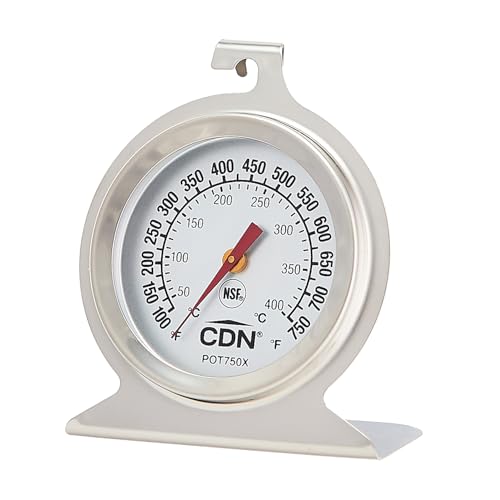
Most dial gauges top out at 550 or 600 degrees. The POT750X reads to 750 degrees Fahrenheit, which makes it the pick for pizza steels, broiling and other high-heat work where lesser gauges run off the end of their scale. With a 500-degree preheat sitting near the middle of the dial instead of near the top, readings land in the zone where a mechanical gauge is most dependable.
The build mirrors the DOT2: a 304 stainless steel housing, a durable laboratory glass lens, NSF certification and a five-year limited warranty. It stands on the rack or hangs from it, and the 2-inch dial uses a dual scale with 25-degree graduations. If your cooking regularly pushes past 550 degrees, this is the gauge that keeps up.
Specs
- Temperature range: 100 to 750°F (50 to 400°C)
- Dial style: Analog, dual °F/°C scale with target range indication
- Placement: Stands on the rack or hangs from a rack
- Material: 304 stainless steel with laboratory glass lens
- Dial size: 2 inches
Comparison Table
| Product | Temperature range | Dial size | Placement | Material |
|---|---|---|---|---|
| Taylor Classic 5932 | 100 to 600°F | 3.25 in | Stand or hang | Stainless steel |
| KitchenAid KQ903 | 100 to 600°F | 3 in | Stand or hang | Stainless steel |
| CDN DOT2 | 150 to 550°F | 2 in | Stand or hang | 304 stainless steel |
| Cooper-Atkins 24HP-01-1 | 100 to 600°F | 2 in | Stand or hang | Stainless steel |
| CDN POT750X | 100 to 750°F | 2 in | Stand or hang | 304 stainless steel |
Frequently Asked Questions
Where should I place an oven thermometer for the most accurate reading?
Put it on the middle rack, near the center, close to where the food will sit. Keep it clear of the oven walls, the door and any exposed heating element, because contact with those surfaces skews the reading. If you suspect hot or cool spots, move the gauge to a different corner on a later bake and compare.
How far off can a home oven temperature be?
Swings of 25 to 50 degrees around the set point are common, because the thermostat cycles the element on and off rather than holding a steady heat. Older ovens and ovens with worn door seals can drift further. A leave-in gauge shows you the size and direction of the swing so you can nudge the knob to compensate.
Can I leave an oven thermometer in during a self-cleaning cycle?
No. Remove it first. Self-cleaning cycles run far hotter than any of these gauges are built to read, and the makers warn against leaving a thermometer in the oven during cleaning. The extreme heat can damage the dial mechanism and discolor the face.
What is the difference between an oven thermometer and a meat thermometer?
An oven thermometer measures the air temperature inside the oven and stays in place for the whole bake. A meat thermometer measures the internal temperature of food with a probe and tells you about doneness. They answer different questions, and many cooks use both: the gauge to confirm the oven, the probe to confirm the food.
Why does the needle move slowly, and why does the reading dip when I open the door?
A bimetal coil responds gradually as it absorbs heat, so the needle takes minutes to settle after a change. Opening the door lets hot air escape, and the gauge honestly reports the cooler air that replaces it. Read the dial through the closed door whenever you can, and judge the temperature after the oven has cycled with the door shut.
Conclusion
An oven thermometer is the simplest upgrade a baker can make: no battery, no app, just a dial that tells the truth about your oven. Choose the Taylor 5932 or the KitchenAid KQ903 if readability through the door glass matters most. Pick the CDN DOT2 or the Cooper-Atkins 24HP-01-1 for a compact, foodservice-grade gauge, and reach for the CDN POT750X when your cooking runs past 600 degrees. Whichever you choose, give it a few bakes in different rack positions, learn how your oven behaves, and your results will get more consistent every time.
More from Amazon
Programs that pair well with the guide above. Offers and eligibility are set by Amazon and may change.
Set up recurring deliveries of everyday items on eligible products. Terms and savings are set by Amazon.
Explore Subscribe & SaveCollect the home and kitchen items you want in one registry that guests can shop from.
Create a wedding registryFree shipping on eligible items, Prime Video and more. Eligible new members can start with a free trial.
Start a Prime free trialAudiobooks and podcasts to listen to on the go. Eligible new members can start with a free trial.
Try Audible freeAs an Amazon Associate we earn from qualifying purchases.