A bathroom vanity top has to tolerate water, cosmetics, soap, heat
from styling tools, and daily cleaning in a relatively small area.
Quartz, marble, granite, and solid surface can all work, but they do not
age or respond to damage in the same way. The best choice depends less
on which material is considered premium and more on the household’s
tolerance for maintenance, visible wear, seams, and future repairs.
This guide compares the four materials without assuming that one is
right for every project. Before ordering, confirm the fabricator’s
current care instructions, warranty terms, sink compatibility, and slab
or color availability.
Our top picks


As an Amazon Associate we earn from qualifying purchases at no extra cost to you.
Coordinate slab dimensions and sink placement with our bathroom vanity size guide. For natural-stone selection and care, use the Natural Stone Institute care resources alongside the fabricator’s instructions for the exact material.
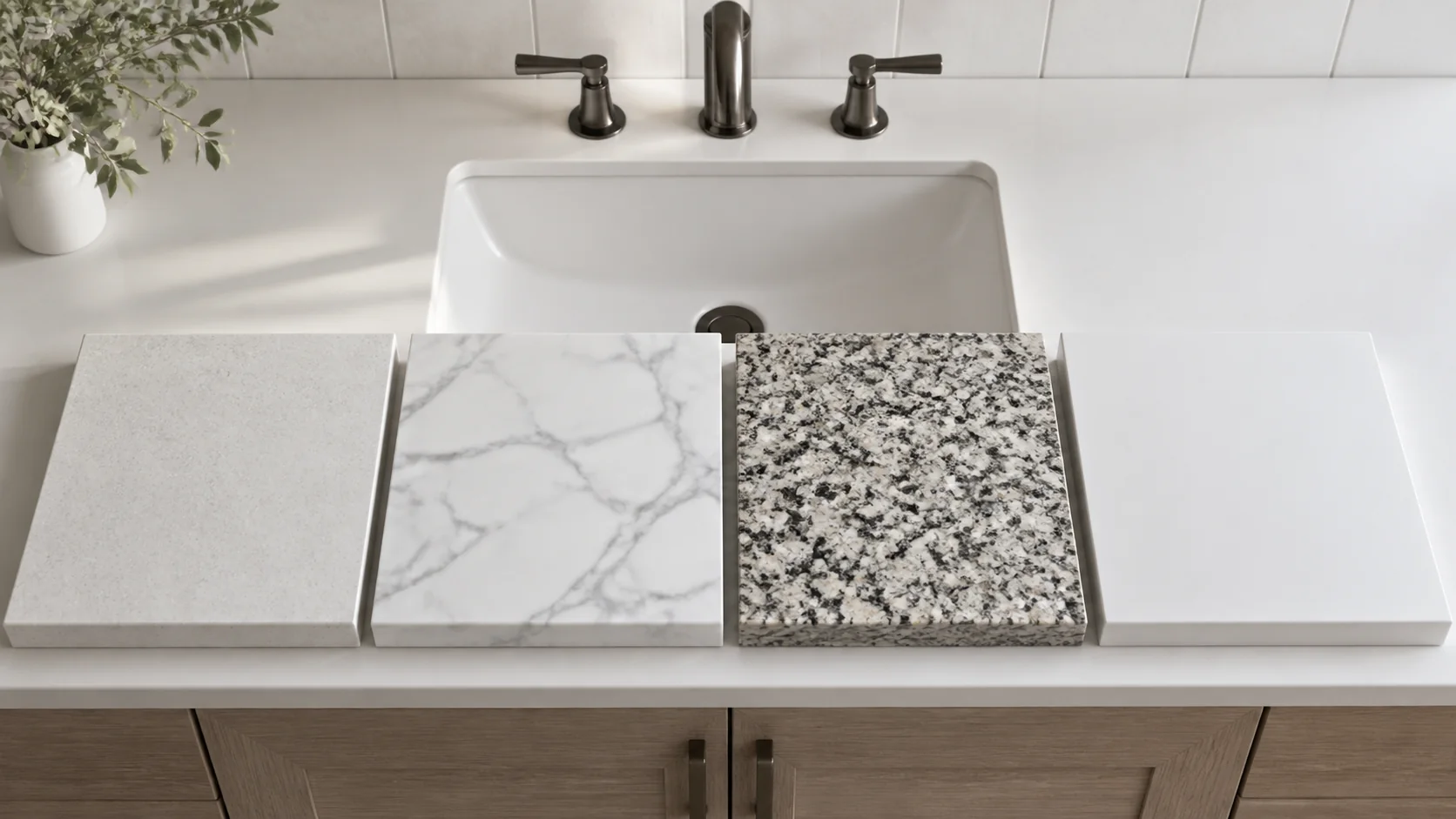
Quick Comparison of the
Four Materials
Quartz is an engineered surface made from mineral particles, resin,
and pigments. It offers consistent color and low routine maintenance,
but excessive heat and some chemicals can affect its resin
components.
Marble is natural stone valued for veining and visual depth. It can
develop patina, etching, and staining, which some homeowners accept as
character and others find frustrating.
Granite is natural stone with considerable variation between slabs.
Properly selected and maintained granite can be durable, although
porosity and sealing needs vary by stone.
Solid surface is a manufactured, nonporous material with a uniform
appearance. It can often be renewed by sanding and may allow
inconspicuous seams or an integrated sink, but sharp impacts and high
heat can damage it.
| Material | Routine upkeep | Common concern | Notable strength |
|---|---|---|---|
| Quartz | Low | Heat and chemical sensitivity | Consistent, nonporous surface |
| Marble | Higher | Etching and staining | Distinctive natural veining |
| Granite | Moderate | Variable porosity | Natural pattern and good durability |
| Solid surface | Low to moderate | Scratches and heat | Repairability and seamless options |
Quartz:
Consistency and Low Routine Maintenance
Quartz suits homeowners who want a broad selection of repeatable
colors and patterns. Because the surface is engineered, a sample usually
represents the installed color more reliably than a small natural-stone
sample. Quartz is generally nonporous, so it does not normally need
periodic sealing. That simplifies maintenance around sinks and
backsplashes.
It is not indestructible. Hot curling irons should rest on a
heat-resistant mat rather than directly on the top. Strong solvents,
abrasive powders, and aggressive drain chemicals can discolor or dull
some finishes. Dark, solid colors may show soap residue and water spots
more readily than patterned colors.
Quartz slabs are heavy and typically require professional
fabrication. Sink openings, faucet holes, and outlet clearances must be
finalized before fabrication. Ask whether the chosen color is available
in the needed thickness and whether exposed edges are built up or full
thickness. Also check whether the warranty covers bathroom use and which
cleaners are approved.
Marble: Natural Beauty
with Visible Aging
Marble offers movement, veining, and subtle color changes that
manufactured surfaces imitate but do not perfectly reproduce. Each slab
is different, making slab selection important. A bathroom may expose
marble to fewer food acids than a kitchen, but toothpaste, cosmetics,
fragrances, and some cleaners can still etch or stain it.
Etching is a chemical reaction that dulls the finish; it is not
simply dirt and cannot always be wiped away. Honed marble tends to make
minor etching less conspicuous than a polished finish, though it may
still stain. Sealer can slow absorption but does not prevent acid
etching. Owners should blot spills, use mild stone-safe cleaner, and
accept that the surface may develop a lived-in patina.
Marble works best when its appearance matters enough to justify that
care. Inspect the full slab for fissures, fill, and vein placement.
Discuss support around sink cutouts and overhangs with the fabricator,
since stone strength varies with thickness, pattern, and cutout
location.
Granite:
Natural Variation and Practical Durability
Granite is often chosen as a middle path: a natural material with
strong resistance to ordinary bathroom wear. Yet “granite” covers many
stones with different absorption rates and mineral structures. One
sample may be dense and low maintenance, while another may benefit from
periodic sealing.
Do not rely on a universal sealing schedule. Ask the supplier whether
the exact stone needs sealing and how to test it. When sealing is
required, follow the product and fabricator guidance rather than
applying multiple coats indiscriminately. A poorly removed sealer can
leave haze.
Granite patterns can disguise water spots and minor debris,
particularly in mid-tone colors. On the other hand, busy movement may
make seams more obvious or conflict with patterned tile. View the actual
slab and approve how it will be cut. Confirm whether natural pits or
fissures are considered normal for that selection.
Solid Surface:
Seam Control and Repairability
Solid-surface material is nonporous and available in many subdued
colors. Fabricators can join pieces with color-matched adhesive,
creating seams that are often less noticeable than stone seams. Some
designs use an integrated bowl, eliminating the rim where grime collects
around a drop-in sink.
The surface is softer than stone or quartz. Fine scratches may
develop, especially on dark or glossy colors. The advantage is that
trained technicians can often sand and refinish localized damage. Deep
cuts, cracks, and heat damage still require professional assessment. A
removable heat mat remains sensible near styling tools.
Solid surface can be a strong option for an accessible bathroom, a
long counter with multiple transitions, or a design where easy cleaning
matters more than natural variation. Ask whether the sink and top can be
repaired separately and whether the chosen finish will show
scratches.
Moisture, Cleaning, and Daily
Use
All four materials can perform in a bathroom when installed
correctly. Many failures attributed to the countertop actually begin at
joints and penetrations. Water can enter an unsealed faucet hole, failed
backsplash joint, loose sink clip, or cabinet edge. The installer should
use compatible sealants and preserve any required movement joints.
Clean spills promptly. Use a soft cloth and a cleaner approved by the
material manufacturer. Avoid mixing cleaners, and never combine bleach
with ammonia or acidic products. Do not use an abrasive pad unless the
care guide explicitly permits it. Keep hair dye, nail products, and
drain chemicals off the counter whenever possible.
For a shared family bath, quartz or a light-patterned solid surface
may reduce day-to-day concern. For a lower-use powder room, marble’s
maintenance demands may be easier to accept. Granite can fit either
setting when the selected stone’s care needs are understood.
Sink, Edge, and
Installation Decisions
An undermount sink emphasizes the top and makes wiping water into the
bowl easy, but the exposed cutout must be finished cleanly. An
integrated solid-surface sink minimizes joints. A drop-in sink can
conceal the cutout and may simplify future replacement, although its rim
needs cleaning.
Choose an edge that matches both safety and style. A slightly eased
or rounded edge is less sharp in a narrow bathroom. Elaborate edges add
fabrication complexity and may reduce usable visual space on a small
vanity. Confirm faucet reach, handle clearance, backsplash thickness,
and the distance from the sink to the front edge before approving
templates.
Cabinets must be level and capable of supporting the top. Stone and
quartz should not be forced onto an uneven base. Long spans, overhangs,
and narrow rails around large sinks may need added support. Plumbing
should be disconnected and reconnected by a qualified person where local
rules require it.
How to Choose
Start with behavior rather than appearance. Choose quartz if low
maintenance and color consistency lead the list. Choose marble if unique
veining matters and visible patina is acceptable. Choose granite for
natural pattern and durability, after verifying the exact slab’s
porosity. Choose solid surface for easy cleaning, subtle seams, or
potential refinishing.
Then compare actual samples under bathroom lighting. Place soap,
tile, cabinet, and paint samples next to them. Obtain written care and
warranty information, approve slab layout where relevant, and have the
fabricator verify all dimensions. These steps matter more than a generic
ranking.
Frequently Asked Questions
What is the easiest
vanity top to maintain?
Quartz and solid surface are generally low-maintenance because they
are nonporous. They still require approved cleaners, prompt spill
cleanup, and protection from excessive heat.
Does marble always stain?
Not necessarily, but marble can absorb liquids and is vulnerable to
etching from acidic substances. Sealing may reduce absorption but will
not prevent etching.
Is granite
suitable for a frequently used bathroom?
Yes, many granites are suitable. Confirm the properties and sealing
recommendations for the exact slab rather than assuming every granite
behaves alike.
Can a cracked vanity top
be repaired?
Sometimes. Repairability depends on the material, crack location,
color, and cause. Solid surface is often repairable; stone and quartz
repairs may remain visible. A fabricator should assess structural
cracks.
Should
the vanity top be ordered before the cabinet is installed?
Final templating normally occurs after the cabinet is installed,
level, and secured. Coordinate the sequence with the fabricator,
plumber, and cabinet installer.