Key takeaways
- Ceiling height: Minimum 8 feet. The bottom of the bag should sit at eye level to nose level. For a 5 ft 10 inch user, that is about 62 to 66 inches from the floor.
- Forward clearance: At least 36 inches of open space in front of the center of the platform so you can stand with elbows slightly bent and move side to side.
- Side clearance: At least 24 inches on each side of the bag to avoid hitting walls or furniture on missed punches.
- Room footprint: A 10 x 12 ft room easily fits a platform on the short wall with room for a workout mat behind you, but do not place the platform on a wall shared with a bedroom if noise is a concern.
- Mounting hardware: Lag bolts into two studs minimum, 3/8 inch diameter x 3.5 inch long, with a backing board if studs are not 16 inches on center.
Best Bo
The best boxing speed bags for most home and gym setups are a small 6 x 9 inch leather bag with a ball-hook swivel on a height-adjustable platform for fast rebound, and a medium 7 x 10 to 8 x 11 inch bag with a chain or U-bolt swivel for beginners who need more forgiveness and durability.
How to Choose the Right Speed Bag Size
Size directly controls rebound speed, target area, and how hard the bag is to hit consistently. Smaller bags move faster and demand more accuracy, while larger bags are slower and more forgiving for learning rhythm.
Our top picks
 Everlast Powerlock Speed Punching Bag
- Come with 1 Premium grade leather speedbag
- Features reinforced seams for added strength
- Balanced for accurate rebounds while training
 Redipo Boxing Speed Bag
- 【Professional Balanced Design】-- Pear-shaped balance design ensures accurate…
- 【Premium Boxing Equipment】--PU leather and heavy-duty latex bladder,…
- 【Perfect Training Partner】--Ideal for everyone—whether you are a…
 Meister SpeedKills Leather Speed Bag with Lightweight
- Genuine full-grain cowhide leather construction is built to…
- Lightweight inner latex bladder provides faster performance
- Balanced and centered for predictable and consistent rebounds
| Product | Key specs | |
|---|---|---|
| Everlast Powerlock Speed Punching Bag | Come with 1 Premium grade leather speedbag Features reinforced seams for added strength Balanced for accurate rebounds while training | Check price |
| Redipo Boxing Speed Bag | 【Professional Balanced Design】-- Pear-shaped balance design ensures accurate… 【Premium Boxing Equipment】--PU leather and heavy-duty latex bladder,… 【Perfect Training Partner】--Ideal for everyone—whether you are a… | Check price |
| Meister SpeedKills Leather Speed Bag with Lightweight | Genuine full-grain cowhide leather construction is built to… Lightweight inner latex bladder provides faster performance Balanced and centered for predictable and consistent rebounds | Check price |
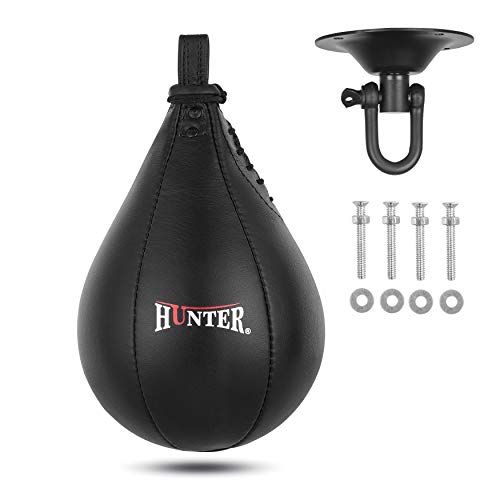 Hunter Leather Speed Bag for Boxing Hunter Leather Speed Bag for Boxing | Crafted from genuine cowhide leather for exceptional durability,… Each speed ball is meticulously shaped and balanced… The lightweight structure, combined with a durable latex… | Check price |
As an Amazon Associate we earn from qualifying purchases at no extra cost to you.
| Bag Size (Diameter x Height) | Common Label | Rebound Speed | Best For | Skill Level |
|---|---|---|---|---|
| 4 x 7 inch (10 x 18 cm) | Extra Small / Peanut | Very Fast | Advanced hand speed, fight camp timing | Advanced |
| 5 x 8 inch (13 x 20 cm) | Small | Fast | Fast tempo training in compact gyms | Intermediate to Advanced |
| 6 x 9 inch (15 x 23 cm) | Small-Medium | Moderate-Fast | Best all-around size for home gyms | Beginner to Advanced |
| 7 x 10 inch (18 x 25 cm) | Medium | Moderate | Learning rhythm and endurance | Beginner |
| 8 x 11 inch (20 x 28 cm) to 10 x 13 inch | Large | Slow | New users, heavy hands, rehabilitation work | Beginner |
If you can only buy one bag for a shared home gym, choose 6 x 9 inch or 7 x 10 inch. You get enough speed to build timing without the frustration of a peanut bag that requires near-perfect accuracy on every strike. Fighters who already have solid rhythm and want to push speed should add a second, smaller bag later rather than starting too small.
Swivel Types Determine Rebound Style and Noise
The swivel is more important than the bag itself for how the bag feels. It controls how freely the bag rotates, how quickly it rebounds, and how much vibration transfers into your ceiling or wall.
Ball-Hook Swivel
The standard for speed. A metal ball sits in a hook mounted to the underside of the platform. It allows 360-degree rotation with minimal friction and the fastest, most unpredictable rebound. It is the choice for Title Boxing, Everlast, and Cleto Reyes platforms in most commercial gyms. Downside: it is louder and transfers more vibration than other types.
Chain-Link and U-Bolt Swivel
A short chain or rigid U-bolt connects the bag to the platform. Rebound is slower and more linear, which makes it easier to find rhythm. It is more forgiving for beginners and quieter than a ball-hook. Many Century and Ringside starter kits use this style. It wears faster at the link points if not oiled regularly.
Butterfly or S-Hook Swivel
Less common today. A flat metal loop allows limited rotation. It is the slowest and most controlled option, sometimes found on budget vinyl sets. It is durable but does not develop elite timing because the bag returns to the same spot each time.
Mounting Requirements and Real Space Needs
A speed bag is only as good as its mount. A weak mount makes even a premium leather bag feel sloppy and can damage drywall or joists.
Platform Mount (Wall or Ceiling)
This is the traditional setup: a 24-inch diameter wooden drum or board mounted to wall studs or ceiling joists with a height-adjustable bracket. You need solid wood studs or concrete, not drywall anchors alone. The platform weight is usually 45 to 65 lbs before the bag is added.
Clearance requirements for a wall-mounted platform:
- Ceiling height: Minimum 8 feet. The bottom of the bag should sit at eye level to nose level. For a 5 ft 10 inch user, that is about 62 to 66 inches from the floor.
- Forward clearance: At least 36 inches of open space in front of the center of the platform so you can stand with elbows slightly bent and move side to side.
- Side clearance: At least 24 inches on each side of the bag to avoid hitting walls or furniture on missed punches.
- Room footprint: A 10 x 12 ft room easily fits a platform on the short wall with room for a workout mat behind you, but do not place the platform on a wall shared with a bedroom if noise is a concern.
- Mounting hardware: Lag bolts into two studs minimum, 3/8 inch diameter x 3.5 inch long, with a backing board if studs are not 16 inches on center.
Free-Standing Speed Bag Stand
A steel frame with a base plate and adjustable platform height, no drilling required. Ideal for renters, garages with metal studs, or rooms where you cannot locate joists. Units from Century and Title Boxing usually stand 70 to 88 inches tall, have a footprint of about 36 x 44 inches, and weigh 80 to 120 lbs empty. You must add weight plates or sandbags (often 100+ lbs) to the base to prevent walking. They wobble more than wall mounts and take up significant floor space.
Doorway and Corner Alternatives
Lightweight doorway bar attachments exist but are best avoided for serious training. They flex, have slow rebound, and can damage trim. If you are in a small apartment, a free-standing stand pushed into a corner when not in use is more stable than any doorway option.
Material and Construction Trade-Offs
Material affects durability, hand feel, air retention, and how the bag sounds.
| Material | Durability | Rebound Feel | Air Retention | Maintenance | Price Range |
|---|---|---|---|---|---|
| Genuine Leather (cowhide) | Very High – 3 to 7 years with care | Crisp, balanced, breaks in over 2-3 weeks | Excellent with latex bladder | Condition occasionally, keep inflated 60-70% | Usually $50–$120 for bag only |
| Genuine Leather (Kangaroo/Cleto Reyes style) | High but thinner cut | Very fast and soft on hands | Excellent | More sensitive to over-inflation | Usually $80–$150 |
| Synthetic Leather (polyurethane/ vinyl) | Moderate – stitching and coating crack in 12-24 months in dry or cold garages | Stiffer, louder pop | Good with PVC bladder, but valve leaks more common | Wipe clean, no conditioning | Usually $25–$60 |
| Canvas | High abrasion resistance, lower shape retention | Deader rebound, less bounce | Moderate | Washable but absorbs sweat | Usually $30–$70 |
Construction details to check: triple-stitched seams, a recessed valve that does not hit your knuckles, and a genuine latex bladder rather than thin PVC. Latex holds air for weeks and provides more consistent rebound. Welded vinyl seams and plastic bladders lose air every few days and feel inconsistent.
Matching the Bag to Your Situation
Use this decision matrix instead of chasing the fastest bag if your space or household limits what you can install.
| Your Situation | Recommended Setup | Why |
|---|---|---|
| Small apartment or renter, cannot drill | Free-standing stand + 7 x 10 inch synthetic or leather bag with chain swivel | No wall damage, stable enough for learning, quieter swivel for neighbors |
| Dedicated garage or basement gym with wood studs | Wall-mounted 24-inch platform + 6 x 9 inch leather bag with ball-hook swivel | Fastest rebound, permanent and rock-solid, best long-term value |
| Beginner or teenager learning rhythm | Any stable platform + 8 x 11 inch leather bag | Larger target builds timing and confidence before moving smaller |
| Advanced fighter or coach in commercial gym | Heavy-duty platform + 4 x 7 or 5 x 8 inch leather bag (Everlast or Title Boxing Pro) with ball-hook swivel + height adjustment | Maximum speed and unpredictable angles for fight preparation |
| Shared home with kids, pets, or low ceilings | Height-adjustable platform mounted at 66-68 inches + medium bag stored deflated when not in use | Keeps bag out of reach, adjustable for different user heights, reduces accidental contact |
| Home gym focused on low-impact cardio and shoulder endurance | Medium leather bag + U-bolt swivel on sturdy mount | Slower rhythm is easier on joints and better for longer rounds |
Assembly, Moving and What Wears First
Shipping weight for a wall platform is usually 48 to 70 lbs in one large flat box, often 26 x 26 x 8 inches. It will not fit through a narrow 24-inch utility doorway without opening the box. Free-standing stands ship in two boxes totaling 90 to 130 lbs. Assembly takes 60 to 90 minutes with two people, a stud finder, level, and socket wrench.
What actually wears first is not the bag leather but the small parts: the swivel hook elongates, the elastic cord or chain stretches, and the bladder valve loosens. Keep a hand pump with a needle, a spare bladder (usually $10–$20), and a small bottle of 3-in-1 oil for the swivel. Inflate the bag so you can depress it about 0.5 inch with your thumb. Over-inflation makes it too fast and stresses seams; under-inflation makes it sag and throws off timing.
For garaykitchensandbaths.com readers fitting a speed bag into a multi-use room, consider the platform location like any other piece of wall-mounted furniture. Place it on an interior wall with double studs, away from pendant lights and cabinets. If you have hardwood floors, put a rubber mat under a free-standing stand to prevent scuffs and dampen vibration. The noise travels through framing, so adding a 3/4 inch plywood reinforcement board behind the platform spreads load and reduces rattling better than mounting directly to drywall with toggle bolts.
Care and Longevity Tips
- Rotate the bag 180 degrees every month if your platform is slightly uneven to prevent lopsided wear.
- Wipe leather with a dry cloth after sweaty sessions; do not leave it in a freezing garage or in direct sun, which dries and cracks both leather and vinyl.
- Check lag bolts quarterly. Vibration loosens them over time, especially on ball-hook setups.
- Replace the swivel immediately if you see metal shavings or hear grinding. A $15 swivel protects a $80 bag and your wall.
Frequently Asked Questions
How high should a speed bag be mounted?
The belly or widest part of the bag should be level with your eyes or nose when you stand in your boxing stance. Most adjustable platforms allow 10 to 14 inches of vertical travel, enough to accommodate users from about 5 ft 2 inch to 6 ft 2 inch on the same mount.
Can I mount a speed bag on drywall or a rental wall?
No, not safely on drywall alone. You need at least two wood studs or a concrete/masonry wall. If you cannot drill, use a weighted free-standing stand instead.
Why does my new leather bag feel slow?
New leather is stiff and needs 10 to 15 sessions to break in. Keep it at moderate inflation for the first two weeks and work consistent single punches before attempting fast alternating rhythms.