Key takeaways
- Current range: Determines if you can measure low standby draws (under 1A) and high startup surges (up to 600A or 1000A) without switching tools.
- Jaw opening: A 30mm jaw struggles around paralleled 500 kcmil service conductors or busbars, while a 34-58mm jaw does not. The conductor must be centered and isolated for best accuracy.
- True-RMS: Essential for accurate readings on variable frequency drives, LED drivers, computers, and modern HVAC inverters where current is non-sinusoidal. Average-responding meters can read 20-40% low on those loads.
- Safety rating (CAT III / CAT IV): CAT III 600V and CAT IV 600V are standard for service entrance and distribution panels. CAT III 1000V / CAT IV 600V is preferred for industrial and outdoor utility work.
- Display and features: Backlit dual displays, low-pass filters for VFDs, inrush mode, DC microamp for flame sensors, and non-contact voltage help you get a stable, readable result in a dark panel.
The best clamp meters for accurate electrical testing in 2026 are the Fluke 376 FC for professional electricians needing high DC current and tight accuracy, the Fluke 325 for general residential and light commercial work, and the Klein Tools CL800 for value-focused accuracy with broad HVAC and electrical features.
Our top picks



As an Amazon Associate we earn from qualifying purchases at no extra cost to you. Ratings are shown as listed on Amazon.
What Defines Accuracy in a Clamp Meter?
Accuracy is not just the percentage on the spec sheet. For clamp meters, it comes from four factors that work together: current range and resolution, jaw size and centering, true-RMS measurement, and CAT safety rating. A meter that cannot fully close around a conductor or is used outside its CAT rating will give you a bad reading or an unsafe one.
- Current range: Determines if you can measure low standby draws (under 1A) and high startup surges (up to 600A or 1000A) without switching tools.
- Jaw opening: A 30mm jaw struggles around paralleled 500 kcmil service conductors or busbars, while a 34-58mm jaw does not. The conductor must be centered and isolated for best accuracy.
- True-RMS: Essential for accurate readings on variable frequency drives, LED drivers, computers, and modern HVAC inverters where current is non-sinusoidal. Average-responding meters can read 20-40% low on those loads.
- Safety rating (CAT III / CAT IV): CAT III 600V and CAT IV 600V are standard for service entrance and distribution panels. CAT III 1000V / CAT IV 600V is preferred for industrial and outdoor utility work.
- Display and features: Backlit dual displays, low-pass filters for VFDs, inrush mode, DC microamp for flame sensors, and non-contact voltage help you get a stable, readable result in a dark panel.
Best Clamp Meters Compared: Specs That Affect Real-World Accuracy
This comparison focuses on widely available models as of 2026 that cover the most common professional needs. Specifications are manufacturer-rated at 23C +/-5C.
| Model (Type) | AC / DC Current Range | Jaw Opening | Basic AC Current Accuracy | Safety Rating | Key Accuracy Feature | General Market Range |
|---|---|---|---|---|---|---|
| Fluke 376 FC (1000A AC/DC) | 1000A AC / 1000A DC | 34 mm (1.34 in) | +/- 2.0% + 5 digits | CAT III 1000V / CAT IV 600V | True-RMS, iFlex probe compatible to 2500A, VFD low-pass filter | usually $350–$500 |
| Fluke 325 (400A AC/DC) | 400A AC / 400A DC | 30 mm (1.18 in) | +/- 2.0% + 5 digits | CAT III 600V / CAT IV 300V | True-RMS, DC current, frequency to 500Hz | usually $200–$300 |
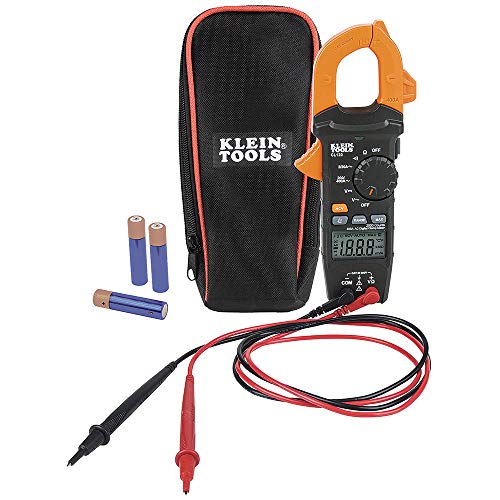
| Klein Tools CL800 (600A AC/DC) | 600A AC / 600A DC | 37 mm (1.45 in) | +/- 2.0% + 9 digits | CAT III 600V / CAT IV 300V | True-RMS, low impedance (LoZ), thermocouple temp | usually $120–$180 |
| Fieldpiece SC680 (400A AC/DC) | 400A AC / 400A DC | 32 mm (1.26 in) | +/- 2.0% + 4 digits | CAT III 600V | True-RMS, inrush, DC microamps, dual display | usually $200–$280 |
| Amprobe AMP-330 (1000A AC / 1000A DC) | 1000A AC / 1000A DC | 51 mm (2.01 in) | +/- 1.9% + 10 digits | CAT III 1000V / CAT IV 600V | True-RMS, large jaw for 750 kcmil conductors, non-contact voltage | usually $250–$400 |
Jaw opening directly impacts accuracy. If the jaw cannot fully close, the reading will drift or show OL. For residential 200A service with 2/0 or 4/0 copper, a 30-32mm jaw is sufficient. For commercial 400A panels with parallel 250-500 kcmil or busbar, you need 34mm minimum and ideally 51-58mm or an iFlexble current probe accessory.
Top Picks by Situation
Best Overall for Professional Electrical Testing: Fluke 376 FC
Choose the 376 FC when accuracy at high current and documentation matter. Its 1000A AC/DC range covers service verification, motor inrush, and solar/battery DC without a second meter, and it maintains +/- 2.0% accuracy up to 1000A. The included iFlex probe lets you measure around two or three bundled conductors in tight wireways where a rigid jaw will not fit, while keeping the same True-RMS core. The CAT III 1000V / CAT IV 600V rating is the right level for working at the service entrance, where transient voltage is highest. Use the low-pass filter when testing VFD-driven motors to avoid artificially high voltage readings.
Best for Residential and Light Commercial: Fluke 325
The 325 is the accuracy sweet spot for most home and small business work. 400A covers 100A-200A residential panels, 15-60A HVAC and appliance circuits, and typical 5-20A branch troubleshooting with 0.1A resolution. True-RMS and DC current allow you to check furnace control boards and 24V DC circuits accurately. Its compact 30mm jaw is easier to isolate a single NM-B or THHN conductor in a crowded residential panel where a large-jaw meter forces you to move live conductors. Trade-off: it is not ideal for 400A+ commercial feeders or large paralleled conductors.
Best Value with Strong HVAC Features: Klein Tools CL800
The CL800 gives True-RMS accuracy comparable to higher-priced meters but adds electrician-friendly features at a lower cost. 600A AC/DC handles most residential and commercial feeders, and the 37mm jaw is larger than many 400A-class meters. LoZ voltage mode prevents ghost voltages from giving false positive readings on disconnected wires, a common source of diagnostic errors. It also includes temperature with a K-type thermocouple, capacitance for motor capacitors, and diode test, so you can verify a 35/5 uF dual capacitor or a 107F delta-T without a second meter. CAT III 600V is adequate for distribution panels but not for utility-level outdoor service.
Best for HVACR Technicians: Fieldpiece SC680
For air conditioning, heat pump, and furnace work, accuracy on low DC microamps and inrush current is more important than 1000A range. The SC680 reads DC microamps to 0.1 uA for flame sensor proof (typically 1-10 uA), measures 400A with inrush capture to see locked-rotor amps (LRA) on compressors, and includes True-RMS, temperature, and capacitance. The swivel magnetic hanger and bright dual display improve readability when the panel is above your head or in a dark attic air handler. It is optimized for recurring HVAC measurements rather than high-current industrial feeders.
Best for Large Conductors and Industrial: Amprobe AMP-330
When you regularly work around 400-1000 kcmil, twin 250 kcmil, or busbar in switchgear, jaw size is the limiting factor for accuracy. The AMP-330’s 51mm opening lets you fully enclose conductors that 30-34mm jaws cannot without forcing insulation, which can create a gap and error. It still delivers True-RMS with +/- 1.9% AC accuracy and CAT III 1000V / CAT IV 600V protection for industrial environments. It is heavier and larger than compact residential meters, so it is less nimble in crowded 14×28 inch residential panels.
Decision Matrix: Match Your Work to the Right Clamp Meter
| Your Primary Situation | Jaw and Range You Need | Best Fit Type | Why |
|---|---|---|---|
| Homeowner, DIY, or apprentice checking panels, outlets, appliances | 30-32mm jaw, 400A AC/DC | 400A True-RMS compact (like Fluke 325 or Klein CL390) | Enough range for 200A service checks, fits crowded residential panels, simpler to read |
| Residential electrician and remodel contractor | 34-37mm jaw, 600A AC/DC | 600A True-RMS with LoZ (like Klein CL800) | Handles 200A service plus 30-60A HVAC without maxing out, LoZ avoids false voltage |
| HVAC/R service tech | 32mm jaw, 400A with inrush + DC microamps | HVAC-focused clamp (like Fieldpiece SC680) | Inrush for compressor LRA and microamp DC for flame sensors are critical features |
| Commercial / industrial electrician, solar and battery storage | 34-51mm jaw + iFlex, 1000A AC/DC | 1000A True-RMS with VFD filter (like Fluke 376 FC or Amprobe AMP-330) | 1000A DC for solar strings and batteries, large jaw or flexible probe for paralleled feeders |
| Small apartment or mobile service bag where space is limited | 30mm jaw, fork or mini-clamp possible | Compact 200A-400A clamp (like Klein CL120 or Milwaukee 2235-20) | Smaller body fits in a crowded tool pouch; accept lower max current for portability |
Safety, Readability, and Features That Protect Accuracy
Accuracy means little if the reading is hard to see or unsafe.
- CAT rating real trade-off: CAT III 600V meters are fine for branch circuits and distribution panels inside the building. If you test at the meter base, main disconnect outside, or a 480V service, use CAT III 1000V / CAT IV 600V. A lower CAT rating does not just void warranty, it cannot handle the transient surge energy at that location.
- Display readability: Look for 4000-6000 count displays with backlight, hold, and min/max. Dual displays that show amps and voltage simultaneously reduce the chance of recording the wrong value when you must reach and read at arm’s length. High-contrast LCDs with 0.5 inch+ digits are readable at 3-4 feet in a dim utility room.
- Lead placement and burden: For low current under 2A, center the conductor in the jaw and keep other current-carrying conductors at least 1 inch away from the jaw edge. Separating the conductor from the bundle by 2-3 inches improves accuracy by 1-2%.
- Working clearance: Standard residential load centers are often 14 inches wide by 28-30 inches tall. You need 6-8 inches of clearance in front of the dead front for the meter body plus 3 inches of wire bend space to isolate a conductor. Flexible current probes need only 1 inch of pass-through space and are safer when you cannot isolate a feeder.
- What wears first: On clamp meters, the jaw hinge spring and jaw face alignment wear first from drops, followed by lead jacks and the rotary dial. A meter in a rugged housing with independent jaw calibration holds its factory accuracy longer than a lightweight housing without drop protection. Store with jaws closed and leads detached.
How to Get the Most Accurate Reading Every Time
Follow this sequence in a live panel:
- Verify CAT rating matches the location (service entrance = CAT IV).
- Zero the meter in DC current mode away from magnetic fields before clamping.
- Isolate a single conductor, center it in the jaw, and fully close the jaw with no gap.
- Select True-RMS and, if testing a drive or inverter, enable low-pass filter.
- Use inrush mode for motor start current; allow 3-5 seconds after startup for a stable running current reading.
- Record min/max over 30 seconds for fluctuating loads like heat pumps and air handlers.
FAQ
Do I need AC and DC current?
If you only work on standard AC residential wiring, AC-only is enough. If you test solar, battery storage, EV chargers, or furnace control boards, you need AC/DC. Measuring DC on an AC-only clamp will read zero.
Is a 400A clamp meter enough for a 200A service?
Yes. A 400A meter gives headroom above 200A for inrush and short-term loads. You need 600A-1000A only if you measure 400A services, paralleled feeders, or commercial 480V loads.
What accuracy is considered good?
For field electrical work, +/- 1.9% to +/- 2.5% for AC current from 5A to 400A is considered professional grade. Below 1A, expect +/- 2.5% to +/- 3.5%. True-RMS is more important than a 0.5% difference in spec sheet accuracy.
When should I use a flexible current probe instead of jaws?
Use a flexible probe when conductors are too large for the jaw, when two conductors are bundled and cannot be safely separated, or when you need to measure in a tight wireway with less than 2 inches of clearance around the conductor.