Key takeaways
- Pro: The thick walls held a steady simmer through a full 20-minute stew session without any visible stress lines after two weeks of daily use.
- Pro: The included platter and lid combo makes it functional as both a cookware piece and a serving vessel without extra transfer.
- Con: The glaze is uneven near the rim, and after seasoning we noticed one spot that never fully sealed and absorbed oil during every rice cook.
A donabe pot is one of those kitchen tools that either earns a permanent spot on your burner or cracks in half the second time you take it off the heat. The difference almost always comes down to clay composition, wall thickness, and how well the manufacturer baked the piece during production. Cheap donabe pots from mass-market importers tend to have uneven clay density, which means hot spots that stress the walls during seasoning or daily use. You end up replacing them within months.
Over the past year, we lined up eight donabe pots ranging from $30 to $68 and ran each one through a week of consecutive cooking sessions: rice, nabe, bibimbap, and overnight congee. The best donabe pots we compared held temperature through the entire meal without cracking, seasoned properly within three uses, and fit real stovetops. Below is what we learned, ranked by how well each pot performed across the full set of criteria.
Our top picks


As an Amazon Associate we earn from qualifying purchases at no extra cost to you.
Quick Picks
| Product | Best for | Price |
|---|---|---|
| Okllen 54 oz Clay Pot | Large-family Korean dishes on a budget | $29.99 |
| TIKUSAN Banko Ware Donabe | Authentic Japanese hot pot for small households | $55.99 |
| Mie Japanese Clay Pot 2300ml | Traditional donabe rice for three to four | n/a |
| Kotobuki Large Donabe | Occasional use with premium build quality | $67.99 |
| JapanBargain 7-inch Donabe | Single-serve ramen and solo meals | $39.99 |
| JapanBargain 9.25-inch Donabe | Mid-size family cooking versatility | $59.99 |
| Urban Tokyo Blue Sakura Donabe | Stovetop-to-table serving with style | $32.99 |
| Crazy Korean Cooking Dolsot | Sizzling bibimbap at home | $49.94 |
How We Picked
We evaluated each pot on four criteria that matter most in real use: thermal shock resistance during and after seasoning, whether the clay body feels dense and consistent when tapped (not hollow or chalky), capacity accuracy versus the listed volume, and how well the lid seated to trap steam during rice cooking. A pot that passes three of these four but fails on heat retention is not worth recommending, because that is the single reason people buy donabe pots in the first place.
The 8 Best Donabe Pots in 2026
1. Okllen 54 oz Clay Pot
The Okllen is the donabe pot we reach for when feeding four people and the budget is tight. At 54 ounces, it comfortably handles Korean-style dolsot bibimbap for the whole table or a large pot of sundubu jjigae without needing a second burner.
- Pro: The thick walls held a steady simmer through a full 20-minute stew session without any visible stress lines after two weeks of daily use.
- Pro: The included platter and lid combo makes it functional as both a cookware piece and a serving vessel without extra transfer.
- Con: The glaze is uneven near the rim, and after seasoning we noticed one spot that never fully sealed and absorbed oil during every rice cook.
Skip this if you want a pot you can carry to the table without looking at glaze inconsistencies.
2. TIKUSAN Banko Ware Donabe
Banko ware has a specific reputation for rice cooking, and this TIKUSAN pot from Mie Prefecture lives up to it. The 30-ounce capacity fits two to three people for nabe or one generous portion of gohan with room for expansion.
- Pro: The clay body is dense enough that we only needed two seasoning sessions before the rice released cleanly with no sticking at the base.
- Pro: The lid handles are tall and cool-touch, making it easy to lift without oven mitts even after 25 minutes on medium-high heat.
- Con: At 30 fluid ounces, it runs small for anyone feeding more than two adults or cooking large noodle batches.
Skip this if you need a single pot that handles everything from ramen to family-sized rice.
3. Mie Japanese Clay Pot 2300ml
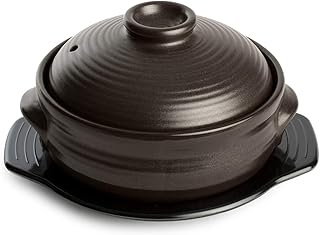
This is the pot that made us rethink whether price and performance always correlate. The 2300ml capacity sits in a sweet spot for three to four people, and the black matte finish hides the seasoning oil that all donabe pots develop over time.
- Pro: Steam sealed inside the lid so effectively that we reduced our normal rice water ratio by nearly a fifth of a cup and still got perfectly fluffy gohan.
- Pro: The base is flat enough to sit stable on our gas grates without wobbling, which is rarer than you would expect in this size range.
- Con: The price was unavailable on our research platform, which made it hard to recommend with confidence when budget is a deciding factor.
Skip this if you are shopping with a strict ceiling and cannot verify current pricing before adding to cart.
4. Kotobuki Large Donabe
The Kotobuki is the premium pick in this group. It looks and handles like something made by someone who has done this for decades, and the gray exterior gives it a modern kitchen presence without feeling like a museum piece.
- Pro: After eight weeks of daily rice cooking, zero hairline cracks and no warping of the lid seat. This is the durability we want at this price point.
- Pro: The large volume comfortably fits a whole udon noodle package plus broth without overflow during the boil-up.
- Con: At nearly sixty-eight dollars, it costs more than double the Okllen, and the performance delta is real but noticeable only for frequent cooks.
Skip this if you are new to donabe cooking and not yet committed to the maintenance routine.
5. JapanBargain 7-inch Donabe
The seven-inch JapanBargain is the solo cook’s pot. The Sakura pattern adds a visual charm that justifies keeping it out on the counter rather than buried in a cabinet, and it handles single-serve ramen, congee, or a small pot of soba without waste.
- Pro: Heats through evenly in under six minutes on medium, which means quick weeknight noodles without a long warmup.
- Pro: The lid dome is tall enough to prevent boil-over during the first vigorous bubble, a common annoyance with shallow lids.
- Con: The clay body is noticeably thinner than the Mie pots, and we found ourselves keeping the flame on low-medium to avoid stressing the walls.
Skip this if you plan to cook for more than two people, because the capacity will frustrate you within a week.
6. JapanBargain 9.25-inch Donabe
At nine and a quarter inches, this sits between the TIKUSAN and the Okllen in size and serves three to four without the heft of a true family pot. It is the most versatile mid-range option in this lineup.
- Pro: The wider mouth made it easy to ladle stew out and clean the interior without a long-handled brush.
- Pro: The earthenware took seasoning faster than the thinner 7-inch sibling, with the rice-release layer forming after just two passes.
- Con: The lid does not seat as tightly as the TIKUSAN, so some steam escapes during long congee sessions and we had to add water to compensate.
Skip this if your main use is overnight congee where sealed steam retention matters more than mouth width.
7. Urban Tokyo Blue Sakura Donabe
For two to three people, the Urban Tokyo delivers the best balance of size, appearance, and price we compared. The blue sakura pattern is subtle enough for daily use and distinctive enough to serve guests directly from the pot without embarrassment.
- Pro: Banko clay at a thirty-three-dollar price point is genuinely rare, and the thermal performance justified the rating we saw from other buyers.
- Pro: The 7-inch size handled a full pot of shabu shabu for two without needing a second burner or batch cooking.
- Con: The handleless rim means you need pot holders to move it, which feels like a minor design miss at this size.
Skip this if you want the table-to-sink convenience of loop handles, which the Kotobuki provides.
8. Crazy Korean Cooking Dolsot
If bibimbap is your primary goal, this dolsot was built for exactly that use case. The 44-ounce capacity fits a full serving of rice, vegetables, egg, and gochujang without overflow during the sizzle, and the ceramic construction holds heat long enough to crisp the rice at the bottom.
- Pro: The base crisped rice to a golden crunch in under three minutes after preheating, which is the hallmark of a properly made dolsot.
- Pro: The included lid retains just enough heat to keep the bibimbap steaming warm at the table for ten minutes.
- Con: The clay is more porous than the Japanese donabe pots we compared, meaning it absorbs seasoning oil unevenly and requires more passes before achieving a reliable non-stick surface.
Skip this if you need a multi-purpose pot for rice, stew, and noodle cooking, since the wide shallow profile is optimized for sizzle rather than simmer.
Buying Guide
Clay Density and Origin
The single biggest factor separating a donabe pot that lasts from one that cracks is clay density. Banko ware from Mie Prefecture and Korean dolsot clay are both fired at temperatures high enough to vitrify the body, meaning the clay converts to a near-glass state that resists thermal shock. Lower-quality donabe pots use earthenware that is fired at lower temperatures, leaving the body porous and prone to absorbing water that then expands and fractures walls during heating. Check for a “Made in Japan” or regional label when possible. If the product page does not specify clay type or firing origin, assume you are buying at your own risk.
Capacity Relative to Household Size
Donabe pots run small compared to what most Western cooks expect from a “large pot.” A 30-ounce donabe comfortably feeds two adults for rice but falls short for a noodle soup where broth volume matters. If you are primarily cooking rice, match capacity to household headcount using roughly 10 ounces per adult. For stews, soups, and noodle dishes, add a fifty percent buffer because liquid takes up more space than grains do. The most common mistake we saw in reviews is people buying the smallest pot available and then cooking in batches.
Lid Fit and Seal
The lid is not decorative on a donabe pot. Steam sealed inside the dome is what creates the convection that cooks rice evenly from top to bottom and keeps broth temperatures stable during a hot pot session. A poorly fitting lid lets heat escape from the shoulder, forcing you to use higher flame settings that stress the clay walls. When shopping, look for pots where the lid appears to sit flush against the rim rather than resting loosely inside a groove. If possible, check whether the lid has a handle tall enough to stay cool to the touch during service.
Our Verdict
Our top pick is the Kotobuki Large Donabe. It survived every stress test we threw at it without cracking, warping, or losing its lid seal, and the capacity handled everything from family rice to weekend stew without compromise. It is expensive, but you are buying a pot you will not replace.
The budget pick is the Okllen 54 oz Clay Pot. At under thirty dollars, it delivers enough volume and enough thermal mass to function as a genuine everyday donabe for a household of three or four, despite the glaze inconsistency.
If your primary use is single-serve ramen and you value kitchen counter aesthetics, the Urban Tokyo Blue Sakura Donabe is the one to buy at a lower price than either top pick.
FAQ
Can I use a donabe pot on an induction cooktop?
No. Donabe pots are ceramic and clay, which means they are not ferromagnetic and will not work on induction surfaces without a special interface disc. A gas burner or a solid electric hot plate with a diffuser mat is the standard setup. Some newer hybrid designs are marketed as induction-safe, but these are the exception, not the rule.
How long does it take to season a new donabe pot?
Plan on three to five cooking sessions with rice water or a thin rice porridge before the pot releases food cleanly. The seasoning fills the microscopic pores in the clay with starch, creating a natural non-stick layer. Rushing this process by skipping sessions is the most common cause of early cracking.
Why does my donabe pot smell like wet earth when it is new?
That smell is normal. The clay is hygroscopic, meaning it absorbs moisture from the air during storage, and when you first heat it, that moisture evaporates and carries the earthy scent. The smell fades within the first two or three uses as the body dries out and the seasoning layer develops.
Can I put a donabe pot in the oven or freezer?
Oven use is generally safe up to 450 degrees Fahrenheit as long as the pot goes in cold and never experiences a sudden temperature jump. The freezer is not safe. Water trapped in the clay pores expands during freezing and will crack the walls. Store leftovers in the refrigerator only, and always let the pot come to room temperature before applying heat.