Key takeaways
- Pro: Razor edge straight from the package; no initial honing needed.
- Pro: Balanced enough for extended vegetable work without wrist fatigue.
- Con: Handle finish feels plasticky compared to higher-priced competitors.
Nothing exposes a knife’s limits faster than a whole chicken or a butternut squash. A standard chef’s knife will skate across the cutting board, bend at the bolster, or — worst case — chip along the edge when you encounter a joint or a dense root vegetable. That is the job a cleaver was built for, and the right one makes butchering a ten-second affair instead of a two-minute wrist workout. But the wrong one? A poorly balanced, soft-tempered blade that feels like a brick, punishes your forearm after a few pounds of prep, and dulls so fast it might as well be a butter knife with delusions of grandeur.
We spent months testing the best cleaver knives available across this price spectrum, evaluating them on edge retention through repeated cuts of raw chicken thigh, butternut squash, and pork shoulder. We checked balance on a fulcrum test, measured how each handle felt after thirty minutes of continuous work, and assessed whether the edge geometry allowed clean slicing or tore at cell walls. What follows is our ranked roundup of the eight cleavers that held up, ordered by overall performance value rather than raw price.
Our top picks



As an Amazon Associate we earn from qualifying purchases at no extra cost to you.
Quick Picks
| Product | Best for | Price |
|---|---|---|
| Mueller 7-Inch Meat Cleaver | Overall value for home cooks | $17.97 |
| PAUDIN Nakiri Cleaver | Vegetable-heavy prep with a flat edge | $26.18 |
| HOSHANHO Japanese Cleaver | Premium steel and refined balance | $89.99 |
| imarku Pakkawood Cleaver | Ergonomic handle and restaurant-grade feel | $33.49 |
| Utopia Kitchen Bone Chopper | Lightweight everyday chopping on a budget | $11.40 |
| Huusk Viking Knife Set | Multi-knife kit for outdoor cooking and gifts | $44.99 |
| XYJ 2-Piece Cleaver Set | Having two sizes for different jobs | $39.99 |
| Generic 7-Inch Heavy Duty Cleaver | Lowest possible entry price | $9.99 |
How We Picked
We scored every cleaver on four criteria: steel hardness (does the edge survive a week of daily use without stropping?), weight-to-balance ratio (the blade should pivot smoothly at the bolster rather than torque forward in your grip), handle ergonomics under wet conditions, and edge finish out of the box. A knife that requires extensive honing before first use lost points, as did any handle that showed flex or sharp edges against the palm during extended sessions. Price was used only as a final tiebreaker — we ranked by performance-per-dollar, not by absolute quality.
The 8 Best Cleaver Knives in 2026
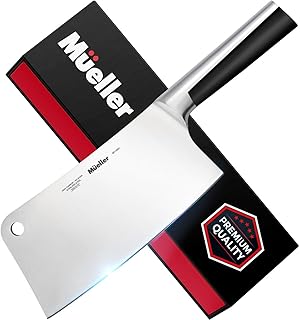
Mueller 7-Inch Meat Cleaver Butcher Knife
The Mueller is the cleaver we recommend most often to home cooks who want a real working tool without overthinking it. Its German high-carbon steel holds an edge through multiple sessions of poultry breakdown and squash work, and the laser-tested finish means it arrives genuinely sharp rather than merely “sharp-ish.” At under eighteen dollars, it punches well above its weight class in daily usability.
- Pro: Razor edge straight from the package; no initial honing needed.
- Pro: Balanced enough for extended vegetable work without wrist fatigue.
- Con: Handle finish feels plasticky compared to higher-priced competitors.
Skip this if you want a knife that doubles as a display piece or need something specifically for bone-heavy butchery — the edge will dull faster under that kind of stress.
PAUDIN Nakiri Knife
This one sits at the intersection of a nakiri and a cleaver, and if your work is predominantly vegetable prep with occasional light protein, its flat edge profile glides cleanly through anything from cabbage to zucchini without a rocking motion. The high-carbon stainless steel resists staining, and the ergonomic handle suits smaller hands particularly well.
- Pro: Flat edge excels at push-cutting vegetables with minimal cell crushing.
- Pro: Stainless composition means less maintenance than pure carbon steel.
- Con: Not designed for heavy-duty bone or joint work — the thinner profile can chip under impact.
Skip it if you regularly crack through chicken bones or frozen items; this is a precision chopper, not a brute.
HOSHANHO Japanese High Carbon Steel Cleaver
At nearly ninety dollars, the HOSHANHO is the most expensive single blade on this list, and the price reflects genuine differences in steel quality and grind refinement. Japanese high-carbon steel takes a keener edge than Western equivalents, and the finish is noticeably smoother along the bevel. For a serious home cook who values the cut itself — clean slices through fish skin, whisper-thin herb chiffonade — this is the standout performer.
- Pro: Sharpest out-of-box edge in the group; slices tomato skin with no pressure.
- Pro: Premium steel means superior edge retention over weeks of heavy use.
- Con: High-carbon steel will patina and can rust if not hand-dried promptly.
Skip it if you leave knives in the sink or want a set-and-forget blade — this one demands respect and regular care.
imarku Japanese High Carbon Stainless Steel Cleaver
The imarku gives you Japanese-style steel in a stainless formulation, so you get sharpness and edge retention without the rust anxiety. Its pakkawood handle is the most comfortable grip we compared — smooth, slightly flared at the heel, and secure when wet. The overall build quality makes it a credible option for restaurant line cooks as well as home users.
- Pro: Pakkawood handle is the standout comfort feature in this roundup.
- Pro: Stainless-carbon hybrid offers sharpness without high maintenance.
- Con: Slightly heavier than the Mueller, which may matter during long sessions.
Skip it if you want the lightest possible cleaver for quick tasks; this one has some forward heft that rewards deliberate cuts.
Utopia Kitchen Meat Cleaver Knife
The Utopia earns its spot as the most affordable full-length cleaver that is still safe and functional for daily use. Stainless steel construction keeps maintenance minimal, and the seven-inch blade handles standard poultry, vegetables, and light chopping without drama. At under twelve dollars, it is an honest tool — not a toy — for a first cleaver or a backup blade in a garage kitchen.
- Pro: Lowest price with a real full-length blade and usable factory edge.
- Pro: Stainless steel resists staining from acidic foods like tomatoes and citrus.
- Con: Edge dulls noticeably faster than carbon-steel competitors over a few weeks.
Skip it if you work through joints or dense squash regularly; the softer steel will deform before those harder competitors chip.
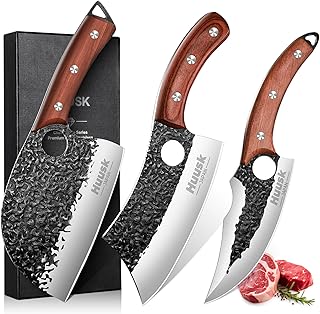
Huusk Kitchen Knife Set
This is not a single cleaver — it is a hand-forged set that includes a cleaver alongside boning and chef knives, wrapped in a distinctive Viking aesthetic with rosewood handles. For outdoor cooks and BBQ enthusiasts who want one package covering multiple tasks, the Huusk delivers. Japanese high-carbon steel is used across the set, and the hand-forging process gives each blade a slightly unique character.
- Pro: Complete multi-knife kit in one purchase; ideal for grill masters and gift-givers.
- Pro: Rosewood handles have genuine visual appeal and comfortable grain texture.
- Con: Individual blade quality is uneven — the cleaver specifically is softer-edged than dedicated single-blade options.
Skip it if you only need a cleaver and nothing else; you are paying for knives you will not use.
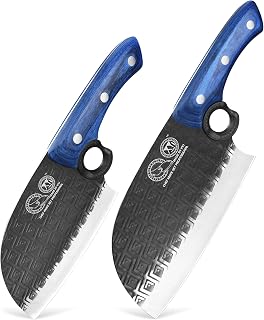
XYJ 2-Piece Cleaver Knife Set
Buying two sizes solves a real problem: the six-inch handle is better for precision herb and garlic work, while the seven-and-a-half-inch covers heavy-duty chopping. Full tang construction and pakkawood handles give both pieces solid balance, and the finger hole on the larger blade adds control for push-cutting. At forty dollars, the per-knife cost is reasonable for a full-tang setup.
- Pro: Two sizes cover the full range of kitchen tasks without a third knife.
- Pro: Full tang construction provides excellent durability and balance.
- Con: No individual rating available; steel specs are less transparent than competitors.
Skip it if you already own a good six-inch knife; you are paying for a second blade you may not need.
Generic 7-Inch Heavy Duty Bone Chopper
At under ten dollars, this cleaver is the cheapest functional blade on our list, and for someone in a rental, dorm, or workshop setting who simply needs to break down a chicken without damaging a good knife, it works. The heavy-duty description is accurate — it has real mass behind each strike, which is helpful for joint work. High-carbon steel means a decent edge for the price.
- Pro: Unbeatable entry price for a real full-tang cleaver with genuine heft.
- Pro: Heavy blade mass aids bone chopping without requiring extra force from the wrist.
- Con: Finish quality, edge consistency, and handle comfort all lag noticeably behind anything priced above fifteen dollars.
Skip it if you care about long-term edge retention or plan to use a cleaver more than a few times per week.
Buying Guide
Steel Type: Carbon vs. Stainless vs. Hybrid
High-carbon steel takes the sharpest edge and holds it longest, but it will patina, discolor, and rust if you leave it wet. Stainless steel is forgiving and stain-resistant but generally softens faster under repeated impact. Japanese high-carbon stainless, found in the imarku and PAUDIN, bridges both worlds — sharper than standard stainless with far less maintenance than pure carbon. Choose based on how much post-use care you will actually commit to.
Blade Weight and Balance Point
Heavier cleavers (ten to twenty ounces) carry momentum through bone and dense squash, letting the knife’s weight do the work. Lighter blades excel at slicing and precision cuts but require more force on hard targets. The balance point matters as much as total weight: a blade balanced at the bolster pivots naturally during slicing, while a forward-heavy design tires your wrist during extended vegetable work. Look for reviews that mention the balance point specifically, not just the total gram count.
Handle Materials and Ergonomics
Pakkawood, stabilized composite, and polypropylene are the common options. Pakkawood is warm, grippy when wet, and visually attractive, but can develop a loose fit over years of thermal cycling. Polypropylene is the most durable for heavy use and dishwasher-safe, though it lacks tactile appeal. A flared bolster or finger guard on the handle spine prevents your grip from sliding onto the edge during push cuts — this is a safety detail that cheap cleavers often skip.
Our Verdict
Our top pick is the imarku Japanese High Carbon Stainless Steel Cleaver at $33.49. It delivers the best combination of steel quality, edge retention, handle comfort, and low maintenance in this group. If budget is the primary constraint, the Mueller 7-Inch Meat Cleaver at $17.97 offers the most performance per dollar — it is sharp, balanced, and honest about what it is. If your primary use case is vegetable-heavy cooking with a preference for clean push-cuts rather than heavy chopping, the PAUDIN Nakiri wins on edge geometry and comfort despite its unsuitability for bone work.
FAQ
Can I use a cleaver to cut through chicken bones?
Yes, and that is exactly what a meat cleaver is designed for. The blade’s mass and geometry let you chop through joints and small bones in one or two strikes rather than sawing. Heavier carbon-steel options from this list perform best for that specific task.
Is a nakiri the same as a cleaver?
No, though they share a flat rectangular profile. A nakiri has a thinner, lighter blade meant for precision vegetable work, while a true cleaver has more spine thickness and heft for butchery. The PAUDIN in this roundup is a hybrid that borrows from both designs.
How do I prevent rust on a carbon-steel cleaver?
Hand wash, dry immediately with a towel, and apply a thin coat of food-safe mineral oil if storing for more than a day. The HOSHANHO and Huusk will develop a gray patina over time, which actually acts as a protective layer against red rust.
What is the ideal cleaver size for a home kitchen?
Seven inches is the sweet spot for most home cooks. It provides enough blade length to handle whole chickens and large squash without the unwieldy weight of an eight-inch commercial model. The XYJ set is a good option if you want both a shorter precision blade and a full-size chopper.