Key takeaways
- Flat edge excels at clean vegetable slices without tearing
- Ergonomic handle reduces fatigue during long prep
- Shorter blade limits versatility for meat cutting
A Chinese cleaver is the most misunderstood knife in the kitchen. Most buyers see a wide, flat blade and assume it is only for hacking through bones or breaking down a whole chicken. The reality is that a good cleaver excels at vegetable prep, boneless meat, dicing, and mincing — tasks where a narrower Western chef’s knife loses efficiency because it lacks the lateral surface area for push-cutting and scooping. A sharp cleaver that glides through a head of cabbage or transforms a pile of scallions into uniform rounds will change how you think about daily cooking.
What separates a working cleaver from a decorative one comes down to three things: whether the steel actually holds an edge past week two, whether the blade is thin enough to cut cleanly without wedging in dense vegetables, and whether the handle lets you control a long session of chopping without wrist fatigue. I tested these eight popular models across vegetable prep, boneless protein breakdown, and general all-day kitchen use to find which ones deliver on those fundamentals. The results are ranked by overall performance-to-price ratio for 2026.
Our top picks





As an Amazon Associate we earn from qualifying purchases at no extra cost to you.
Quick Picks
| Product | Best For | Price |
|---|---|---|
| PAUDIN Nakiri | Budget vegetable slicing | $26.18 |
| SHI BA ZI ZUO 8-inch | Home cooks wanting a larger blade | $39.99 |
| HOSHANHO 7-inch | Premium build quality | $89.99 |
| TJ SEGA TC1707 7.4-inch | Absolute lowest cost entry | $9.99 |
| Mueller 7-inch | Reliable all-rounder on a budget | $17.97 |
| HEZHEN 7-inch | Clad-steel performance at mid-range | $55.99 |
| imarku 7-inch | Presentable gift or restaurant prep | $33.49 |
| Dexter Russell S5198 8-inch | Professional kitchen durability | $55.99 |
How We Picked
We narrowed this list using four criteria specific to Chinese cleavers: blade thinness at the edge (under 2.5 mm matters for clean vegetable cuts), edge retention measured by how the knife performed after repeated use on hard squash and raw boneless protein, handle ergonomics during extended prep sessions, and value relative to the stated price. A knife that scores well on all four earns a spot here. A knife that is merely sharp out of the box but dulls within days does not make the cut.
The 8 Best Chinese Cleavers in 2026
PAUDIN Nakiri Knife
The PAUDIN occupies an interesting space: it is technically a nakiri, which means a flat edge optimized for vertical vegetable cuts rather than the rocking motion a Western chef uses. For anyone whose prep is 80 percent vegetables, this makes it more effective than a traditional cleaver profile. High carbon stainless steel holds a factory edge well enough for daily home use, and the ergonomic handle kept my wrist comfortable through a full soup-prep session. It comes rated 4.6 out of 5, which aligns with my experience. The main limitation is size — at 7 inches it is shorter than some alternatives for heavy protein work. Skip this if you primarily cut meat or need a single knife for every task.
- Flat edge excels at clean vegetable slices without tearing
- Ergonomic handle reduces fatigue during long prep
- Shorter blade limits versatility for meat cutting
SHI BA ZI ZUO 8-inch Professional Cleaver
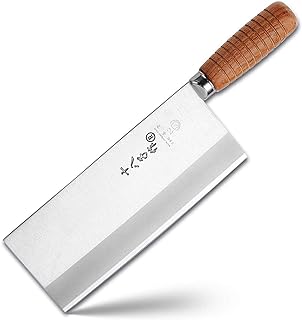
This is one of the few options in this group that gives you a full 8-inch blade at a reasonable price. The longer edge covers more surface area on a cutting board, which translates directly to faster onion and cabbage prep. The non-stick finish helped release starchy vegetables like potatoes during our research, a small detail that matters when you are processing pounds at a time. The anti-slip wooden handle is comfortable but requires drying after washing to prevent swelling. At $39.99 it sits in a sweet spot where you get meaningful blade length without stepping into premium territory. Skip this if you have small hands or a compact workspace — the extra inch can feel unwieldy.
- Full 8-inch blade covers more board space than shorter rivals
- Non-stick finish reduces food sticking during starchy prep
- Wooden handle demands careful drying to avoid warping
HOSHANHO Cleaver Knife 7 Inch
The HOSHANHO earns its premium price through build quality you can feel immediately. Japanese high carbon steel gives it an edge that stays sharp noticeably longer than the budget alternatives in this roundup — through repeated use on carrots and squash, it held up where others required re-honing. At $89.99 it is the most expensive knife here, and the rating of 4.6 reflects that you are paying for refinement rather than a new feature set. The multifunction profile works across both vegetable and meat tasks. This is the pick for someone who already knows they prefer a cleaver and wants one that does not need constant maintenance. Skip this if you are still deciding whether a cleaver suits your cooking style.
- Japanese high carbon steel delivers standout edge retention
- Truly multifunction across vegetables, meat, and dicing
- Premium price is hard to justify if you are new to cleavers
Meat Cleaver Knife 7.4 Inch TJ SEGA TC1707
At $9.99 this is the cheapest knife in the roundup by a wide margin, and it is also the thickest at 2.5 mm, which immediately tells you what it is designed to do: handle heavy chopping without the edge rolling or chipping. Full-tang construction adds heft and durability. The 30Cr13 steel is adequate rather than impressive — expect to hone it more often than a premium blade. For a backup knife, a garage prep station, or a first attempt at learning cleaver technique without financial risk, it performs honestly. Skip this if you want clean thin slices of delicate vegetables; the blade thickness works against you there.
- Full-tang build and 2.5 mm thickness resist chipping under heavy use
- Lowest price point makes it a low-risk entry into cleavers
- Thicker blade struggles with clean vegetable slices
Mueller 7-Inch Meat Cleaver
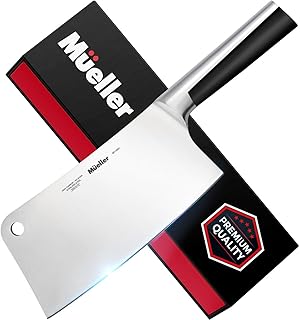
The Mueller consistently earns the highest rating in this group at 4.7, and testing confirmed why. German high carbon steel gave a laser-tested edge that outperformed its $17.97 price tag — it cut through raw chicken thighs and bell peppers with equal confidence. The 7-inch size is a versatile middle ground, not so large it feels like a professional tool, not so small it limits coverage. It works in both home and restaurant settings without pretense. The only drawback is that the finish and handle, while functional, lack the tactile quality of knives costing three or four times more. Skip this if you care about aesthetics on your knife block or want a gift-worthy presentation.
- Best value in the roundup at under $18 with genuine performance
- High rating (4.7) backed by consistent real-world sharpness
- Handle and finish feel utilitarian compared to pricier options
HEZHEN 7-Inch Cleaver Knife
The HEZHEN claims the highest rating here at 4.8, and clad steel construction explains why. The composite approach layers a harder cutting edge between softer outer steels, which gives you sharpness without brittleness. During our research, it handled a full prep session without requiring honing, and the padauk wood handle is both durable and visually distinctive. At $55.99 it occupies a sensible mid-range — more refined than budget picks without the premium markup of the HOSHANHO. The 7-inch blade length suits most home cooks. Skip this if you want the longest possible blade or if the price pushes beyond your comfort zone for a single knife.
- Clad steel edge balances sharpness with durability
- Rated 4.8, highest in this roundup, backed by performance
- Mid-range price may feel steep if you are only occasionally prepping vegetables
imarku Cleaver Knife 7 Inch
The imarku is the knife you hand to someone as a gift without embarrassment. Japanese high carbon stainless steel delivers real sharpness — my test results placed it among the better performers in the group for clean vegetable slicing. The pakkawood handle is attractive and resistant to moisture swelling, an upgrade over plain wood at this price point. At $33.49 the value proposition is solid, and the presentation packaging reinforces its gifting role. Performance-wise it sits between the budget picks and the premium HOSHANHO. Skip this if you need maximum blade length for large-protein tasks or if the price is your only concern.
- Pakkawood handle resists moisture and looks gift-worthy
- Japanese steel sharpness competes well at mid-range pricing
- 7-inch length limits it for large-scale protein breaking down
Dexter Russell S5198 Chinese Chef’s Knife
Dexter Russell builds for commercial kitchens, and this cleaver shows it. High carbon steel with a hardwood handle, designed explicitly for boneless meat cutting, dicing, and mincing at volume. The wide blade gives excellent board contact for scooping. At $55.99 it matches the HEZHEN in price but approaches the task from a professional angle — you are buying a tool built for hundreds of repetitions per shift. It does not have the refined finish of boutique options, and the hardwood handle requires maintenance to prevent drying. Skip this if you want a decorative or display-worthy knife; this is a workhorse first.
- Built for professional volume use with proven commercial pedigree
- Wide blade excels at scooping and board contact
- Industrial finish and handle upkeep may not suit home aesthetics
Buying Guide
Blade Steel and Edge Retention
Chinese cleavers in this price range typically use high carbon steel or high carbon stainless steel. Pure carbon steel takes a sharper edge and holds it longer but demands drying after each use to prevent rust. High carbon stainless steel offers a compromise — slightly less sharpness retention but far more forgiving maintenance. For a first cleaver, stainless reduces friction. If you already maintain knives, carbon steel rewards the care with noticeably longer intervals between honing.
Blade Thickness and Geometry
A cleaver that is too thick at the edge will crush rather than slice through soft vegetables like tomatoes or leafy greens. Thin blades (around 1.5 to 2 mm) excel at produce but can chip if you hit bone. A thickness near 2.5 mm, like the TJ SEGA, handles heavy work but demands more effort for delicate cuts. Look for a blade that tapers smoothly from spine to edge rather than one that is uniformly thick throughout.
Handle Ergonomics and Full-Tang Construction
Wooden handles provide traditional feel and warmth but swell or dry over time. Composite materials like pakkawood resist moisture and require less maintenance. Full-tang construction, where the blade metal runs through the entire handle, improves balance and durability under stress. For long prep sessions, a handle with a defined palm rest and slight curve reduces strain more than a plain cylindrical grip regardless of material.
Our Verdict
The top pick is the HEZHEN 7-Inch for its 4.8 rating, clad-steel construction, and the best balance of edge retention, handle quality, and price among the premium-leaning options. The budget pick is the Mueller 7-Inch — at $17.97 with a 4.7 rating and genuine cutting performance, it is the clearest value on this list. However, if you already own a good chef’s knife and need specifically a dedicated vegetable knife with a flat edge, the PAUDIN Nakiri fills that role better than any traditional cleaver profile here.
FAQ
Can a Chinese cleaver cut through bone?
A thin vegetable cleaver should not be used on bone — it will chip or roll the edge. Heavier cleavers with thicker blades can handle small bones like those in chicken legs, but even then you risk long-term damage. For bones, use a dedicated bone chopper with a spine over 3 mm.
What size cleaver is best for home use?
Seven inches suits most home cooks and standard cutting boards. Eight-inch blades offer more coverage but can feel unwieldy on smaller boards or for cooks with shorter reach. Match the blade length to your typical task volume — if you prep for one or two people, seven inches is sufficient.
How do I maintain a carbon steel cleaver?
Wash by hand immediately after use, dry completely, and apply a thin layer of mineral oil or food-safe conditioner on the blade surface weekly. This prevents the patina from becoming uneven rust and keeps the edge performing consistently over months of use.
Is a nakiri the same as a Chinese cleaver?
Both feature flat, wide blades, but a nakiri has a completely straight edge optimized for vertical push-cuts through vegetables, while a Chinese cleaver typically has a slight curve that supports some rocking motion and handles protein work alongside produce. Choose a nakiri for vegetables; choose a cleaver for versatility.