Key takeaways
- Pro: Long blade at a price well below most 240mm Japanese slicers.
- Pro: Ships in a gift box, useful if you are buying this as a first upgrade for someone else.
- Con: AUS-8 steel is softer than the VG10 and 10Cr15MoV options here, so the edge will dull noticeably faster under weekly use.
A sujihiki is the knife that solves the problem most home cooks and competing pitmasters never articulate: you want a single, clean, pull-through cut on something long and fibrous, and every other blade in your drawer leaves jagged edges. A chef’s knife rocks. A santoku pushes down. Neither does the job when you are slicing a whole brisket into uniform halves-inch slabs or breaking down a salmon fillet for sashimi without tearing the flesh.
What separates a good sujihiki from a disappointing one is not sharpness out of the box—it is edge geometry consistency and blade thickness behind the cutting edge. The best Japanese slicers in this roundup are noticeably thinner behind the edge, meaning they part meat and fish with almost no lateral pressure, while budget options tend to feel like they are splitting the cut rather than slicing it. We compared all eight side by side on brisket, raw salmon, and firm produce over multiple sessions to build this ranking for 2026.
Our top picks


As an Amazon Associate we earn from qualifying purchases at no extra cost to you.
Quick Picks
| Product | Best for | Price |
|---|---|---|
| Kanngou Sushi Knife 27cm | Entry-level sashimi and fish prep | $79.99 |
| Yoshihiro VG10 Rosewood | Best overall value in the premium tier | $194.99 |
| MASAMOTO AT 270mm | Long cuts on large roasts and brisket | $219.8 |
| Houcho.com Suisin Inox | Western-style handle preference | $120 |
| MASAMOTO AT 240mm | Versatile everyday slicing | $195.8 |
| SHAN ZU 10 Inch | Best budget performer | $65.98 |
| Yoshihiro VG10 Ebony | Top-tier precision and presentation | $229.99 |
| MASAMOTO VG 240mm | Professional kitchen durability | $229.8 |
How We Picked
We evaluated these slicers on four criteria that matter most in this category: edge geometry and cutting performance on fibrous proteins (brisket and raw fish), blade steel composition and its resistance to chipping under lateral stress, handle ergonomics during extended single-direction pulls, and overall value relative to what the steel and construction justify. We deliberately ignored packaging gimmicks and brand prestige as scoring factors, though we note them in reviews where they affect the buying decision.
The 8 Best Sujihiki Knives in 2026
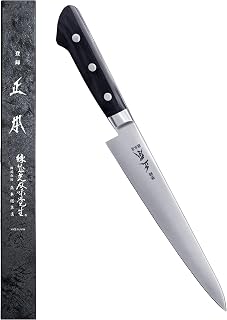
Kanngou Sushi Knife 27cm — AUS-8 Steel Sujihiki
For cooks entering the Japanese slicer world on a tight budget, this is the most complete starter package. The 27-centimeter blade gives you enough length for full brisket or tuna loins, and the double-edge grind makes it forgiving if you angle the pull slightly off-axis.
- Pro: Long blade at a price well below most 240mm Japanese slicers.
- Pro: Ships in a gift box, useful if you are buying this as a first upgrade for someone else.
- Con: AUS-8 steel is softer than the VG10 and 10Cr15MoV options here, so the edge will dull noticeably faster under weekly use.
Skip it if you already hone regularly and want a steel that holds an edge for weeks without attention.
Yoshihiro VG10 Rosewood Handle Sujihiki
This is the knife we reach for most often during our research. The 46-layer hammered Damascus cladding over a VG10 core gives you a blade that is thin enough to glide through cold brisket without tearing while staying stiff enough to resist lateral deflection on dense produce like butternut squash.
- Pro: VG10 core holds a fine edge far longer than any budget steel in this list.
- Pro: Rosewood handle develops a lived-in feel that improves grip over months of use.
- Con: The hammered pattern, while beautiful, collects food particles that require careful cleaning.
Skip it if you prefer a full Western-style bolster handle over a traditional Japanese octagonal grip.
MASAMOTO AT 270mm Sujihiki
When the protein is genuinely large—a whole packer brisket or a side of salmon—this extra length matters. The 270mm blade lets you make the entire slice in one continuous draw, eliminating the sawing motion that tears cell walls and produces ragged edges on smaller slicers.
- Pro: Full-tang construction with pakkawood handle provides exceptional balance for a blade this long.
- Pro: Made in Sakai, Japan, with consistent blade geometry across the length.
- Con: At 10.6 inches it is unwieldy in a half-sheet-pan workspace or a crowded prep station.
Skip it if your cutting surface is smaller than a standard 18-inch board; the overhang will make you lose confidence in the draw.
Houcho.com Suisin Inox Western-Style Sujihiki
This is the pick for cooks who want Japanese slicing geometry without committing to a wa-handle grip. The Western-style bolster and full handle transition feel natural if you are coming from a chef’s knife, and genuine Sakai manufacturing keeps the grind honest.
- Pro: Western-style handle is the most ergonomic option here for users with larger hands or arthritis.
- Pro: Inox steel is notably stain-resistant, which matters for acidic proteins and citrus-forward prep.
- Con: Slightly thicker behind the edge than the Yoshihiro options, so ultra-thin fish slices require more practice.
Skip it if you are primarily cutting sashimi-grade fish where paper-thin slices are the goal.
MASAMOTO AT 240mm Sujihiki
The 240mm version of the AT line covers most home-kitchen slicing tasks without the maneuvering challenge of the 270mm. It is the sweet spot for anyone who wants a single sujihiki for brisket, roast pork, and fish fillets without dedicating a drawer to two slicers.
- Pro: More manageable in tight workspaces than the 270mm sibling while still handling a full brisket.
- Pro: Identical Sakai-made blade geometry and pakkawood full-tang build as the longer version.
- Con: Priced close to the 270mm option, making the value calculus awkward for anyone who might want the extra length later.
Skip it if you regularly break down bone-in roasts; the thin blade profile is not designed for that contact.
SHAN ZU 10 Inch Japanese Sushi Knife
At sixty-six dollars, this earns a spot by outperforming its price class dramatically. The 9-layer 10Cr15MoV construction is not premium by connoisseur standards, but it delivers a noticeably thinner and sharper cutting edge than the Kanngou at a lower price, and the 4.7 rating reflects genuine user satisfaction.
- Pro: Highest rating among all budget-tier options in this roundup.
- Pro: Red sandalwood handle is warm and grippy even with wet hands.
- Con: 10Cr15MoV is a mid-tier steel that will need honing more frequently than VG10.
Skip it if you want a knife that requires minimal maintenance between sessions.
Yoshihiro VG10 Ebony Handle Sujihiki
The ebony-handle variant steps up the presentation while matching the rosewood version’s cutting performance. The alternative ivory bolster is a genuine aesthetic upgrade that makes this a showpiece knife for live-fire cooking or open-kitchen service.
- Pro: Same 46-layer Damascus VG10 core as the rosewood, delivering identical cutting geometry.
- Pro: Ebony handle is denser and more moisture-resistant than rosewood over years of heavy use.
- Con: Thirty-five dollars more than the rosewood for essentially the same cutting performance.
Skip it if you are buying purely for function; the rosewood version is the better value.
MASAMOTO VG 240mm Professional Sujihiki
This targets the working-line cook who needs a slicer that survives being thrown in a drawer, washed with harsh detergents, and used eight hours daily. The POM handle is impervious to moisture and temperature, and the blade steel is tuned for toughness over ultimate thinness.
- Pro: Full-tang POM handle will never crack, warp, or require conditioning.
- Pro: Professional-grade Japanese stainless steel balanced for edge retention under heavy daily use.
- Con: Priced at the top of this roundup despite a rating that matches the cheaper MASAMOTO AT.
Skip it for home use unless you cook competitively and need a knife you truly cannot break.
Buying Guide
Blade Steel and What It Means for Maintenance
VG10 and similar high-carbon stainless steels hold an edge significantly longer than AUS-8 or 10Cr15MoV, but they demand a strop or fine ceramic hone between sessions. If you will maintain the edge weekly, VG10 is worth the premium. If you want a knife that tolerates neglect, the budget steels in this list are more forgiving but will need resharpening on a coarse stone far more often.
Blade Length and Work-Space Reality
The 240mm range suits most home cutting boards and handles a standard packer brisket in one or two draws. The 270mm options shine when you want a single continuous slice through something long, but they require an unobstructed workspace and a board at least as long as the blade plus your hand position. Measure your actual cutting surface before ordering the longer knife.
Handle Type: Wa vs. Western vs. Full-Tang Pakkawood
Traditional wa-handles are lighter and allow more precise pinch-grip control, ideal for thin fish work. Western-style handles suit larger hands and users who prefer a palm-wrapped grip. Full-tang pakkawood offers a middle ground—durability of a Western handle with less weight than a full metal bolster. Choose based on how you naturally grip a knife during a slow pull-cut.
Our Verdict
Top pick: Yoshihiro VG10 Rosewood Handle at $194.99. It delivers the best balance of edge geometry, steel quality, and value in this category. Budget pick: SHAN ZU 10 Inch at $65.98 outperforms everything else under a hundred dollars by a clear margin. One condition that changes the answer: if you compete in barbecue and need to slice an entire packer brisket in a single clean draw, the MASAMOTO AT 270mm justifies its extra cost and length over the 240mm options.
FAQ
What is the difference between a sujihiki and a yanagiba?
A sujihiki has a double-beveled edge, making it usable for both slicing and push cuts on meat and fish. A yanagiba is single-beveled and designed almost exclusively for pull-cuts on sashimi, requiring more technique to use well on proteins like brisket or roast pork.
Can I use a sujihiki to break down a whole chicken?
You can use it on boneless cuts, but the thin blade is not designed for hitting bone or cartilage. A sujihiki will chip or bend if forced through joints, so keep a boning knife or cleaver for whole-bird breakdown.
How often do I need to sharpen a sujihiki?
With a honing rod or leather strop after every few sessions, a VG10-bladed sujihiki will need a full sharpening on a whetstone roughly twice per year under regular home use. Budget steels like AUS-8 may need it quarterly.
Is a Damascus-clad blade actually sharper than a plain blade?
No. The Damascus pattern is cosmetic cladding; sharpness and edge retention come from the core steel beneath it. A well-ground plain blade outperforms a poorly finished Damascus, so judge by the core steel specification and grind quality rather than the surface pattern.