Sagging couch cushions turn a living room centerpiece into something you dodge when guests arrive. The problem is rarely the sofa frame or the fabric—it is the foam insert inside collapsing under repeated weight, losing resilience, and leaving a concave dip where you settle in. Owners describe the experience as sitting “in a hole” or feeling the wooden slats through the seat, and most discover that replacing the insert entirely is cheaper and faster than buying a new sofa.
What separates a worthwhile firm cushion from a disappointing one comes down to density, construction method, and dimensional fit. Low-density polyurethane foam (typically under 20 pounds per cubic foot) may feel adequate for a week and then compress permanently within months. High-density upholstery foam at 40D or above, layered constructions with memory foam or polyester batting, and rigid support boards each solve a different stage of sagging. This guide compares eight products on published specifications, current prices, and aggregated owner feedback so you can match the right fix to your specific problem—whether that means swapping an insert, adding a structural board underneath, or boosting a seat for mobility challenges.
Our top picks
 High Density Upholstery Foam 6" X 24"
- [Upgraded Material]: Our upholstery foam has a 2.81…
- [Multiple Size Options]: Our high density upholstery foam…
- [Reminder]: The replacement couch cushions are packed in…
 HAVARGO Recliner Cushions for Elderly
- The Havargo recliner chair cushions for elderly is…
- The HAVARGO recliner cushion features a patented dual-layer…
- The HAVARGO recliner cushion has a non-slip bottom,…
 Spongiduits Couch Cushion Support for Sagging Seat
- Our sofa support for sagging cushions targets couch…
- Place our couch supports for sagging cushions under…
- Crafted from 40D high density foam cushion, this…
| Product | Key specs | |
|---|---|---|
| High Density Upholstery Foam 6" X 24" | [Upgraded Material]: Our upholstery foam has a 2.81… [Multiple Size Options]: Our high density upholstery foam… [Reminder]: The replacement couch cushions are packed in… | Check price |
| HAVARGO Recliner Cushions for Elderly | The Havargo recliner chair cushions for elderly is… The HAVARGO recliner cushion features a patented dual-layer… The HAVARGO recliner cushion has a non-slip bottom,… | Check price |
| Spongiduits Couch Cushion Support for Sagging Seat | Our sofa support for sagging cushions targets couch… Place our couch supports for sagging cushions under… Crafted from 40D high density foam cushion, this… | Check price |
 GORILLA GRIP Couch Cushion Support Board for GORILLA GRIP Couch Cushion Support Board for | ADD STRONG, LONG LASTING SUPPORT TO COUCHES AND… ULTRA DURABLE .43 INCH THICK PLYWOOD BOARDS: unlike… designed to stay in place on sofas, this… | Check price |
 ComfySure Seat Cushion Extra Large ComfySure Seat Cushion Extra Large | Premium Quality: Made from premium foam designed to… Support and Comfort: reduces pressure on the coccyx… Perfect Fit for Office Chairs, Recliners, Armchairs, Patio… | Check price |
 HOMBYS Memory Foam Couch Cushion Replacement HOMBYS Memory Foam Couch Cushion Replacement | 【Upgarded Memory Foam Cushion Inserts】Memory foam conforms to… 【High Density Foam & Durable】Optimal Comfort Fill is… 【Removable & Machine Washable Cover】HOMBYS Chair Foam inserts… | Check price |
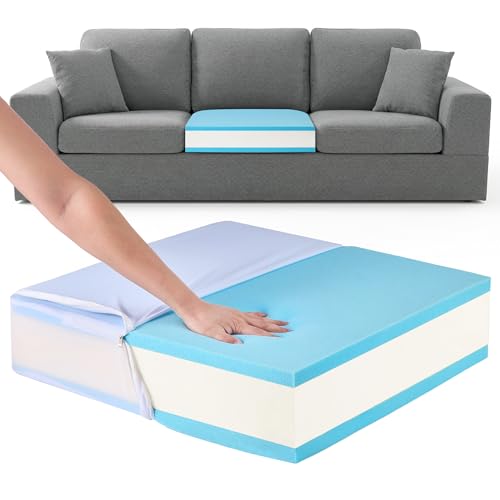 WooPetty Couch Cushion Replacement 3 Layer Thickened WooPetty Couch Cushion Replacement 3 Layer Thickened | Premium High Density Memory Foam - This couch… 3-Layer Extra Thickness Design - Our replacement couch… Removable & Machine Washable Cover - This sofa… | Check price |
 Meliusly Couch Cushion Support Board for Sagging Meliusly Couch Cushion Support Board for Sagging | This under couch cushion support for sagging seats… 8MM THICK PANELS, BUILT TO STAY FLAT An anti-skid finish on the underside grips your… | Check price |
As an Amazon Associate we earn from qualifying purchases at no extra cost to you.
Quick Picks
| Product | Best for | Price |
|---|---|---|
| High Density Upholstery Foam (3PCS) | Full insert replacement on standard sofas | $86.99 |
| HAVARGO Recliner Cushion | Seniors needing seat height and lumbar boost | $39.99 |
| Spongiduits Curved Foam Support | Mild sag repair without removing existing cushions | $26.99 |
| GORILLA GRIP Support Board | Sagging across a wide or sectional seat | $34.99 |
| ComfySure Seat Cushion | Bariatric or heavy users on chairs and recliners | $29.99 |
| HOMBYS Memory Foam Replacement | Cloud-like softness layered over firm support | $56.99 |
| WooPetty 3-Layer Replacement | Plush-firm feel with removable cover | $39.21 |
| Meliusly Support Board | Full-length sectional sofas needing rigid under-support | $44.99 |
How We Picked
Four criteria guided this shortlist. First, density and material grade: only products with published foam density figures or multi-layer constructions made the cut, because single-layer generic foam dominates the market and produces the most complaints. Second, dimensional accuracy: owner reviews consistently penalize products that do not match listed dimensions, so we prioritized inserts and boards whose stated sizes align with common couch-seat measurements. Third, price-to-longevity ratio: a $27 curved foam strip that restores mild sag is a better value than a $57 replacement cushion if your sofa is only beginning to dip. Fourth, use-case specificity: products designed for seniors, bariatric users, or wide sectionals solve problems a generic insert cannot.
The 8 Best Firm Couch Cushions in 2026
High Density Upholstery Foam (3PCS)
This three-piece pack is the closest thing to a universal fix for a three-seat sofa whose original inserts have compressed. Each block measures six inches thick and is cut from high-density upholstery foam, meaning it resists the permanent body-print that plagues cheaper alternatives. Owners praise the immediate spring-back when they remove packaging and the clean fit into standard cushion covers. The two downsides to note: six inches is the thinnest comfortable depth for adults who prefer a plush sit, and you must cut the blocks to size if your sofa uses non-standard cushion covers. Skip this if your couch is deeper than 24 inches front-to-back or if you want a memory-foam cradle feel on top.
HAVARGO Recliner Cushion
Designed around the mobility needs of older adults, this tufted dual-layer cushion raises a recliner seat by five inches while keeping the top surface soft. The patent-pending shape prevents the cushion from sliding forward on sloped recliner seats, which is a frequent complaint with generic pads. Two advantages stand out: the taupe upholstery cover blends with most recliner fabrics, and the lower layer is firm enough to actually lift you out of the chair rather than compress. The trade-off is width—twenty inches is narrow for wide-set hips, and owners on heavier frames report edge pressure. Skip this if your primary goal is replacing a sagging sofa insert rather than boosting a dedicated recliner.
Spongiduits Curved Foam Support
At $26.99 for a set of three, this is the lowest-cost entry point for restoring a seat that has begun to dip but has not fully collapsed. Each curved strip slides under the existing cushion and pushes the middle upward, so you avoid re-covering or re-stuffing anything. Owners report noticeable improvement within days, especially on sofas where the sag is centered rather than full-span. The two pros are price and installation speed; the main con is that it adds roughly two inches of height, which can make a cushion feel perched or shift forward on a tight seat frame. Skip this if your sofa has deep, multi-inch sagging that requires a full insert swap.
GORILLA GRIP Support Board
This rigid board spans 70 inches across the seat pan, targeting wide sofas and sectionals where the frame flexes between support slats. Unlike foam-based solutions, it does not compress; it redistributes weight across a larger area so the existing cushion sits on a stable platform. Owners highlight how it eliminated the “hammock” feeling on older sofas and how the gray surface is discreet under most covers. The two strengths are structural rigidity and length; the con is that it does nothing for cushion softness—if your foam is already thin, you still feel the board’s firmness. Skip this if your issue is worn-out foam rather than a flexing seat base.
ComfySure Seat Cushion
Built for users who need more than a standard pad can offer, this 19-by-17-by-3-inch memory foam cushion is explicitly marketed toward bariatric and overweight individuals. The extra-large footprint prevents edge-collapse that narrower cushions suffer under concentrated weight, and the high-density memory foam core holds shape through repeated long sessions. Owners appreciate the versatility—recliners, wheelchairs, office chairs, stadium seats, and even floor sitting all work. The two pros are load capacity and multi-use design; the con is that three inches is not enough for someone replacing a six-inch sofa insert, and the cover can run warm. Skip this if you need a full replacement cushion rather than a seat-topper.
HOMBYS Memory Foam Replacement
This insert layers high-density upholstery foam at its core, wraps it in memory foam, then finishes with Dacron polyester batting for a rounded, hotel-sofa silhouette. The result is a cushion that feels plush on the surface while maintaining a firm base underneath—addressing the common complaint that pure memory foam sinks too far. The removable cover is a practical win for households with pets or children. Two advantages: the layered construction and washable cover. The con is that at six inches thick and nearly five pounds each, it may overstuff shallow cushion channels. Skip this if your sofa originally used thinner inserts or if you prefer a no-fuss, throw-away-and-replace maintenance model.
WooPetty 3-Layer Replacement
At $39.21 this is the most affordable true replacement cushion on the list, and the three-layer build—firm foam core, softer comfort layer, and a fabric cover—mimics the structure of higher-priced competitors. Owners describe the firm variant as having a solid seat that still eases at the top, avoiding the board-like stiffness of dense foam alone. The two pros are price and balanced firmness; the con is that the cover is not removable, so cleaning spills means spot-treating only. Skip this if you want a washable cover or if your sofa uses zippered channels that require a specific fabric thickness to close properly.
Meliusly Support Board
Spanning 72 inches, this is the longest board in the group and fits a full sectional or a large three-seat sofa without seams. Like its competitor from GORILLA GRIP, it works by eliminating flex in the seat pan rather than adding cushioning, making it ideal when the underlying problem is a bowing wooden or metal frame. Owners report it transformed “trampoline” seats into stable platforms within minutes of installation. The two pros are length and ease of placement; the con is a slightly higher price relative to shorter boards, and it offers no comfort layer of its own. Skip this if your cushion foam is still intact and the issue is purely sagging inserts.
Buying Guide
Foam Density and Compression Resistance
Density, measured in pounds per cubic foot, determines how long an insert holds its shape. Upholstery-grade foam starts around 1.8 to 2.5 lbs/ft³ for budget options, while 40D and higher designations signal firmer, longer-lasting material that resists the permanent deformation caused by daily sitting. If an insert lists no density figure at all, assume it is low-grade and expect visible sag within a year or two under regular adult weight.
Correct Dimensions and Thickness
Measure your existing cushion or the seat cavity before ordering. Standard sofa seat depths range from 21 to 24 inches, and thickness from 4 to 6 inches. A cushion that is even half an inch too thick will strain zipper channels or leave visible gaps at the front edge. For replacement inserts, match width and depth exactly; for toppers and boards, confirm that added height will not shift the cushion forward on a sloped seat.
Insert Replacement Versus Under-Support
Not every sagging sofa needs a new cushion. If the foam still has some resilience but the seat pan flexes, a rigid board underneath restores firmness at a fraction of the cost. Conversely, if the seat base is solid but the foam has collapsed, no board will help—you need a fresh insert. Matching the solution to the actual failure point is the single most important decision in this category.
Our Verdict
The top pick is the High Density Upholstery Foam 3PCS pack: it addresses the root cause of most sagging sofas, offers the best density-per-dollar value among full replacements, and fits standard three-seat configurations without modification. The budget pick is the Spongiduits Curved Foam Support at $26.99, which repairs mild-to-moderate dip without any disassembly and is the cheapest meaningful intervention on the list. However, if your problem is a flexing seat pan rather than worn foam, the Meliusly Support Board wins—its 72-inch span covers sectionals that shorter boards cannot, and rigid structural correction is the only approach that solves frame-level sag.
FAQ
Can I cut high-density foam to fit my cushion covers?
Yes, an electric bread knife or a dedicated foam saw gives the cleanest cut on 6-inch blocks. Allow the foam to fully expand for 24 to 48 hours after unpacking before trimming, since compressed shipping foam continues to regain volume during that window.
How long do firm couch cushion replacements last?
High-density upholstery foam rated 40D or above typically holds shape for five to eight years under regular adult use. Lower-density foam under 20D may flatten noticeably within one to two years, especially under heavier occupants or daily full-weight sitting.
Will a support board make my sofa feel uncomfortable?
A rigid board alone feels firm, which is why it is recommended for sofas where the existing cushion still has thickness and resilience. If your foam is already thin, pair the board with a two- to three-inch memory foam topper to avoid a hard-seat sensation.
Are layered inserts better than solid foam blocks?
Layered construction—firm core, soft top, batting exterior—mimics the feel of a new showroom sofa and reduces the “bottoming out” sensation that a single dense block can produce. The trade-off is higher price and greater thickness, which may not fit shallow cushion channels.