Key takeaways
- Compare five juicers on type, motor power, feed chute size, speeds and cleanup, from fast centrifugal models to slow masticating presses for home use.
A home juicer earns its counter space when it matches the produce you buy, the batch size you pour, and the cleanup you are willing to do after breakfast. The five machines below cover the two main designs on the market: fast centrifugal models that shred produce against a spinning mesh basket, and slow masticating models that crush produce with an auger at low speed. Between them they span wide three-inch feed chutes that swallow whole apples, self-feeding hoppers you load once and leave, and compact vertical designs that take up little room beside the sink.
Each pick below lists the figures the maker publishes: juicing method, motor power, feed chute size, speed settings, and which parts can go in the dishwasher. Where a maker does not publish a figure, the spec line says so rather than guessing. Read the how-to-choose section first if you are new to juicing, because the right type matters more than any single feature.
Disclosure: As an Amazon Associate, we earn from qualifying purchases made through links on this page, at no extra cost to you.
How to Choose a Juicer
Pick the juicing method first. Centrifugal juicers spin a flat cutting disc and mesh basket at high speed. They work quickly, handle hard produce like carrots and beets well, and usually cost less, but the pulp tends to come out wetter and the juice foams more. Masticating juicers, also called slow or cold press juicers, turn a single auger at low revolutions per minute. They take longer per batch, yet they squeeze leafy greens, wheatgrass, and soft fruit more thoroughly and leave drier pulp. Twin-gear and hydraulic designs exist too, but the five machines here stick to the two mainstream types.
Check the feed chute against your prep habits. A three-inch chute accepts a whole small apple or a peeled orange, which cuts chopping to a minimum. Narrow chutes near two inches mean quartering apples and slicing carrots into sticks. A self-feeding hopper is the third option: you load the whole batch at once, close the lid, and the machine feeds produce into the auger on its own.
Match power and speed to produce. Centrifugal models in this roundup run 800 to 850 watts with one or two speed settings, the lower setting meant for softer fruit. Masticating models run 150 to 200 watts but deliver high torque at 43 to 80 RPM, so wattage alone does not tell you how hard a machine can squeeze.
Plan for cleanup before you buy. Juicing makes sticky pulp, and a machine that is annoying to wash will sit unused. Count the parts that come off, check whether they are dishwasher safe or hand wash only, and look for a cleaning brush in the box. A pulp bin that holds a full session of juicing also saves mid-batch emptying.
Think about batch size and storage. A one-liter juice jug suits a family round of glasses; a 500 ml chamber means pouring more often. Vertical slow juicers have a smaller footprint, while horizontal masticating models stretch longer across the counter but often add food-processing extras such as sorbet and nut butter attachments.
The 5 Best Juicers
1. Breville Juice Fountain Plus JE98XL
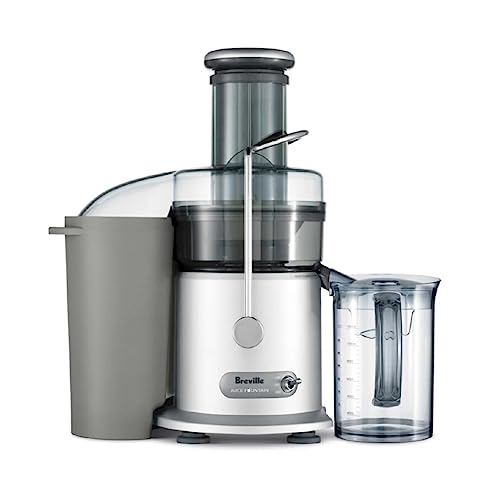
The Juice Fountain Plus is the classic fast centrifugal pick. Its 850-watt motor drives a titanium-reinforced cutting disc against an Italian-made micro mesh filter, and the extra-wide three-inch chute takes whole fruits and vegetables with little pre-cutting. Two electronic speeds let you drop to the low setting for soft fruit and push to the high setting for dense roots. The one-liter juice jug has a built-in froth separator, and the 2.6-quart pulp container sits at the back so you can juice a full batch before stopping to empty it. A safety locking arm keeps the cover in place while the basket spins, and the cord wraps under the base for tidy storage.
Specs
- Type: Centrifugal
- Power: 850 watts
- Feed chute: 3 inches, extra wide for whole produce
- Speeds: 2 electronic settings (low for soft fruit, high for hard produce)
- Dishwasher-safe parts: Removable parts are dishwasher safe on the top rack; the motor base wipes clean
2. Hamilton Beach Big Mouth Juice Extractor 67601A

The Big Mouth is the straightforward budget centrifugal option. An 800-watt motor and a stainless steel strainer turn dense produce into juice in seconds, and the three-inch feed chute fits a whole apple, a peeled orange, or a handful of kale, so prep stays short. The extra-large pulp bin lets you keep juicing longer between stops. Controls could not be simpler: a single on and off dial with no settings to manage. The removable food pusher, cover, strainer, pulp bin, and strainer bowl are all BPA free and go in the dishwasher, and the listing notes an Easy Sweep cleaning tool that cuts strainer scrubbing time. One thing to know before ordering: a juice cup is not included, so you pour into your own glass or pitcher under the spout.
Specs
- Type: Centrifugal
- Power: 800 watts
- Feed chute: 3 inches, fits whole apples and peeled oranges
- Speeds: 1 (single on/off dial)
- Dishwasher-safe parts: Food pusher, cover, stainless steel strainer, pulp bin, and strainer bowl are dishwasher safe
3. Omega NC900HDC Juicer and Nutrition System

The NC900HDC is a horizontal masticating juicer built around a single auger that turns at 80 RPM. The 150-watt motor uses gear reduction the maker equates to a 2 HP motor, and the dual-stage extraction presses produce, then squeezes the pulp again before it exits. An adjustable end cap with five settings changes the pressure for different produce, which helps with leafy greens and wheatgrass that centrifugal machines handle poorly. The feed chute is a rectangle of about 2 by 1.5 inches, so apples need quartering. Beyond juice, the nutrition system fittings let the same auger churn nut butters, grind, mince, extrude pasta with the included nozzles, and make sorbets and baby food. Omega covers the machine with a 15-year warranty, the longest backing in this roundup.
Specs
- Type: Masticating (horizontal single auger, dual-stage)
- Power: 150 watts
- Feed chute: About 2 x 1.5 inches, rectangular
- Speeds: 1 at 80 RPM, with reverse
- Dishwasher-safe parts: Not published as dishwasher safe; removable parts wash by hand in warm soapy water
4. Nama J2 Cold Press Juicer SJ200

The Nama J2 changes the slow juicer routine with a self-feeding hopper. Instead of standing at the counter pushing produce down a narrow chute piece by piece, you load the wide hopper with a whole recipe of ingredients, close the lid, and an internal blade cuts and feeds the produce into the auger while you do something else. The 200-watt motor turns at 50 RPM, and the maker points to the slow squeeze and hands-free loading as the reasons the pulp comes out dry and the juice yield high. Assembly uses a small set of parts that come apart for rinsing, and a cleaning brush is included. Nama directs owners to wash the components by hand, so plan on a few minutes at the sink rather than loading the dishwasher.
Specs
- Type: Masticating (self-feeding cold press)
- Power: 200 watts
- Feed chute: Wide self-feeding hopper for whole-recipe loading; exact opening width not published
- Speeds: 1 at 50 RPM
- Dishwasher-safe parts: Not published as dishwasher safe; the maker recommends hand washing the components
5. Hurom H-AA Slow Juicer

The H-AA is Hurom’s vertical slow juicer with the brand’s Alpha technology. A 150-watt AC motor turns the auger at 43 RPM while a spinning brush rotates at 17 RPM inside the 500 ml chamber, sweeping the strainer as you juice. It ships with fine and coarse strainers plus a homogenizing blank, and a pulp control lever lets you choose how much pulp stays in the glass, so the same machine handles clear juice, thicker blends, nut milks, and frozen-fruit sorbets. The feed opening is about two inches, so plan on cutting apples and carrots to fit. The listing marks care as hand wash only, and Hurom lists a 10-year warranty on the motor with 2 years on parts.
Specs
- Type: Masticating (vertical single auger)
- Power: 150 watts
- Feed chute: About 2 inches
- Speeds: 1, auger at 43 RPM (spinning brush at 17 RPM)
- Dishwasher-safe parts: None; hand wash only per the maker
Comparison Table
| Model | Type | Power | Feed chute | Speeds | Cleanup |
|---|---|---|---|---|---|
| Breville Juice Fountain Plus JE98XL | Centrifugal | 850 W | 3 in | 2 | Top-rack dishwasher parts |
| Hamilton Beach Big Mouth 67601A | Centrifugal | 800 W | 3 in | 1 | Dishwasher-safe removable parts |
| Omega NC900HDC | Masticating | 150 W | About 2 x 1.5 in | 1 (80 RPM) | Hand wash |
| Nama J2 SJ200 | Masticating, self-feeding | 200 W | Wide hopper | 1 (50 RPM) | Hand wash |
| Hurom H-AA | Masticating, vertical | 150 W | About 2 in | 1 (43 RPM) | Hand wash only |
Frequently Asked Questions
What is the difference between a centrifugal and a masticating juicer?
A centrifugal juicer shreds produce against a fast-spinning mesh basket, so it finishes a glass in well under a minute but leaves wetter pulp. A masticating juicer crushes produce slowly with an auger, which takes longer yet squeezes more juice from leafy greens and soft fruit and leaves drier pulp behind.
Can a slow juicer handle leafy greens and wheatgrass?
Yes. The low-speed auger in a masticating model wraps and presses leaves instead of flinging them against a basket, which is why machines like the Omega NC900HDC and the Hurom H-AA list greens and wheatgrass among the produce they handle well. Rolling leaves into a bundle before feeding helps them move through.
How wide should the feed chute be?
A three-inch chute takes a whole small apple and cuts prep to almost nothing, which suits fast centrifugal machines. Chutes near two inches mean quartering apples and cutting carrots into sticks. If prep time is your main complaint, a self-feeding hopper like the one on the Nama J2 removes the piece-by-piece feeding step altogether.
Are the parts of these juicers dishwasher safe?
It depends on the model. The removable parts of the Breville Juice Fountain Plus and the Hamilton Beach Big Mouth are dishwasher safe. The Omega, Nama, and Hurom models here are hand wash designs, and their makers direct you to rinse the parts in warm soapy water instead.
Do I need to peel and core produce before juicing?
Most makers say to wash everything, peel citrus and thick rinds that taste bitter, and remove large pits and hard seeds. Apples can go in whole through a three-inch chute, core and all, on the centrifugal picks, while slow juicers with smaller openings need produce cut into pieces that fit the chute or hopper.
Conclusion
For speed and simple cleanup, the Breville Juice Fountain Plus and the Hamilton Beach Big Mouth cover the centrifugal ground at two levels of spend, both with three-inch chutes and dishwasher-safe parts. For greens, wheatgrass, and drier pulp, the Omega NC900HDC adds food-processing range, the Nama J2 removes the feeding chore with its self-loading hopper, and the Hurom H-AA gives you pulp control in a compact vertical body. Match the machine to the produce you buy most and the cleanup you will actually do, and a juicer becomes a daily habit rather than another appliance in the cupboard.
More from Amazon
Programs that pair well with the guide above. Offers and eligibility are set by Amazon and may change.
Set up recurring deliveries of everyday items on eligible products. Terms and savings are set by Amazon.
Explore Subscribe & SaveCollect the home and kitchen items you want in one registry that guests can shop from.
Create a wedding registryFree shipping on eligible items, Prime Video and more. Eligible new members can start with a free trial.
Start a Prime free trialAudiobooks and podcasts to listen to on the go. Eligible new members can start with a free trial.
Try Audible freeAs an Amazon Associate we earn from qualifying purchases.