Key takeaways
- Compare the best reverse hyper machines for home gyms, from heavy plate-loaded pendulums to a bodyweight decompression bench, with pad and fit checks.
Most lower back training moves the torso against load while the legs stay planted. A reverse hyper machine flips that arrangement. You lie face down on a wide pad with your hips at the edge, grip the handles, and your legs hang from a pendulum arm loaded with plates. As you lift your legs behind you and let them swing back under the pad, the glutes, hamstrings and spinal erectors work while your upper body never moves. At the bottom of each swing, the hanging load gently pulls on the pelvis, the quality that made this machine famous.
Be clear about what this guide is not. It is not about hyperextension benches, the roman chair stations covered in the hyperextension benches roundup, where your legs are fixed and your torso folds forward over a pad. It is also narrower than the glute machines roundup, which spans every kind of glute station. The five picks are four plate-loaded pendulum machines and one decompression bench that trains the same leg swing unloaded.
Disclosure: As an Amazon Associate, we earn from qualifying purchases made through links on this page, at no extra cost to you.
How to Choose a Reverse Hyper Machine
Understand the pendulum first. The whole movement lives in the swing arm. Your legs strap or rest against the arm, the arm pivots under the pad, and plates on the arm set the load. On the way down, your legs travel under your body and the hanging load creates a mild traction effect through the lower back, opening the joints of the lumbar spine for a moment before you lift again. No deadlift, row or back extension does this, because in all of those the spine is compressed while it works.
Keep the load light and the swing short. The reverse hyper earned its place as a recovery and accessory movement, not a maximal strength lift. Working sets use modest plates and smooth, rhythmic reps. The common fault is swinging the legs too high: once they rise above the line of your torso, the lift stops being hip extension and becomes lumbar arching, loading the exact joints the machine is meant to spare. Stop the swing at the line of your body, and keep the return slow.
The pad decides comfort more than the frame. Your hip bones and pelvis rest fully on the pad while everything below the waist moves. A pad that is too narrow lets the hip bones hang off the sides, and a pad edge that digs into your stomach on every rep is the signature of a cheap or wrongly sized machine. Look for a pad wide enough to hold your whole pelvis, thick enough that the frame never prints through, with your hip crease right at the edge.
Plate posts and arm length set the feel. Two numbers shape how a reverse hyper loads: how much plate the posts hold, and how long the pendulum arm is. A longer arm moves the same plates through a bigger arc and makes them feel heavier at the top of the swing, while a short arm feels snappier and lighter. Check sleeve length against your plates, because thick bumpers fill a post far faster than thin steel ones.
Strap or roller: how the legs attach. Machines connect your legs to the pendulum in two ways. An ankle strap wraps both ankles and hangs from the arm, letting the legs move naturally, but it can bite into the ankles under heavier loads. A padded roller bar sits behind your lower legs and spreads the pressure over a wider area, more comfortable for long sets, though it fixes your leg position. Know which one a machine uses before you buy.
Know the origin, and keep it in proportion. The reverse hyper was developed by Louie Simmons of Westside Barbell after he broke his back and needed a way to train the posterior chain while his spine healed. That rehab origin is why the machine exists. It is context, not a medical claim: a reverse hyper is exercise equipment, not a treatment. If you have a herniated disc, ongoing back pain or a history of spinal injury, talk to a doctor first.
Measure the room, not just the machine. A reverse hyper needs clear floor behind the pad for the swing, and side space for loading plates. The spec sheet footprint is only the frame; add the swing path before deciding where it will live.
The 5 Best Reverse Hyper Machines
1. Titan Fitness H-PND Reverse Hyper — the full size benchmark

The H-PND is the machine most home gym reverse hypers are measured against. The frame is 11-gauge steel at 250 lb, heavy enough that the base stays planted when a loaded arm swings, and the pendulum takes up to 700 lb of Olympic plates on a 10 inch sleeve. Handles adjust through eight positions in 2 inch steps, so different torso lengths can set a relaxed grip. Titan includes the ankle strap, two spring collars and a cross brace for bands. This is the default pick for anyone with the floor space.
Specs
- Model: H-PND
- Type: Plate-loaded pendulum reverse hyper
- Loadable capacity: 700 lb
- Frame: 11-gauge steel
- Footprint: 52.25 x 41 in
- Height: 44.5 in
- Machine weight: 250 lb
- Plate sleeve: 2 in Olympic, 10 in loadable length
- Handles: 6 in grips, 8 positions in 2 in steps
- Leg attachment: Ankle strap
- Included: Hyper strap, 2 spring collars, band cross brace
2. Titan Fitness Economy H-PND Reverse Hyper — the same swing, lighter frame

The Economy H-PND keeps the pendulum layout and trims the structure around it. The 2 x 2 in tubing frame weighs 147 lb, over 100 lb less than the full size H-PND, and the arm is rated for 550 lb of plates with a 300 lb user limit. The sleeve is the same 10 inch Olympic post, the handles adjust through the same eight positions, and the strap and collars are in the box. The trade is stability at the extremes: strong lifters swinging heavy plates will notice the lighter frame sooner.
Specs
- Model: Economy H-PND (ECONPND)
- Type: Plate-loaded pendulum reverse hyper
- Loadable capacity: 550 lb
- Max user weight: 300 lb
- Frame: 2 x 2 in steel tubing
- Footprint: 55 x 39 in
- Height: 44.5 in
- Machine weight: 147 lb
- Plate sleeve: 2 in Olympic, 10 in loadable length
- Leg attachment: Ankle strap
- Included: Hyper strap, spring collars
3. VINE H-PND Reverse Hyperextension Machine — the big pad, high capacity option

The VINE H-PND is built around the pad. At 35 x 24.2 in and 3.3 in thick, it is the largest platform in this group, on a 13-gauge steel frame with a stated total capacity of 1,100 lb, split between a 440 lb user limit and 660 lb of plates on the 2 inch sleeve. Handles and the weight bar both adjust to suit your build. At 125 lb it is also the lightest full size pendulum machine here.
Specs
- Model: H-PND
- Type: Plate-loaded pendulum reverse hyper
- Total capacity: 1,100 lb (440 lb user, 660 lb loadable)
- Frame: 13-gauge steel
- Footprint: 50.7 x 38.9 in
- Height: 48.1 in
- Machine weight: 125 lb
- Pad: 35 x 24.2 in, 3.3 in thick
- Plate sleeve: 2 in
- Adjustment: Multi-position handles and weight bar
4. Gronk Fitness Reverse Hyperextension Machine (5916-G1) — padded rollers and an adjustable footplate

The Gronk Fitness machine takes the other approach to the leg connection: padded rollers and an adjustable footplate instead of a strap, so pressure spreads across the back of the legs and your position is set before the set begins. Its manual is unusually plain about limits: maximum user weight is 330 lb, plates capped at 110 lb per side, plate holes over 50 mm and outside diameters under 450 mm. That cap is lower than the Titan frames offer, making this a machine for controlled, moderate loading. A leg strap and spring clips are included.
Specs
- Model: 5916-G1
- Type: Plate-loaded pendulum reverse hyper
- Frame: 11-gauge steel
- Assembled size: 51.6 x 31.4 x 45.4 in
- Max user weight: 330 lb
- Plate limit: 110 lb per side
- Plates: Olympic, hole over 50 mm, diameter under 450 mm
- Leg attachment: Padded rollers with adjustable footplate
- Included: Leg strap, spring clips
- UPC: 810143801460
5. Teeter DEX II Inversion and Core Training System — the bodyweight decompression route
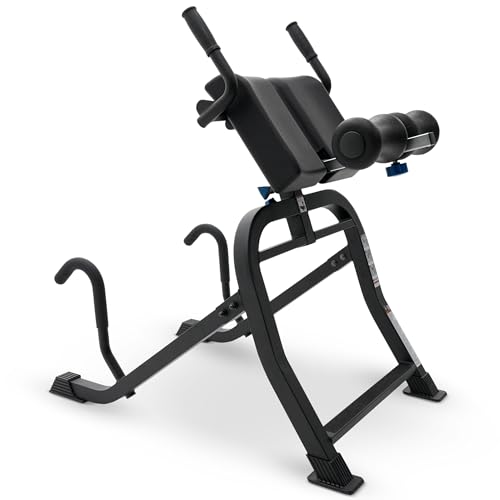
The DEX II is the different animal in this group, for buyers whose priority is decompression rather than loaded training. There is no pendulum and no plate post. You rest your pelvis on the lap cushion in a 90/90 hip-supported position and work through bodyweight reverse hyperextensions, back extensions and inverted stretches, with your own leg weight providing the traction effect at the bottom of the movement. The frame is rated for 350 lb and fits users from 4 ft 8 in to 6 ft 6 in. It cannot be loaded progressively like the machines above.
Specs
- Model: DEX II (D12000C)
- Type: Hip-supported inversion and core station, bodyweight
- Capacity: 350 lb
- User height range: 4 ft 8 in to 6 ft 6 in
- Loading: Bodyweight only, no plate posts
- Frame: Steel
- Machine weight: Not published
- Footprint: Not published
Comparison Table
| Machine | Type | Loadable capacity | Footprint | Machine weight | Leg attachment |
|---|---|---|---|---|---|
| Titan Fitness H-PND | Pendulum, plate loaded | 700 lb | 52.25 x 41 in | 250 lb | Ankle strap |
| Titan Fitness Economy H-PND | Pendulum, plate loaded | 550 lb | 55 x 39 in | 147 lb | Ankle strap |
| VINE H-PND | Pendulum, plate loaded | 660 lb | 50.7 x 38.9 in | 125 lb | Adjustable weight bar |
| Gronk Fitness 5916-G1 | Pendulum, plate loaded | 110 lb per side | 51.6 x 31.4 in | Not published | Padded rollers |
| Teeter DEX II | Inversion station | Bodyweight only | Not published | Not published | Lap cushion |
FAQ
What muscles does a reverse hyper machine work?
The glutes and hamstrings drive the leg lift, while the spinal erectors and the rest of the lower back hold the torso still on the pad. The abdominals brace throughout, so the whole trunk gets stabilising work even though only the legs move.
How is a reverse hyper different from a hyperextension bench?
On a hyperextension bench your legs are fixed and your torso folds and rises over the pad, compressing the spine under load. On a reverse hyper your torso is fixed and your legs swing from a pendulum, so the lower back gets a gentle pulling sensation at the bottom of the swing instead.
How much weight should I use on a reverse hyper?
Less than you think. Begin with no plates or the lightest plates you own and learn the swing first. Add load in small steps only while every rep still stops at the line of your torso and returns under control. If the weight forces you to arch or kick, it is too heavy.
Can a reverse hyper fix my back pain?
No machine can promise that. The reverse hyper was designed in a rehabilitation setting and many lifters use it to train around sore backs, but it is exercise equipment, not a medical treatment. Persistent pain, a herniated disc or pain that travels down a leg needs a doctor.
How much space does a reverse hyper machine need?
Plan for the frame footprint plus the swing. The full size machines here occupy roughly 51 to 55 in of length and 39 to 41 in of width, and the pendulum needs clear floor behind the pad through its whole arc, plus side room for loading plates.
Conclusion
For most home gyms, the Titan Fitness H-PND is the reverse hyper to buy first: the heaviest frame, the highest plate capacity and a proven strap setup. The Economy H-PND delivers the same swing in a lighter frame for moderate loads. The VINE H-PND answers with the biggest pad and the highest stated total capacity, the Gronk Fitness 5916-G1 suits anyone who prefers padded rollers and plainly stated limits, and the Teeter DEX II covers the bodyweight decompression end of the category. Keep the load modest, the swing short and the pad comfortable, and the machine will do the quiet work it was invented for.
More from Amazon
Programs that pair well with the guide above. Offers and eligibility are set by Amazon and may change.
Set up recurring deliveries of everyday items on eligible products. Terms and savings are set by Amazon.
Explore Subscribe & SaveCollect the home and kitchen items you want in one registry that guests can shop from.
Create a wedding registryFree shipping on eligible items, Prime Video and more. Eligible new members can start with a free trial.
Start a Prime free trialAudiobooks and podcasts to listen to on the go. Eligible new members can start with a free trial.
Try Audible freeAs an Amazon Associate we earn from qualifying purchases.