Key takeaways
- More stable temperature: The valve is designed to keep the water near your selected setting when hot-water demand changes elsewhere in the home.
- Better scald protection: A built-in temperature limit can help reduce the risk of accidentally turning the water dangerously hot, particularly for children, older adults, and people with limited mobility.
- More comfortable daily use: Separate temperature and flow controls make it easy to start the shower at a familiar setting instead of adjusting the handle every time.
- Useful for busy households: The benefit is easiest to notice when a dishwasher, washing machine, second bathroom, or toilet can affect water flow.
- Good upgrade during remodeling: If the wall is already open, adding the valve may require less disruption than retrofitting it later.
- Potentially longer cartridge service life: Quality brass bodies and replaceable cartridges can be serviced instead of replacing the entire visible control, although maintenance depends on water quality and the specific brand.
The Short Answer
Yes—a thermostatic shower valve is worth it if your home has noticeable temperature swings, more than one person uses water at the same time, or you want stronger protection against scalding. It is especially useful when a toilet flush, washing machine, or kitchen faucet can suddenly change the shower temperature.
If your current shower already holds a steady temperature, your water pressure is consistent, and you are trying to spend as little as possible, a thermostatic valve may not justify the extra cost and installation work. In practical terms, expect to spend roughly $70 to $250 for the valve or trim, plus about $200 to $600 for professional installation when the wall must be opened. New construction and major bathroom renovations are the easiest times to add one.
Our top picks

As an Amazon Associate we earn from qualifying purchases at no extra cost to you. Ratings are shown as listed on Amazon.
What You Actually Get
A thermostatic shower valve mixes hot and cold water while continuously monitoring the mixed-water temperature. Inside the valve, a temperature-sensitive cartridge adjusts the hot and cold inlets as supply conditions change. That is different from a standard pressure-balance valve, which mainly reacts to changes in water pressure.
For example, if someone flushes a toilet, a pressure-balance valve helps prevent a burst of cold water from making your shower suddenly hot. A thermostatic valve can respond to pressure changes too, but its primary job is maintaining the temperature you selected. Many models include a temperature dial with a safety stop at around 100°F or 104°F. The stop can usually be overridden for hotter water, but doing so takes a deliberate push or adjustment.
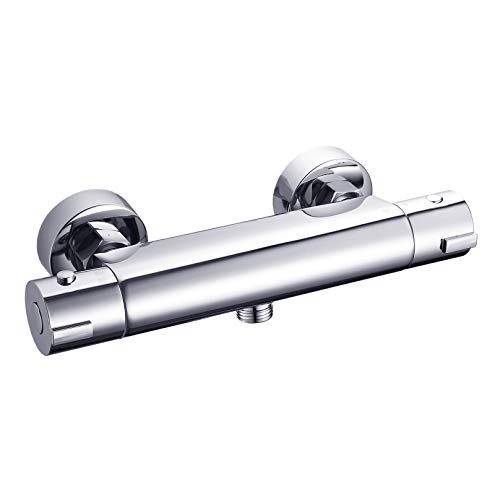
Most thermostatic systems have separate controls for temperature and water flow. One control lets you select, say, 100°F; another starts, stops, or regulates the flow. That means you can turn the shower off while keeping your preferred temperature setting. Some exposed models combine these functions in a larger wall-mounted body, while concealed valves place the working parts behind the wall and use a slimmer trim plate.
Check the specifications carefully before buying. Common shower valve connections are ½-inch NPT, although supply plumbing and manufacturer requirements vary. A typical exposed valve may be approximately 6 to 12 inches wide, 4 to 7 inches high, and 2 to 4 inches deep. Concealed valves require a wall cavity with enough depth for the valve body, often around 2 to 3 inches, plus room for the trim. Product weights commonly range from 3 to 8 pounds, depending on whether the package includes a diverter, hand shower outlet, or other fittings.
Thermostatic control cannot create hot water or fix inadequate plumbing. Your water heater still needs enough capacity, and the home needs acceptable hot-water temperature and pressure. Tankless systems, older homes, low-flow fixtures, and homes with long pipe runs should be checked for compatibility before installation.
Pros
- More stable temperature: The valve is designed to keep the water near your selected setting when hot-water demand changes elsewhere in the home.
- Better scald protection: A built-in temperature limit can help reduce the risk of accidentally turning the water dangerously hot, particularly for children, older adults, and people with limited mobility.
- More comfortable daily use: Separate temperature and flow controls make it easy to start the shower at a familiar setting instead of adjusting the handle every time.
- Useful for busy households: The benefit is easiest to notice when a dishwasher, washing machine, second bathroom, or toilet can affect water flow.
- Good upgrade during remodeling: If the wall is already open, adding the valve may require less disruption than retrofitting it later.
- Potentially longer cartridge service life: Quality brass bodies and replaceable cartridges can be serviced instead of replacing the entire visible control, although maintenance depends on water quality and the specific brand.
Cons
- Higher upfront cost: A basic pressure-balance valve may cost about $35 to $100, while thermostatic trim and valve packages commonly run from $100 to $400 or more.
- Installation can be complicated: Replacing a simple shower control may require opening the wall, changing pipe connections, adding blocking, and setting the valve at the correct depth.
- Not every valve is a complete system: Some listings include only the exposed trim or mixing body. You may still need a compatible rough-in valve, shutoff valves, escutcheon, shower arm, or handheld outlet.
- It needs correct calibration: If the temperature limit is set incorrectly, the water may be too cool or the safety stop may allow water that is hotter than intended.
- Water-quality problems can shorten cartridge life: Sediment, hard-water scale, and debris from older pipes can make the control stiff or cause temperature fluctuations.
- It cannot solve every pressure problem: A weak well pump, undersized supply line, clogged showerhead, or undersized water heater will remain a problem.
- More controls may feel less familiar: Some people prefer a single lever because it is faster and visually simpler.
Who Should Buy It
Buy a thermostatic shower valve if temperature consistency is a recurring annoyance or a safety priority. It is a strong choice for families, multibath homes, and anyone who regularly showers while other appliances or fixtures are running. It also makes sense for a primary bathroom renovation where the walls are already open and you want a more deliberate, hotel-like control setup.
It is particularly suitable for households with children, older adults, or anyone who may not react quickly to a sudden temperature change. A model with a clearly marked temperature dial and an adjustable safety stop is more useful than a decorative valve with vague markings.
Budget-friendly exposed options can work well in an RV bathroom, guest bath, clawfoot tub setup, or renovation where concealed plumbing would be too disruptive. For example, the FUGO RV Thermostatic Shower Faucet is listed at about $64.99, while a 2-Handle Thermostatic Shower Valve Trim is listed at about $69.99. Treat those prices as product-price examples, not the complete installed cost. Confirm connection size, hot-and-cold orientation, temperature range, included hardware, and whether the item is intended for residential code requirements before ordering.
Who Should Skip It
Skip the upgrade if your existing shower maintains a comfortable temperature and you do not experience noticeable changes when other fixtures run. A pressure-balance valve is usually the better value for a straightforward replacement, especially if the existing rough-in is compatible and the wall does not need to be opened.
You should also wait until a plumber evaluates the system if you have low pressure, rusty or sediment-filled water, a failing water heater, or inconsistent hot water throughout the house. Installing a sophisticated control on top of a plumbing problem can add cost without improving the shower.
Cheaper Alternatives
| Option | Cost | Trade-off |
|---|---|---|
| Pressure-balance shower valve | $35–$150 for parts | Usually cheaper and easier to match to existing plumbing, but it mainly responds to pressure changes and may feel less precise. |
| Basic single-handle replacement cartridge | $20–$80 | Can restore normal operation at low cost, but it will not add thermostatic control or a separate temperature setting. |
| High-quality adjustable showerhead | $25–$100 | May improve spray comfort and perceived pressure, but it cannot prevent household water-temperature swings. |
| Point-of-use anti-scald limiter | $20–$75 | Can restrict maximum temperature, but it does not regulate temperature as actively or conveniently as a thermostatic valve. |
| Exposed thermostatic valve | $65–$180 | More affordable and easier to retrofit than a concealed system, but larger and more visible on the wall. |
FAQ
Is a thermostatic shower valve better than a pressure-balance valve?
Neither is automatically better for every bathroom. A thermostatic valve generally offers more accurate temperature control and is preferable when comfort and scald protection are priorities. A pressure-balance valve is often less expensive, simpler, and adequate for a bathroom with stable water pressure. Both should be installed and adjusted correctly.
Does a thermostatic valve save water?
Not by itself. It may reduce the time spent adjusting the shower and can make it easier to turn the water off and back on at the same setting, but water savings depend on user habits, shower length, and the showerhead flow rate. In the United States, many standard showerheads are rated at no more than 2.5 gallons per minute, while water-saving models may use around 1.5 to 2.0 gallons per minute.
Can I install one without opening the wall?
Sometimes. An exposed thermostatic valve can connect to accessible hot- and cold-water lines and is often the least disruptive option. A concealed valve usually requires access behind the wall, especially if the existing plumbing layout, valve depth, or pipe spacing does not match. Shut off the water and verify the manufacturer’s installation diagram before assuming it is a direct replacement.
What temperature should I set it to?
Many people find a shower comfortable around 100°F to 105°F. The exact setting depends on personal preference, incoming water temperature, and the valve’s calibration. Keep the maximum limit conservative, particularly in homes with children or older adults. A plumber can measure the actual outlet temperature with a thermometer rather than relying only on the dial markings.