Key takeaways
- High-carbon steel holds a noticeably keener edge than generic stainless at this tier
- Non-slip ergonomic handle earns consistent praise for comfort during long prep sessions
- Carbon steel demands hand-drying and occasional oiling — not a set-it-and-forget-it blade
A Japanese chef knife is not a luxury item you buy once and forget about. It is the single tool in your drawer that determines whether your weeknight dinner prep takes fifteen minutes or thirty, whether your tomato slices come out clean or crushed, whether your onion work makes you feel like a trained cook or a frustrated amateur. The real problem a buyer faces is not finding a sharp knife out of the box — almost every knife in this roundup is sharp when new. The problem is finding one that stays sharp through weeks of daily use, that balances well enough to reduce hand fatigue, and whose handle construction survives repeated washing and the occasional dishwasher sin.
What separates a genuinely good Japanese chef knife from a mediocre one comes down to three things: the steel’s ability to hold a fine edge, the geometry of the grind (thin behind the edge means clean cuts but also more fragility), and the handle-to-blade connection, where many cheap knives fail first. The eight options here span from a thirty-nine-dollar single blade to a premium Shun at nearly two hundred, and the price gap reflects real material differences, but not always a proportional performance gap. This roundup for 2026 compares published specs, listed prices, and aggregated owner feedback to help you match your actual cutting needs to the right tier.
Our top picks




As an Amazon Associate we earn from qualifying purchases at no extra cost to you.
Quick Picks
| Product | Best for | Price |
|---|---|---|
| HOSHANHO 8 Inch | High-carbon feel on a tight budget | $64.99 |
| Atumuryou VG10 Damascus | Gift-ready sharpness without premium pricing | $79.99 |
| imarku 3-Piece Set | Home cooks who want a full kit from one brand | $139.99 |
| imarku Santoku 7 Inch | Under-$40 entry into Japanese-style blades | $39.99 |
| 67-Layer Damascus Set | Statement pieces and serious gift-giving | $169.99 |
| SHAN ZU Chef Knife | Damascus look with balanced weight | $69.99 |
| MITSUMOTO SAKARI Gyuto | Cheapest functional 9Cr18MoV option | $53.54 |
| Shun Premier 8 Inch | Brand-name reliability and lifetime edge reputation | $219.95 |
How We Picked
We compared steel composition and layer construction, handle material and its impact on balance and durability, blade length and grind geometry for the chef-knife role specifically, and real-world owner reports on edge retention and rust resistance at each price point. A knife that looks beautiful but chips on a frozen onion has already failed its job, so owner feedback on fragility carried weight equal to any spec sheet.
The 8 Best Japanese Chef Knife in 2026
HOSHANHO 8 Inch High Carbon Steel
For the cook who wants the bite and edge-retention character of high-carbon steel without crossing into premium pricing. This is one of the few sub-$70 chef knives that actually uses high carbon rather than a vague “stainless” label.
- High-carbon steel holds a noticeably keener edge than generic stainless at this tier
- Non-slip ergonomic handle earns consistent praise for comfort during long prep sessions
- Carbon steel demands hand-drying and occasional oiling — not a set-it-and-forget-it blade
Skip it if you routinely run knives through the dishwasher or live in a very humid climate where carbon-steel maintenance feels like a chore.
Atumuryou VG10 Damascus 8 Inch
Sits in the sweet spot for someone who wants VG10 performance and a gift-box presentation without paying a luxury brand markup. Owner feedback highlights the initial shaving-sharp edge out of the box.
- VG10 core with Damascus cladding offers solid edge retention and visual appeal
- Resin wood handle is lighter than pakkawood and resists moisture-related swelling
- The 8-inch blade can feel head-heavy for cooks with smaller hands
Skip it if you need a knife for precision work on herbs; the blade profile is optimized for rocking and push-cutting, not tip-heavy detail tasks.
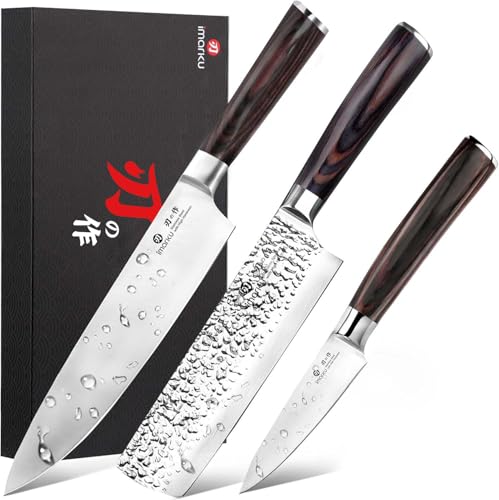
imarku 3-Piece Knife Set
Built for the home cook upgrading from a knife block who wants three coordinated blades without mixing brands. The pakka wood handles on all three pieces match, and the set covers chef, santoku, and utility roles.
- High-carbon stainless steel gives you edge quality without carbon-steel maintenance
- Ergonomic pakka wood handles resist warping better than plain wood in humid kitchens
- Set pricing at $139.99 means each individual knife is mid-tier quality, not flagship
Skip it if you already own a good chef knife and only need one blade; buying a single knife from this brand or another is more cost-effective.
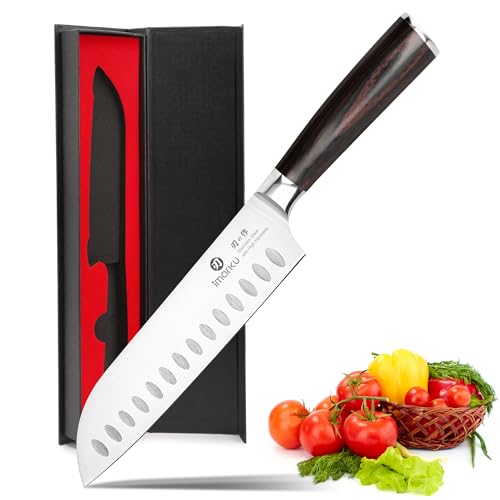
imarku Santoku 7 Inch
The lowest entry price here, and the most common first Japanese-style knife. For a seven-inch santoku, owner reviews consistently call it sharp and well-balanced right out of the packaging.
- Under $40 for a functional, sharp Japanese-profile blade is hard to beat on value
- High-carbon stainless composition avoids the rust anxiety of pure carbon steel
- Santoku grind is thinner and flatter than a Western chef knife, so it is not a drop-in replacement if you rely on a heavy rocking cut
Skip it if you primarily butcher, carve roast meat, or need blade mass to power through dense vegetables like butternut squash.
67-Layer Damascus Chef Knife Set
The most visually impressive option in this group, and the one you buy as a gift or a kitchen centerpiece. Three knives, a VG10 core, ocean-blue resin handles, and an elegant box make it a presentation piece as much as a tool.
- 67-layer construction is genuinely beautiful and signals a higher manufacturing process than 3-layer cladding
- VG10 steel core delivers the edge performance the price implies
- The set cost is nearly three times what a single blade at this tier costs elsewhere
Skip it if you want maximum cutting performance per dollar rather than aesthetics and gift packaging.
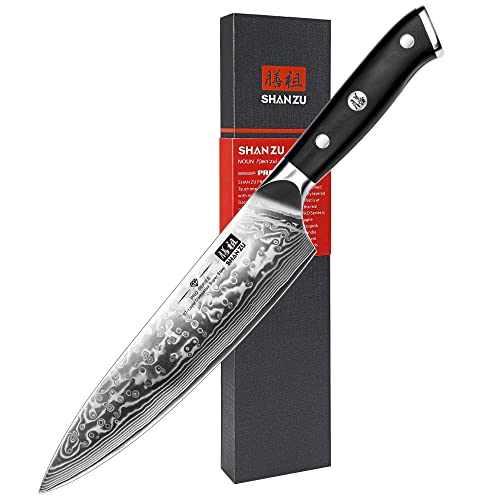
SHAN ZU Chef Knife 8 Inch Damascus
A middle-ground option that adds Damascus layering and a traditional Japanese feel without crossing into the premium tier. Owner feedback often notes the satisfying hand weight and initial sharpness.
- Damascus layering adds corrosion resistance over a carbon-steel core
- Balance is praised as close to neutral, good for extended sessions
- The sheath or packaging is minimal, so store it carefully if your drawer is crowded
Skip it if you want a full set or a knife with a strong brand warranty and service network.
MITSUMOTO SAKARI 8-Inch Gyuto 3-Layer 9Cr18MoV
The cheapest full-size chef knife here that names its steel specifically. 9Cr18MoV is a mid-range stainless often found in Japanese kitchen knives, and the three-layer construction puts a harder cutting layer between softer cladding.
- At $53.54, it is the most affordable 8-inch option with a transparent steel spec
- Gyuto profile works well as a general-purpose chef knife for mixed prep
- 3-layer cladding means the Damascus look is cosmetic rather than structural, and the edge will dull faster than VG10
Skip it if you plan to use the knife daily for months without sharpening; this is a knife you will need to hone more often.
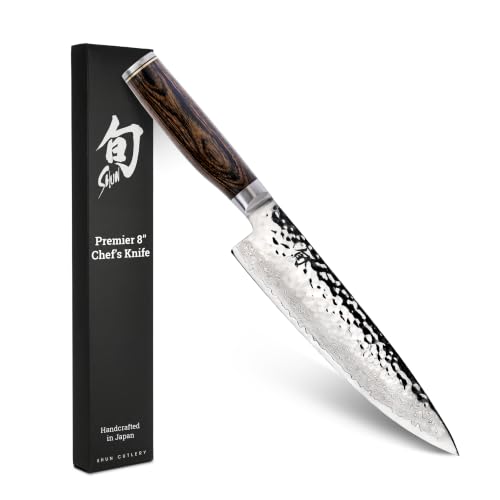
Shun Premier 8 Inch Chef’s Knife
The brand-name anchor of this list. Shun’s reputation rests on consistent grind geometry, quality control, and an established edge-holding track record across hundreds of reviews. You are paying partly for that reliability.
- Squirrel-tongue handle profile and hammered finish reduce food sticking and add grip
- Owner reports on long-term edge retention are the strongest in this group
- The premium price is roughly double what Atumuryou charges for a similar steel profile
Skip it if your budget is capped near $80; the performance gap between Shun and the mid-tier options does not scale linearly with the price.
Buying Guide
Steel Type and Edge Retention
High-carbon steel cuts the keenest edge and holds it longest but rusts if neglected. VG10 and 9Cr18MoV are stainless steels used in Japanese knives that resist corrosion but trade some edge-holding for convenience. A three-layer construction uses a hard core between softer cladding, which protects the cutting layer while allowing a thin grind. Decide how much maintenance you will realistically do: if the answer is “none beyond a quick rinse,” stick with stainless or carbon-stainless blends.
Blade Geometry and Rocker Profile
Japanese chef knives and gyutos tend to be thinner behind the edge than Western counterparts, which means cleaner slices but more vulnerability to chipping on hard ingredients like pumpkin or frozen items. A santoku has a flatter profile suited to push-cutting rather than rocking. If you slice soft produce and boneless proteins, a thin Japanese grind is an upgrade. If you break down whole chickens or face dense root vegetables regularly, a slightly thicker grind or a rocking chef profile matters more.
Handle Material and Balance
Pakkawood and resin handles resist moisture and temperature changes far better than plain wood. Traditional wa handles are lighter and more comfortable for pinch-grip work but can feel hollow in larger hands. Weight distribution matters more than total mass: a head-heavy knife tires your wrist over long sessions, while a tang-heavy handle can make the tip feel sluggish. Check owner feedback on specific models because the same blade can balance differently depending on the handle attachment.
Our Verdict
Top pick: the Atumuryou VG10 Damascus at $79.99 gives the best balance of steel quality, initial sharpness, and durability for the money. Budget pick: the imarku Santoku 7 Inch under $40 is a legitimate first knife that will not embarrass you in a kitchen. A Shun Premier wins the condition where you want one knife you never think about maintaining and have a budget that allows it.
FAQ
Do Japanese chef knives require special care?
Hand-wash and dry immediately regardless of steel type, but carbon steel specifically needs to be dried right away and occasionally oiled to prevent surface rust. Avoid the dishwasher and magnetic strips on hard surfaces where the edge can ding.
Is a santoku the same as a chef knife?
Not exactly. A santoku typically has a shorter, flatter blade with a sheepsfoot tip, optimized for push-cutting and vertical chopping. A gyuto or Japanese chef knife has a longer, curved profile that accommodates a rocking motion closer to a Western chef knife.
Does Damascus layering improve performance?
The visible Damascus pattern is cosmetic cladding over a cutting steel core. What matters is the core steel. A VG10 core with Damascus layers cuts identically to the same VG10 in a plain finish; the layers add visual appeal and marginal corrosion protection for the softer outer layers.
How often will I need to sharpen a Japanese knife?
With proper honing on a ceramic rod every few sessions, expect to fully sharpen every one to three months for daily home use. Cheaper stainless steels like 9Cr18MoV will dull faster than VG10 or high-carbon, so budget an extra session or two per quarter.