Key takeaways
- Best deep cycle marine batteries: the right pick depends on your boat and charging setup For most boaters, the best deep cycle marine batteries are a properly sized 12-volt AGM battery for a straightforward, lower-cost replacement or a lithium iron…
Best deep cycle marine batteries: the right pick depends on your boat and charging setup
For most boaters, the best deep cycle marine batteries are a properly sized 12-volt AGM battery for a straightforward, lower-cost replacement or a lithium iron phosphate (LiFePO4) battery for frequent use, lower weight, and faster recharging. Flooded lead-acid is worth considering when purchase price matters most and you can check water levels and provide ventilation. Compare usable capacity—not just the amp-hour label—along with reserve capacity, charging compatibility, dimensions, and weight before buying.
AGM vs. lithium vs. flooded: a head-to-head comparison
The figures below are useful planning ranges for common 12-volt, roughly 100-Ah deep cycle batteries, not specifications for every model. Battery construction, temperature, discharge rate, and manufacturer limits can change actual results. Confirm the data sheet and the fit in your boat before purchase.
Our top picks

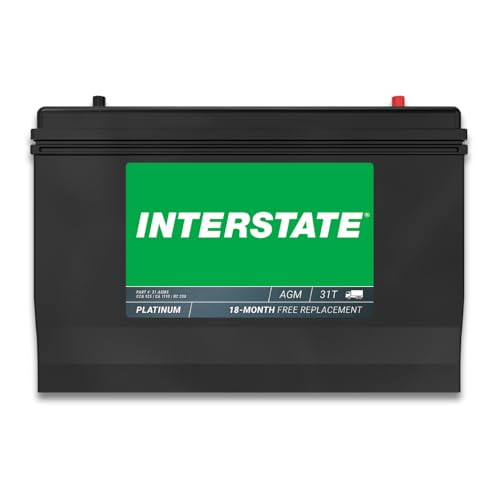
As an Amazon Associate we earn from qualifying purchases at no extra cost to you. Ratings are shown as listed on Amazon.
| Type | Typical rated capacity | Practical usable capacity | Typical reserve capacity | Approx. weight | Typical dimensions | Maintenance and charging |
|---|---|---|---|---|---|---|
| Flooded lead-acid | 80–110 Ah | About 40–55 Ah for good service life | About 150–200 minutes | 55–70 lb | About 12.9 × 6.9 × 8.9 in | Check electrolyte where serviceable; ventilate during charging; use a compatible lead-acid charger |
| AGM lead-acid | 80–110 Ah | About 40–55 Ah for good service life | About 150–200 minutes | 60–75 lb | About 13.0 × 6.8 × 9.4 in | Sealed and generally maintenance-free; charger must match the battery’s AGM profile |
| LiFePO4 lithium | 100 Ah | Often 80–100 Ah, subject to manufacturer limits | Not directly comparable; check the specified discharge rate | 22–35 lb | About 13.0 × 6.8 × 8.5 in | No watering; requires a compatible charger and a battery management system (BMS) |
Dimensions are approximate examples of common group-size formats, not guaranteed fit measurements. Some lithium batteries use a smaller case than a lead-acid battery with a similar capacity. Allow room for terminals, cables, hold-down hardware, and safe ventilation where required.
Capacity: compare usable energy, not just amp-hours
A 100-Ah rating does not mean every chemistry delivers 100 Ah in everyday use. Lead-acid batteries typically provide better service life when routinely discharged only partway, so a conservative planning estimate is around 50 Ah usable from a 100-Ah battery. Many LiFePO4 models permit a deeper discharge, making roughly 80–100 Ah available, but the battery manual sets the actual limit.
Estimate your load by adding the amp draw of each device multiplied by its hours of use. For example, a 4-amp trolling motor running for five hours uses about 20 Ah, before accounting for other electronics, changing motor demand, battery aging, or cold weather. Choose capacity with a margin rather than planning to drain the battery completely on every trip.
Reserve capacity: useful for lead-acid, but not the whole story
Reserve capacity (RC) is the number of minutes a fully charged lead-acid battery can supply 25 amps before reaching a specified voltage. A battery rated at 180 minutes therefore provides a standardized comparison point, not a promise of three hours for your boat’s particular equipment. Actual runtime depends on current draw, temperature, battery condition, and the cutoff voltage of the load.
Lithium batteries may not publish RC in a directly comparable way. For a lithium option, prioritize rated amp-hours, permitted continuous discharge, BMS limits, and manufacturer runtime guidance for your load. For any chemistry, calculate expected use from your actual equipment rather than treating RC as a universal runtime figure.
Choose by boating situation
| Your situation | Best fit to consider | Why | Check before buying |
|---|---|---|---|
| Occasional day trips and a tight upfront budget | Flooded deep cycle | Usually the lowest purchase cost, with widely available replacement options | Tray fit, venting, access for maintenance, and safe battery restraint |
| Regular use with a simple lead-acid replacement | AGM deep cycle | Sealed construction avoids routine watering and is convenient in many installations | AGM charging profile, weight capacity, and the battery’s permitted mounting position |
| Frequent fishing trips, long accessory use, or a weight-sensitive boat | LiFePO4 deep cycle | More usable capacity per rated Ah, lower weight, and often faster charging | Charger and alternator compatibility, BMS limits, cold-weather charging protection, and upfront cost |
| Long stretches away from shore power | Size any chemistry to the energy budget; consider LiFePO4 for repeated deep cycles | Runtime depends on total daily use and the energy available between charges | Daily Ah consumption, solar or generator input, and reserve for poor weather |
Recharge speed and charging-system compatibility
Lithium can accept a higher charging current than many lead-acid batteries, so it may recharge faster when the charger and wiring can supply that current. The battery itself does not guarantee a quick recharge: charger output, cable size, alternator capacity, temperature, and the battery’s charge limits all matter. A small onboard charger can make even a lithium battery slow to refill.
Before switching chemistries, check the manufacturer’s charging-voltage and current requirements. A charger with separate flooded, AGM, or lithium settings is useful, but confirm that its profile matches the specific battery. For an alternator-charged lithium house battery, verify that the system is designed for lithium; an appropriate DC-to-DC charger may be needed to manage current and protect the charging system.
LiFePO4 batteries generally must not be charged below their specified minimum temperature unless they have suitable low-temperature protection. Do not assume that a BMS makes every charging arrangement safe; follow the battery and boat-equipment manuals.
Weight, dimensions, and installation realities
Replacing a 65-pound lead-acid battery with a 25-pound lithium battery can remove about 40 pounds from the boat. That eases handling and may help on a weight-sensitive craft, but it does not remove the need for a secure battery box or hold-down. A loose battery can shift under acceleration and rough water.
Measure the tray’s internal length, width, and height, then check clearance above the terminals and space for cable bends. A nominal group-size label is a useful starting point, not proof that a battery will fit. Check terminal type and location, polarity, hold-down compatibility, and whether the manufacturer permits the planned orientation. Flooded batteries require appropriate ventilation and protection against spills; sealed AGM and lithium batteries still need installation that meets their manuals and local boating requirements.
In many installations, the first trouble is not simply a worn case: it is corrosion at terminals, loose restraints, damaged cables, or a charging setup that does not match the battery. Inspect connections periodically, keep terminals secure and protected, and avoid mixing old and new batteries in the same bank unless the manufacturer specifically allows it.
What will it cost over time?
As a broad U.S. market guide in 2026, a common deep cycle flooded or AGM battery often falls around $100–$350, while a 100-Ah LiFePO4 battery commonly costs about $250–$700 or more. Prices vary with capacity, BMS features, warranty, and construction. Lithium’s higher purchase price may be offset by lower weight and more usable energy per charge, but the comparison only makes sense if your charger and electrical system are compatible.
Bottom line
Choose flooded lead-acid when low upfront cost and routine maintenance fit your use. Choose AGM when you want a sealed, low-maintenance lead-acid option and your charging system supports it. Choose LiFePO4 when you use the boat often, benefit from lower weight and deeper usable capacity, and can verify charging compatibility. In every case, size the battery from your real load, confirm the manufacturer’s reserve and discharge specifications, and measure the installation space before ordering.