Key takeaways
- Compare the best hip adductor machines for home gyms, from plate-loaded inner and outer thigh frames to a compact band trainer that fits a bedroom corner.
Squats, presses, and deadlifts build the big muscles of the leg, yet they barely touch the adductors, the group running down the inner thigh. Few free-weight movements load the legs as they squeeze together, so the inner thigh is often the weakest link in a strong lower body. That gap matters beyond looks: strong adductors help hold the knee in line during squats and steady the pelvis when you run. A dedicated machine loads that squeeze pattern directly, with a guided path and resistance you can raise in controlled steps.
This guide covers seated inner-thigh work and the combo frames that pair it with outer-thigh training. Unlike the glute machine roundups, which focus on hip extension work such as thrusts and kickbacks, the adduction movement leads here. Four picks are plate-loaded steel frames that switch between adduction and abduction, and the fifth is a compact band-driven trainer for small rooms.
Disclosure: As an Amazon Associate, we earn from qualifying purchases made through links on this page, at no extra cost to you.
How to Choose a Hip Adductor Machine
Why the adductors deserve their own station
The adductor group works every time your leg moves toward the midline of the body, and it fires hard to keep the knee tracking over the toes at the bottom of a squat. Runners lean on it for pelvic control with every stride. Because barbells and dumbbells offer almost no direct way to train the squeeze, this group lags behind the quads and glutes, and lagging adductors are a common thread in groin strains.
One frame, two directions
Most home machines in this category are combo units. The pads sit outside the knees for abduction, pushing the legs apart, then reposition inside the knees for adduction, squeezing them together. The changeover should take seconds: a lever or pin moves the arms, and the pads flip or rotate to face the other way. If a listing trains only one direction, know that before you buy: a single-direction unit leaves half of this guide’s purpose undone.
The entry angle is a joint-safety setting
Combo machines let you set the initial position of the pads, usually in fixed steps of about 15 degrees per side. That setting decides how wide your legs sit before the first rep. Choose an entry angle inside your natural range: forcing the hips open wider than they comfortably go strains the joint and the groin, while too narrow a setup shortens the work. Begin one step inside your comfortable limit and widen as the muscles warm up.
Pads should follow your leg, not fight it
Better machines use thigh pads that rotate a full 360 degrees. As your leg moves through the arc, the pad rolls with the thigh instead of dragging across it, so pressure stays on the thigh and the knee is not twisted sideways. Fixed pads are the weak point of budget frames: the edge digs in, the shin gets levered at an angle, and the knee absorbs sideways torque. Thick padding matters too, since the load passes through a small patch of thigh.
Match the load steps to a smaller muscle group
The adductors are strong for their size, but they are not the quads, and they progress in smaller jumps. Pin-select weight stacks on gym machines change in fine steps, which suits this group well. Plate-loaded home frames depend on the smallest plates you own: a pair of 2.5 lb change plates gives gentle jumps, while loading only 10 lb plates makes every increase a leap. Budget for change plates if you go plate-loaded.
Know the budget families for what they are
Below the steel frames sits a cheaper family: squeeze-style thigh exercisers and small spring or band devices clamped between the knees. They cost little and can teach the squeeze pattern, but there is no dial, no stack, and no honest number to beat next week, so progress is guesswork.
A seat and handles keep the work in the thighs
Under a heavy squeeze, the body cheats by rotating the pelvis and leaning the torso. A firm seat, a backrest to brace against, and side handles give fixed points to lock against, so the load stays in the adductors. Backrest angle also changes fit: more positions mean the pad line can match short and tall legs alike. Finally, measure the footprint with the legs at their widest setting, because combo frames swing wider than their parked dimensions suggest.
The Best Hip Adductor Machines
1. HVO Hip Abductor Machine

The HVO is the most flexible plate-loaded pick here because its loading rod accepts both 1 in and 2 in plates, so it works with whatever plate set a home gym already owns. The rod handles up to 300 lb, and two storage rods rated at 400 lb each keep spare plates on the frame.
A six-position lever sets the entry angle, the thigh pads rotate a full 360 degrees so they follow the leg through both directions, and the backrest adjusts across four positions for different leg lengths. Its footprint is the tightest of the plate-loaded group here.
Specs
- Resistance: plate-loaded, fits 1 in and 2 in plates
- Loading: rod holds 300 lb; storage rods 400 lb each
- Angle settings: 6 positions, lever adjusted
- Thigh pads: 360-degree rotating
- Backrest: 4 positions
- Dimensions: 39.49 x 63.17 x 38.73 in (D x W x H)
- Maximum weight recommendation: 1,600 lb (maker figure)
2. Mikolo Plate-Loaded Hip Abductor Machine
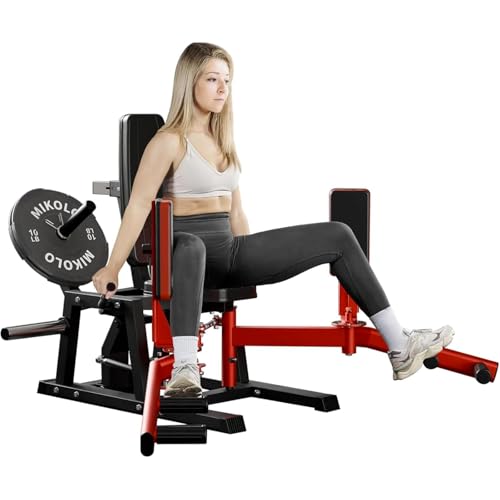
The Mikolo is the big-frame option, a wide steel unit built around a six-level gear system that steps the pad angle in 15-degree increments for both directions. Plate storage is built into both sides, with pins holding four to six Olympic plates each.
Seat and back cushions are a full 2 in thick, and the backrest adjusts across four settings. The trade-offs are size and logistics: at 79 in long it needs a dedicated stretch of floor, and it ships in two boxes.
Specs
- Resistance: plate-loaded, 2 in Olympic plates
- Gear system: 6 levels, 15-degree steps
- Backrest: 4 settings
- Storage: pins hold 4 to 6 plates per side
- Padding: 2 in seat and back cushions
- Dimensions: 79 x 42 x 44 in (L x W x H)
- Maximum weight recommendation: 1,200 lb (maker figure)
- Warranty: 2 years
3. Hipicute Hip Abductor Machine

The Hipicute earns its place by fitting the users most combo machines leave out: shorter lifters. Owners as short as 4 ft 11 in report reaching every adjustment and lining the pads up without compromise, thanks to the four-position backrest and rotating pads. Six gear levels step 15 degrees per side, the loading rod takes up to 300 lb, and two storage sleeves hold 400 lb each.
The frame is wide at full spread, up to 70.8 in, so it still needs a real patch of floor. Leg travel at some settings feels limited to longer-legged users: the geometry favors compact frames.
Specs
- Resistance: plate-loaded, 2 in Olympic plates
- Loading: rod holds 300 lb; storage sleeves 400 lb each
- Max user weight: 440 lb
- Gear system: 6 levels, 15-degree steps
- Thigh pads: 360-degree rotating
- Backrest: 4 positions
- Dimensions: 68.5 x 70.8 x 43.7 in (L x W x H)
- Machine weight: Not published
4. JELENS HA01 Hip Abductor Machine

The HA01 is the value route into plate loading. The steel frame wears a powder-coat finish, the pads move through five angle levels, and the backrest adjusts across three positions. Plate pins sit on both sides and at the back, and rotating thigh cushions pair with extended foot pedals that give longer legs a solid brace.
The honest gaps are in the paperwork: the maker publishes no footprint, machine weight, or max user weight, so you judge size from listing photos and measure your floor against the swing of the arms yourself. It is still the lowest-cost route here to real plate-loaded adduction and abduction.
Specs
- Model: HA01
- Resistance: plate-loaded
- Frame: steel, powder coat finish
- Angle levels: 5
- Backrest: 3 positions
- Storage: plate pins on both sides and rear
- Thigh pads: rotating cushions; extended foot pedals
- Dimensions: Not published
- Max user weight: Not published
5. FED Fitness FLYBIRD HA1 Hip Abductor and Adductor Machine

The HA1 is the compact band-driven pick, built for rooms where a plate-loaded frame will not fit. Six bands rated at 18 lb each combine for up to 108 lb of resistance, added or removed in band steps. A pin and a flip of the pads switch between abduction and adduction, and dual foot bars change foot position to shift emphasis across the glutes and inner thighs.
At roughly 16 x 35 in it fits a bedroom corner, and band resistance keeps it quiet. The limits follow from the design: the top setting is light for strong lifters, the steps are coarse compared with plates, and the band figure is a tension estimate, not a measured load. Taller users over 6 ft may find the frame small. It suits entry-level and daily activation work; for long-term strength, the frames above it win.
Specs
- Model: HA1
- Resistance: 6 bands at 18 lb each, up to 108 lb combined
- Switching: pin and pad flip between adduction and abduction
- Foot bars: dual positions
- Footprint: about 16 x 35 in
- Max user weight: Not published
- Machine weight: Not published
Comparison Table
| Machine | Resistance | Angle settings | Footprint | Best for |
|---|---|---|---|---|
| HVO Hip Abductor Machine | Plates, 1 in and 2 in | 6 positions | 39.49 x 63.17 in | Mixed plate sets, tight space |
| Mikolo Plate-Loaded | Plates, 2 in | 6 levels, 15-degree steps | 79 x 42 in | On-frame storage, warranty |
| Hipicute Hip Abductor Machine | Plates, 2 in | 6 levels, 15-degree steps | 68.5 x 70.8 in | Shorter users |
| JELENS HA01 | Plates, 2 in | 5 levels | Not published | Lowest-cost plate loading |
| FED Fitness FLYBIRD HA1 | Bands, up to 108 lb | Pin and pad flip | About 16 x 35 in | Small rooms, quiet use |
FAQ
Do hip adductor machines help squats and running?
Yes, indirectly. The adductors help keep the knee tracking in line with the toes during a squat and steady the pelvis with each stride when you run. Building them on a machine removes a weak link, although the work supports your main lifts, not replaces them.
What is the difference between adduction and abduction on a combo machine?
Adduction squeezes the legs together against the pads and trains the inner thigh. Abduction pushes the legs apart and trains the outer hip and glute medius. A combo machine trains both from one seat by moving the arms and flipping the pads.
How wide should I set the pads for adduction work?
Set the entry angle one step inside the widest position you can reach without strain. Your hips should feel a stretch, never a pinch, and the first reps should stay smooth. Widen the setting over weeks as you adapt.
Are plate-loaded machines better than band-driven trainers?
For long-term strength, yes. Plates give exact, repeatable loads and small jumps with change plates. Band trainers are quieter and far smaller, but their steps are coarse and the resistance an estimate, so they suit beginners and light daily work.
How much floor space does a hip adductor machine need?
Plate-loaded combo frames are wide: plan for roughly 40 to 80 in of length and up to about 71 in of width at full leg spread, plus room to load plates from the side. The band trainer here needs only about 16 x 35 in.
Conclusion
For most home gyms, the HVO is the balanced pick: it accepts both plate sizes, keeps a compact footprint for a plate-loaded frame, and covers the full adjustment checklist. The Mikolo suits buyers who want storage pins and a longer warranty and have the floor for it, the Hipicute is the fit-first choice for shorter users, and the JELENS HA01 trims cost by trimming paperwork. If the room is small or the training light, the FED Fitness HA1 trades load for a footprint that fits almost anywhere. Whichever frame you choose, set the entry angle with respect for your hips, load in small steps, and the inner thigh will stop being the forgotten half of leg day.
FAQ
Do hip adductor machines help squats and running?
What is the difference between adduction and abduction on a combo machine?
How wide should I set the pads for adduction work?
Are plate-loaded machines better than band-driven trainers?
How much floor space does a hip adductor machine need?
More from Amazon
Programs that pair well with the guide above. Offers and eligibility are set by Amazon and may change.
Set up recurring deliveries of everyday items on eligible products. Terms and savings are set by Amazon.
Explore Subscribe & SaveCollect the home and kitchen items you want in one registry that guests can shop from.
Create a wedding registryFree shipping on eligible items, Prime Video and more. Eligible new members can start with a free trial.
Start a Prime free trialAudiobooks and podcasts to listen to on the go. Eligible new members can start with a free trial.
Try Audible freeAs an Amazon Associate we earn from qualifying purchases.