Key takeaways
- Compare the best seated row machines for home gyms, from plate-loaded leverage and cable models to a compact linear row, with specs and setup help.
A seated row machine does one job: it lets you pull heavy, horizontal loads into your mid-back while your torso stays locked against a pad. That fixed position is the whole point. With no hip hinge to manage, the lats, rhomboids, and traps take the load and your form stays the same on every rep.
This guide is narrower than our lat pulldown machine roundup, where many towers add a low pulley and call the floor position a row station. Here, every machine exists for the seated row itself: four chest-supported leverage machines, one cable row, and a linear bearing row on a fixed track. If the row is an afterthought, it did not make this list.
Disclosure: As an Amazon Associate, we earn from qualifying purchases made through links on this page, at no extra cost to you.
How to Choose a Seated Row Machine
The chest pad is the feature that defines the category. Pressing your sternum into a firm pad locks the torso in place, which removes the hip swing and body English that creep into heavy rows. It also takes the lower back out of the support role, so lifters who cannot load a bent-over row comfortably can still train the mid-back hard. The trade is honest: a free row with no pad lets you reach further forward through a longer range, and it trains the spinal erectors and grip along the way. A chest-supported machine gives up that extra range and stabilizer work in exchange for repeatable, back-friendly loading.
On a cable machine, the pulley height sets the pull line. The low pulley should sit level with your hands in the seated position, so the cable runs straight back and the load lands on the lats and mid-back. A pulley mounted too high drags the handle up at an angle, and the work shifts toward the upper traps and rear shoulders whether you want it there or not. On leverage machines the arm geometry fixes the path instead; either way, the handles should meet your hands at lower-chest height at the finish.
Fit the seat and chest pad to your torso and thigh length. Seat height decides where the handles finish against your body, and chest pad depth decides how far you reach at the front of the rep. Tall lifters need pad travel that keeps a slight bend in the elbows at full reach; shorter lifters need the pad close enough that the shoulders stay down. Machines with several positions on both parts fit a household of mixed sizes far better than fixed geometry.
A grippy footplate is your foundation. You brace through your feet on every rep, and that brace keeps you and the machine planted when the load gets heavy. Look for a wide plate with a textured or raised surface. Smooth painted steel lets shoes skate mid-set, and a sliding foot turns a back exercise into a balance drill.
Independent arms fix left-right gaps; a single path feels even. Leverage machines with two arms let each side pull its own load, so a dominant side cannot take over the rep, and one-arm rows are there when you want them. A cable station or a fixed bar joins both hands to one load path, which feels smoother and simpler, and many lifters prefer that even tension. Known imbalance points to independent arms; general back work is fine either way.
Check the load ceiling first. Back muscles are among the strongest in the body, and a dedicated rower progresses fast. A machine capped near 270 pounds suits a beginner for a year or two and then becomes the limit. The 400-pound class covers most home lifters for good. Count the plates you own, too: a high ceiling is useless if your plate collection tops out below it.
Leave working room behind and around the frame. Cable machines need clear floor behind the seat for the cable’s full travel, and leverage arms swing through an arc that should not clip a wall or a rack upright. Measure the frame, then add the space your body and the moving arms use before you commit to a corner.
The 5 Best Seated Row Machines
Valor Fitness CB-14 Seated Row Machine
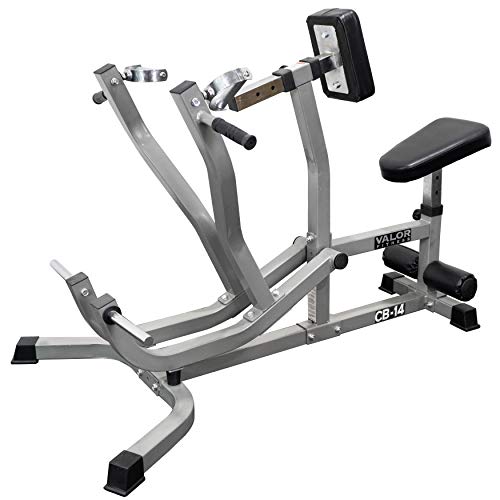
The CB-14 is the imbalance hunter of this group. Its two converging arms move on their own, each loaded to 200 pounds, so the weaker side of your back has to produce its share of every rep instead of riding along. Two grip choices per arm: rotating handles that let the wrists settle naturally, and fixed handles that mimic a T-bar row line. The seat adjusts across four positions and the chest pad across five, which covers a wide span of torso lengths. Olympic adapter sleeves come in the box, so 1-inch plates load directly and 2-inch plates fit with the adapters on. The 12-gauge frame is the lightest build here, so plan on a touch of flex near the per-arm ceiling.
Specs
- Model: CB-14 (UPC 844192004886)
- Type: Plate-loaded leverage row, independent converging arms
- Dimensions: 54 x 34 x 41 in (L x W x H)
- Capacity: 400 lb total, 200 lb per arm
- Frame: 12-gauge steel
- Seat: 4 positions
- Chest pad: 5 positions
- Grips: Rotating handles and fixed handles
- Plate fit: 1 in posts; 2 in Olympic adapters included
- Product weight: 81 lb
Titan Fitness Plate-Loaded Seated Row Machine

Titan’s entry is the adjustment leader. A fixed bar joins the two arms and offers six width positions, so you can row wide for the upper back or narrow for the lats without swapping attachments. Six seat heights and five chest pad angles give it the widest fit range in this roundup, and bolt-down holes in the base let you anchor the frame to the floor for good. Both arms pull together here, which keeps the movement simple and even. The honest limit is the ceiling: at 270 pounds, this is the lightest capacity on the list, and strong rowers will reach it. For lifters still building toward that load, the fit range is the best reason to pick it.
Specs
- Type: Plate-loaded leverage row, fixed bar
- Capacity: 270 lb
- Arm widths: 6 positions
- Seat heights: 6 positions
- Chest pad: 5 angle positions
- Plate fit: Olympic 2 in sleeves
- Mounting: Bolt-down holes in base
SPART AX9005 Seated Row Machine

The SPART carries the highest ceiling here, 440 pounds across two independent arms, which makes it the pick for lifters who already row heavy and do not want the machine to set their limit. The handles rotate a full 360 degrees, so your wrists find their own angle through the pull instead of following a fixed one. Six seat positions and six chest pad positions match the Titan for fit range, and adapters in the box take both 1-inch and 2-inch plates. The brand is newer than the established names here, and its long-term support record is thinner, which is the main trade for the capacity.
Specs
- Model: AX9005
- Type: Plate-loaded leverage row, independent arms
- Dimensions: 63.9 x 37.3 x 43.8 in (L x W x H)
- Capacity: 440 lb
- Seat: 6 positions
- Chest pad: 6 positions
- Grips: 360-degree rotating handles
- Plate fit: 1 in and 2 in adapters included
- Included: Bicep curl bar
Body-Solid GSRM40 Seated Row Machine

The GSRM40 is the cable option, and it feels different from every leverage machine above. Plates load on a post and pull through a cable, so tension stays even from the first inch of the rep to the last, with none of the arc-based load change a lever arm produces. The low pulley exits at seated hand height, which keeps the pull line straight into the mid-back. Four-way handgrips let you change hand position without swapping attachments, and the DuraFirm pads are the thickest-feeling set in this group. It loads standard 1-inch plates, with an Olympic adapter sleeve available if your collection is 2-inch. Body-Solid does not publish a load capacity for this model, and it backs home use with lifetime coverage, the strongest support terms here.
Specs
- Model: GSRM40
- Type: Cable seated row, plate post loading
- Dimensions: 54 x 44 x 39 in (L x W x H)
- Capacity: Not published
- Plate fit: 1 in post; Olympic adapter OAS14 optional
- Pads: DuraFirm seat and chest pads
- Grips: Four-way hand positions
- Product weight: 88 lb
- Warranty: Lifetime for home use
Mikolo SR06 Ultra Linear Row Machine

The SR06 takes a third route: a knurled bar rides on linear bearings along a fixed track, so the path never wanders and there are no cables or lever pivots to maintain. There is no chest pad on this design. Your seat position and the fixed track do the guiding, giving it a feel closer to a machine-guided barbell row. The bar offers narrow, medium, and wide grips, pronated or supinated, and each side loads to 220 pounds for a 440-pound total. Rear posts store spare plates off the floor. At about 5.8 square feet by the maker’s measure, it owns the smallest footprint in this roundup, which makes it the one to look at when floor space is the hard limit.
Specs
- Model: SR06 Ultra
- Type: Plate-loaded linear bearing row
- Capacity: 440 lb total, 220 lb per side
- Frame: 2 x 2 in, 14-gauge steel
- Weight horns: 9.25 in loadable
- Plate fit: 1 in and 2 in plates
- Grips: Multi-grip knurled bar, narrow to wide
- Footprint: About 5.8 sq ft (maker figure)
- Product weight: 114 lb
Comparison Table
| Machine | Type | Capacity | Arms | Chest Pad |
|---|---|---|---|---|
| Valor Fitness CB-14 | Leverage | 400 lb | Independent | 5 positions |
| Titan Plate-Loaded Seated Row | Leverage | 270 lb | Fixed bar | 5 angles |
| SPART AX9005 | Leverage | 440 lb | Independent | 6 positions |
| Body-Solid GSRM40 | Cable | Not published | Single cable path | Fixed DuraFirm pad |
| Mikolo SR06 Ultra | Linear bearing | 440 lb | Guided bar | None |
Frequently Asked Questions
Is a chest-supported row easier on the lower back than a barbell row?
Yes. The pad carries your torso, so the lower back stops working as a support beam and the mid-back takes the load. Lifters managing a cranky lower back can usually row heavier and longer here. The barbell row still builds more total-body strength, because the hinge position itself is part of the training.
Should I pick independent arms or a fixed bar?
Independent arms expose and fix a stronger side doing extra work, and they allow true one-arm rows. A fixed bar or a cable path feels smoother and needs less attention per rep. If you already know one side of your back pulls harder, independent arms are worth it.
How much capacity does a home rower actually need?
More than you expect. Back training loads climb quickly once form is locked in, and many lifters pass 200 pounds within their first couple of years. A 400-pound ceiling covers most home gyms for good; the 270-pound machine here suits newer lifters or anyone who rows for higher reps.
Do these machines take the plates I already own?
Most likely. Four of the five load both 1-inch and 2-inch plates out of the box or with included adapters. The Titan takes Olympic 2-inch plates only, and the Body-Solid loads 1-inch plates unless you add its adapter sleeve. Check your plate holes against the post before ordering.
How much clear space does a seated row machine need?
Plan for the frame footprint plus a step of working room on the seat side and clear space behind for cable travel or arm swing. The compact linear row here fits in about six square feet of floor, while the wider leverage frames need a patch closer to five feet deep and three feet wide.
Conclusion
For most home gyms, the Valor CB-14 is the seated row to buy first: independent arms, a 400-pound ceiling, and fit adjustments that cover nearly everyone. The Titan trades capacity for the best grip-width and fit range, while the SPART is the heavy lifter’s pick with the highest ceiling in the group. Choose the Body-Solid GSRM40 if you want the even pull of a cable and lifetime home coverage behind it, and the Mikolo SR06 if floor space rules every other decision. Measure your room, count your plates, and pick the machine whose limit you will not reach.
More from Amazon
Programs that pair well with the guide above. Offers and eligibility are set by Amazon and may change.
Set up recurring deliveries of everyday items on eligible products. Terms and savings are set by Amazon.
Explore Subscribe & SaveCollect the home and kitchen items you want in one registry that guests can shop from.
Create a wedding registryFree shipping on eligible items, Prime Video and more. Eligible new members can start with a free trial.
Start a Prime free trialAudiobooks and podcasts to listen to on the go. Eligible new members can start with a free trial.
Try Audible freeAs an Amazon Associate we earn from qualifying purchases.