Key takeaways
- Compare five freestanding dip stations and power towers with their own floor frames, judged on grip width, base stability, height and room for loaded dips.
A dip station in this guide means one thing: a single freestanding frame on its own floor base, carrying a pair of dip handles. That is a different shelf from the dip bars covered elsewhere on this site. Separate bar pairs can drift apart and store flat, a wall mounted station needs studs and a permanent install, and low parallettes are floor tools for L-sits and handstand work.
The five picks below are all one-piece frames, most of them power towers where the dip handles share an upright with a pull up bar and a knee raise station. They are judged as dip stations first: how the handles sit, how the base behaves under load, and how much room your legs and a loaded belt have at the bottom.
Disclosure: As an Amazon Associate, we earn from qualifying purchases made through links on this page, at no extra cost to you.
How to Choose a Dip Station
Grip width should land near your shoulders. Your hands belong under or just outside your shoulders, with your upper arms close to vertical at the top of the rep. Handles set much wider roll the shoulders outward and push the load onto the front of the joint. Handles set too narrow turn the dip into a triceps-only movement and crowd your ribs. Towers fix the width at the factory, so check the handle spacing against your shoulder measurement before you buy.
Stability is decided at the floor. A dip moves your whole body weight up and down in front of the uprights, and the load shifts forward as you lean into the rep. Long feet spread that load, and a cross member tying the base together stops the frame twisting as one unit. Short feet and a light frame will rock, and the rocking gets worse when you hang plates from a dip belt. If you plan to dip loaded, put base length and frame weight ahead of every other figure on the page.
Handle angle and grip size spare your wrists. Straight handles force the wrist into extension under load. Handles that angle slightly, so the hands sit in a more neutral line with the forearms, take pressure off the joint, and a tube diameter that fills the palm spreads force across the hand. The angle and diameter matter more than foam padding.
Height has to clear your legs and your plates. At the bottom of a full dip your body hangs well below the handles. On a short station your knees or feet reach the floor before your elbows reach a full bend, and the rep ends early. A belt with plates hangs lower still. Taller users should look for handles that sit high with open space beneath them, and confirm the floor-to-handle height, not the pull up bar height.
Pads on a power tower are not dip equipment. The back pad and forearm pads serve the vertical knee raise station: they hold your back and arms while your legs swing. They do nothing for a dip, and on some frames a back pad sits close behind the handles and can brush your hips at the bottom of a rep. Judge a tower for dips by its handles and base.
Build the dip before you load it. If you cannot yet do a full bodyweight dip, loop a heavy resistance band across the handles and rest your knees in it; the band carries the most weight at the bottom, where you are weakest. Use a thinner band as you get stronger, then full bodyweight reps, and only then a belt with plates.
Depth is a shoulder decision. Lower until your upper arms are about parallel to the floor. Going deeper puts the shoulder into loaded extension, and the front of the joint takes the strain. Keep the descent controlled and stop if the shoulder pinches.
The 5 Best Dip Stations
1. BangTong&Li Power Tower — six frame heights for shared use

BangTong&Li builds this tower around a pull up bar that sets at six heights, from 74.8 to 82.68 inches, the easiest frame here to fit under different ceilings and to different users. The dip handles sit on the uprights below the knee raise pads, on a steel base with anti-slip end caps. A 330 pound capacity gives a mid-weight user real headroom for belt-loaded dips later on.
The honest limits are what the listing leaves vague. Footprint figures vary between listings of this model, and the dip handle width is not published, so check the grip spacing on arrival. At about 51 pounds the frame is mid-weight here: steady for strict reps.
Specs
- Type: Freestanding power tower, single frame
- Model: BT-POWERTOWER
- Capacity: 330 lb
- Height settings: 6, from 74.8 to 82.68 in
- Dip handle width: Not published
- Frame: Alloy steel
- Weight: About 51 lb
- UPC: 769891593281
2. Weider Power Tower — the long-running padded tower
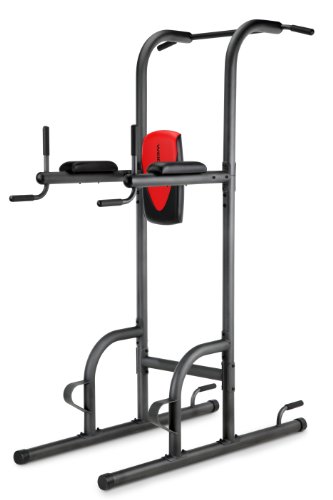
The Weider tower, model WEBE99712, is the established design in this group: a tall steel frame with a multi-grip pull up bar, dip handles, push up bars and a padded knee raise station. It carries a 300 pound user capacity, and its 57 by 41 inch footprint gives it the longest base here, exactly what you want under the forward lean of a dip set.
It is a fixed-height, fixed-width frame, so it suits one main user better than a household of different sizes. The dip handles are plain grips without an angled line, so wrist comfort depends on your hand placement. In return you get a proven frame and a base that stays planted.
Specs
- Type: Freestanding power tower, single frame
- Model: WEBE99712
- Capacity: 300 lb user weight
- Assembled size: 57 x 41 x 84 in (L x W x H)
- Stations: Pull up, dip, push up, vertical knee raise
- Dip handle width: Not published
- Frame: Steel
- Warranty: 90-day parts and labor
3. Body Champ VKR1010 Power Tower — wide H-base, four stations
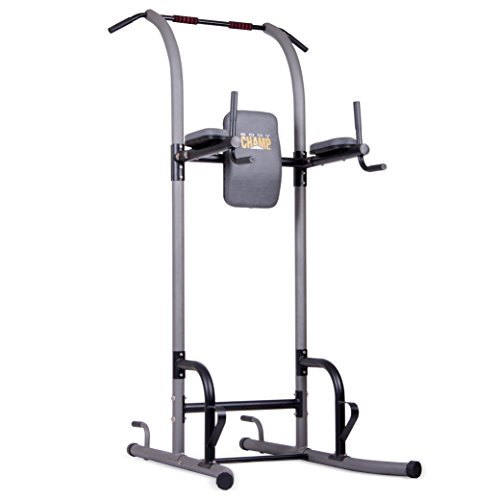
Body Champ’s VKR1010 spreads its frame over a 55 by 41 inch footprint with an H-shaped base, and that wide stance is its dip argument: the base resists the side-to-side twist a narrow frame shows when one arm drives harder than the other. Four stations share the frame — pull up bar, knee raise, dip handles and low push up bars — and the listed maximum user weight is 250 pounds.
That capacity is the ceiling to respect. A heavier user, or a mid-weight user planning a loaded belt soon, will outgrow it faster than the towers above it here. Within its limit it is a steady, simple frame that one person can still move.
Specs
- Type: Freestanding power tower, single frame
- Model: VKR1010
- Capacity: 250 lb
- Assembled size: 55 x 41 x 83 in (L x W x H)
- Stations: Pull up, dip, push up, vertical knee raise
- Dip handle width: Not published
- Frame: Steel
- Weight: 64 lb
4. Stamina 1690 Power Tower — the open frame with nothing in the way

The Stamina 1690, model 50-1690, strips the tower down to tubes and grips. There is no back pad and no forearm pads, so nothing crowds your hips at the bottom of a rep, and the open frame leaves the space under the handles clear for straight legs or a swinging belt. It covers pull ups, dips, push ups and knee raises with foam grips, in a 49 by 42.5 inch footprint for smaller rooms.
The trade is capacity and mass. The listed limit is 250 pounds, and at 54 pounds this is a light frame: fine for strict bodyweight work, less settled under loaded dips. The maker backs it with a one year frame warranty and 90 days on parts.
Specs
- Type: Freestanding power tower, open frame, no pads
- Model: 50-1690
- Capacity: 250 lb
- Assembled size: 49 x 42.5 x 81 in (L x W x H)
- Stations: Pull up, dip, push up, vertical knee raise
- Dip handle width: Not published
- Frame: Steel with foam grips
- Weight: 54 lb
- Warranty: 1 year frame, 90 days parts
5. SogesPower Power Tower — compact H-base with ten heights

SogesPower’s PSBB005 is the small-room pick. Its H-shaped base measures 32.3 by 29.5 inches, the smallest footprint here, with suction cup feet that want a flat, hard floor — the maker advises concrete over carpet. The pull up bar sets at ten heights, and the frame carries a 330 pound figure, joint highest here alongside the BangTong&Li.
Two cautions come straight from the listing. It states the bar height range two ways — 65 to 82.7 inches in one place and 74.8 to 90.6 inches in another — so measure your ceiling against the taller figure. The dip handle width is not published either. At about 28 pounds this is the lightest frame here: a compact station for controlled bodyweight dips, not heavy belt work.
Specs
- Type: Freestanding power tower, single frame
- Model: PSBB005
- Capacity: 330 lb
- Height settings: 10 positions; listing states both 65 to 82.7 in and 74.8 to 90.6 in
- Base: H-shaped, 32.3 x 29.5 in, suction cup feet
- Assembled size: 38.6 x 32.3 x 82.7 in (L x W x H)
- Dip handle width: Not published
- Frame: Alloy steel
- Weight: About 28 lb
Comparison Table
| Product | Type | Capacity | Base or footprint | Height adjustment | Best for |
|---|---|---|---|---|---|
| BangTong&Li Power Tower | Power tower | 330 lb | Own steel base, size varies by listing | 6 settings, 74.8 to 82.68 in | Shared use, ceiling fit |
| Weider Power Tower | Power tower | 300 lb | 57 x 41 in | Fixed | Long base, proven design |
| Body Champ VKR1010 | Power tower | 250 lb | 55 x 41 in, H-base | Fixed | Wide stance stability |
| Stamina 1690 Power Tower | Open frame tower | 250 lb | 49 x 42.5 in | Fixed | Clear space under handles |
| SogesPower Power Tower | Power tower | 330 lb | 32.3 x 29.5 in, H-base | 10 settings | Small rooms, hard floors |
Frequently Asked Questions
How wide should dip station handles be?
Close to your own shoulder width, or a touch wider. Hands under the shoulders keep the upper arms near vertical and share the load between chest and triceps. Much wider rolls the shoulders outward and loads the front of the joint; much narrower crowds the movement into the triceps alone. Towers fix the width, so compare the listed spacing with your shoulder measurement before buying.
Will a power tower wobble during dips?
A light frame on short feet can rock, because your weight hangs in front of the uprights and shifts as you lean. Long feet, a cross member tying the base together and a heavier frame all calm it down. Loaded dips ask the most of the base, so match the frame to the heaviest dipping you plan to do.
How deep should I dip on a station?
Lower until your upper arms are about parallel to the floor, then press back up. Deeper puts the shoulder into loaded extension and moves strain to the front of the joint without adding much for the chest. Keep the elbows tracking behind you and descend slowly.
Can I do dips if I am not strong enough yet?
Yes, with help. Loop a heavy resistance band across the dip handles and rest your knees in it; the band supports the most weight at the bottom of the rep, where you are weakest. Move to a thinner band, then full bodyweight reps, and add a dip belt only after bodyweight sets are solid.
Do the back and arm pads on a power tower help with dips?
No. Those pads belong to the vertical knee raise station: the back pad supports your spine and the arm pads hold your forearms while your legs raise. Dips use only the handles and the base under you. On some towers a back pad sits close behind the handles, so check it will not crowd your hips.
Conclusion
Buy the base first and the handles second. The Weider brings the longest footprint and a proven frame for one main user. BangTong&Li adds six height settings for shared rooms. Body Champ spreads the widest stance, the Stamina 1690 keeps the space under the handles open, and the SogesPower fits the smallest floor — with a listing you should measure twice. Set grips near your shoulders; dip to parallel.
FAQ
How wide should dip station handles be?
Will a power tower wobble during dips?
How deep should I dip on a station?
Can I do dips if I am not strong enough yet?
Do the back and arm pads on a power tower help with dips?
More from Amazon
Programs that pair well with the guide above. Offers and eligibility are set by Amazon and may change.
Set up recurring deliveries of everyday items on eligible products. Terms and savings are set by Amazon.
Explore Subscribe & SaveCollect the home and kitchen items you want in one registry that guests can shop from.
Create a wedding registryFree shipping on eligible items, Prime Video and more. Eligible new members can start with a free trial.
Start a Prime free trialAudiobooks and podcasts to listen to on the go. Eligible new members can start with a free trial.
Try Audible freeAs an Amazon Associate we earn from qualifying purchases.