Key takeaways
- Compare the best fly machines for home gyms, from plate-loaded pec decks to a selectorized fly and rear delt station, with specs on arms, cams and seats.
A dedicated fly machine does one job with a fixed, repeatable arc: it loads the chest through a wide squeeze in front of the body, then, with you turned around in the same seat, it loads the rear delts on the way back. That separates it from the cable machines covered elsewhere on this site. A functional trainer can imitate a fly with two low pulleys, but the handles wander and the path changes from set to set. It also separates a fly machine from a chest press machine. A press moves load in a straight push and leans on the triceps; a fly machine keeps the elbows at a near-fixed angle and puts the work on the pecs through horizontal adduction, the chest’s main job.
Every machine below trains both the pec fly and the reverse fly for rear delts, so one footprint covers the front and back of the shoulder girdle. Four are plate-loaded and one uses a pin-select stack. The differences that matter are the arm style, how the entry position adjusts, and how the resistance curve behaves.
Disclosure: As an Amazon Associate, we earn from qualifying purchases made through links on this page, at no extra cost to you.
How to Choose a Fly Machine
Decide between forearm pads and handles first. The classic pec deck uses padded arms: your forearm presses a vertical pad and the elbow stays bent near 90 degrees. That style is friendly to the shoulder joint because the elbow angle never changes. The other style uses straight handles gripped with a nearly straight arm, much closer to a dumbbell fly. It gives a longer lever and a deeper stretch, but puts more stress through the front of the shoulder. If your shoulders have a history of trouble, pads are the safer default.
Check the entry position adjustment. On a fixed machine, the arms rest behind the line of your shoulders, and reaching back to grab them under load is how shoulders get hurt. Better machines let you set the opening position across several notches, so the pads or handles begin in front of that danger zone and you only open the arc as far as your mobility allows. Treat a multi-notch entry adjustment as a core safety feature, not a luxury. A deep stretch under heavy load is the classic route to a torn pec, so the last notch is rarely the right one.
Confirm it trains rear delts properly. The second movement is half the value of this category. You sit facing the pad, rest your chest against it, and pull the arms back. Check that the pads or handles still line up with your shoulders in that position, that the chest pad is thick enough to brace against, and that switching over takes seconds rather than tools. Rear delts respond to modest loads and high reps, and most home lifters undertrain them.
Set seat height so the handles meet mid-chest. The seat is the main alignment tool. Set correctly, the pads or handles sit level with the middle of your chest and your shoulders stay down and back. Too low and the movement turns into a front delt exercise; too high and the arc pulls across the upper chest and neck.
Understand the cam curve. A cam is the shaped profile that changes leverage through the rep. On a good fly machine it keeps tension high at the fully squeezed position, exactly where a dumbbell fly goes slack because the weights end up stacked over the shoulder joint. Even tension across the whole arc is the main reason to own one of these machines, and why they suit moderate loads and controlled reps.
Match the loading system to how you train. Plate-loaded machines cost less, use plates you already own, and accept tiny jumps with change plates. A selectorized stack changes weight with a pin in seconds, and its small fixed steps fit isolation work, where a 10 lb jump can be the difference between clean reps and swinging. Either way, fly movements use far less load than presses, so smooth motion at moderate weights matters more than a huge capacity number. Whatever you pick, check the width with the arms open and the height against your ceiling before it arrives.
The 5 Best Fly Machines
1. Titan Fitness Plate-Loaded Fly Machine V2 — Best Overall

Titan’s second-generation fly machine is the most complete plate-loaded option here. Dual overhead cams drive the arms, and each arm moves on its own, so one side cannot cover for a weaker side. The handles swivel through a full circle, letting you roll your grip from a vertical hold for chest work to the turned position rear delts prefer.
The frame uses the same 2 x 2 in steel tubing as Titan’s racks, the plate posts are Olympic diameter, and the unit fits in a footprint smaller than a typical bench setup. The trade-offs are the one-year warranty and plate changes between sets, the normal cost of this format.
Specs
- Model: CBFLYv2
- Type: Plate-loaded pec fly and reverse delt machine
- Frame: 2 x 2 in steel tubing
- Arms: Independent, dual overhead cams
- Handles: 360-degree swivel
- Plate posts: Olympic (2 in)
- Load capacity: 300 lb
- Footprint: 28 x 32 in
2. Mikolo Pec Fly Machine — Best Compact Footprint
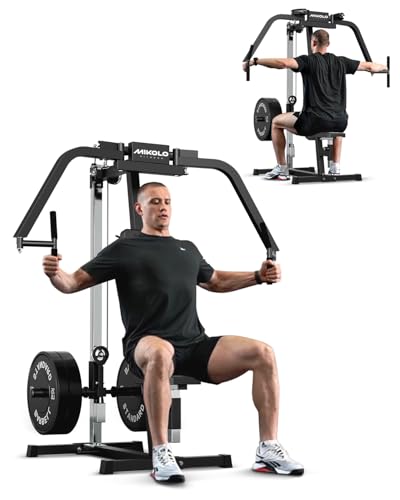
The Mikolo takes up about 13.5 square feet, the smallest footprint in this group. It still carries a 400 lb capacity on a 50 x 50 mm 14-gauge steel frame, and the arms adjust across six positions so you can set the opening angle to match your shoulder mobility.
Band pegs on both sides add band tension for a harder squeeze at the top of the arc, and the plate posts accept both 1 in and 2 in plates, which helps if your plate set is mixed. The backrest carries a slight 10-degree recline that shifts some emphasis toward the upper chest. Assembly instructions are the common complaint here, so budget an unhurried afternoon.
Specs
- Type: Plate-loaded pec fly and reverse delt machine
- Frame: 50 x 50 mm, 14-gauge steel
- Load capacity: 400 lb
- Arm positions: 6 adjustable
- Plate posts: 1 in and 2 in compatible
- Extras: Band pegs on both sides
- Backrest: 10-degree recline
- Footprint: About 13.5 sq ft
3. GOIMU CF01 Chest Fly Machine — Best Arm Freedom
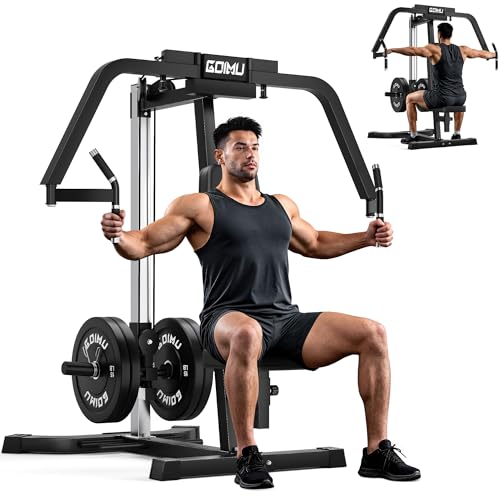
The GOIMU takes a freestyle approach: articulating arms on dual overhead cams move with a looser, more natural path than a rigid single-pivot design, so the arc follows your shoulder mechanics rather than forcing one line. Six arm positions set the range of motion, and the 10-degree inclined backrest angles the torso to bring the upper chest into the movement.
Capacity is 400 lb on a 50 x 50 mm 14-gauge frame, and at 78.3 lb the machine is light enough to shift around the room when your layout changes. Band pegs add tension at peak contraction. This is the pick for lifters who find fixed-path machines uncomfortable.
Specs
- Type: Plate-loaded pec fly and reverse delt machine
- Frame: 50 x 50 mm, 14-gauge steel
- Load capacity: 400 lb
- Arm positions: 6 adjustable
- Arms: Freestyle articulating, dual overhead cams
- Backrest: 10-degree incline
- Dimensions: 44.9 x 53.5 x 65.2 in
- Machine weight: 78.3 lb
- Extras: Band pegs
4. Synergee Chest Fly and Reverse Delt Machine — Best Seat Adjustment

Synergee’s machine stands out for fit. The seat adjusts through six positions in small 25 mm steps, making it easier to land the handles exactly at mid-chest height, and the arms adjust too. Plate holders take both 1 in and 2 in plates, and capacity is 400 lb.
The pads are 5 cm thick high-density foam with a sweat-resistant cover, which matters where your chest braces hard against the pad for every rear delt set. At 40.7 in deep it is one of the shallower machines here, though wide at 56.3 in with the arms counted. For households where two people of different sizes share one machine, this is the most accommodating option here.
Specs
- Type: Plate-loaded chest fly and reverse delt machine
- Load capacity: 400 lb
- Seat: 6 positions, 25 mm steps
- Plate holders: 1 in and 2 in compatible
- Padding: 5 cm high-density foam
- Dimensions: 40.7 x 56.3 x 64.4 in
- Machine weight: 78 lb
5. SFE Fitness Selectorized PEC Fly and Rear Delt Machine — Best Selectorized

The SFE is the commercial route: a 250 lb weight stack at a true 1:1 pull ratio, changed with a pin, so alternating fly and reverse fly sets takes seconds and the small stack steps suit isolation loads. The frame is 11-gauge ASTM A36 steel, the cable is nylon-coated to a military specification, and the pulleys are fiberglass-impregnated nylon on sealed bearings, a club machine’s hardware list rather than a home one.
That build comes with real commitments. The machine weighs 500 lb, stands nearly 82 in tall, and arrives by freight, so it needs a planned, permanent spot and two people to install. In return you get the fastest weight changes in this group.
Specs
- Type: Selectorized pec fly and rear delt machine
- Weight stack: 250 lb, 1:1 pull ratio
- Frame: 11-gauge steel, ASTM A36
- Cable: Nylon-coated, military specification
- Pulleys: Fiberglass-impregnated nylon, sealed bearings
- Dimensions: 51.18 x 46.26 x 81.89 in
- Machine weight: 500 lb
Comparison Table
| Machine | Loading | Capacity or Stack | Footprint or Size | Best For |
|---|---|---|---|---|
| Titan Fitness Fly Machine V2 | Plate-loaded | 300 lb | 28 x 32 in | Independent arms, swivel handles |
| Mikolo Pec Fly Machine | Plate-loaded | 400 lb | About 13.5 sq ft | Small rooms, mixed plate sets |
| GOIMU CF01 | Plate-loaded | 400 lb | 44.9 x 53.5 x 65.2 in | Natural, free-moving arm path |
| Synergee Chest Fly Machine | Plate-loaded | 400 lb | 40.7 x 56.3 x 64.4 in | Fine seat adjustment, shared use |
| SFE Fitness Selectorized | Pin-select stack | 250 lb stack | 51.18 x 46.26 x 81.89 in | Fast changes, commercial build |
FAQ
Can a fly machine replace dumbbell flyes?
For most home training, yes. The cam keeps tension on the pecs at the squeezed position, where dumbbells go slack, and the fixed path makes the movement easy to repeat set after set. Dumbbells still win on freedom of path and floor space, so many lifters keep both.
How much weight should I use on a pec deck?
Far less than your press. Flyes are an isolation movement with a long lever, so loads that feel light on a bench can be plenty here. Begin with a weight you can move slowly for 12 to 15 clean reps and add small jumps. If your shoulders roll forward at the bottom, the weight is too heavy or the entry position sits too far back.
Is the reverse fly on the same machine as good as a dedicated rear delt exercise?
It is one of the better options. Sitting facing the pad braces your torso, so the rear delts do the work instead of your lower back, and the same cam that smooths the chest fly keeps the reverse movement even. Use lighter loads and higher reps.
Should I choose plate-loaded or selectorized?
Choose plate-loaded if you already own plates and want the lower cost and smaller footprint; changing plates between sets is the only real chore. Choose selectorized if you train in supersets, share the machine, or want small fixed steps for isolation work.
How do I keep my shoulders safe on a fly machine?
Set the entry position so the pads begin in front of your shoulder line, keep the seat high enough that the handles meet mid-chest, and leave the deepest stretch notch alone until you know the machine. Warm up light, move slowly, and never let the arms pull you deeper at the end of a hard set.
Conclusion
A fly machine earns its floor space by doing two movements, chest fly and reverse fly, with a smoother resistance curve than free weights can offer. The Titan Fly Machine V2 is the strongest all-round plate-loaded pick. The Mikolo fits the tightest spaces, the GOIMU gives the freest arm path, and the Synergee adjusts its seat in the smallest steps for shared use. For pin-select convenience and a commercial build, the SFE selectorized machine is the heavy, permanent answer. Whichever you choose, set the entry position with respect for your shoulders.
More from Amazon
Programs that pair well with the guide above. Offers and eligibility are set by Amazon and may change.
Set up recurring deliveries of everyday items on eligible products. Terms and savings are set by Amazon.
Explore Subscribe & SaveCollect the home and kitchen items you want in one registry that guests can shop from.
Create a wedding registryFree shipping on eligible items, Prime Video and more. Eligible new members can start with a free trial.
Start a Prime free trialAudiobooks and podcasts to listen to on the go. Eligible new members can start with a free trial.
Try Audible freeAs an Amazon Associate we earn from qualifying purchases.