Key takeaways
- Compare the best belt squat machines for home gyms, from standalone lever units to rack attachments, with capacity, footprint and belt fit guidance.
A belt squat machine hangs the load from a belt around your hips instead of resting it on your shoulders. You stand on a platform, clip the belt to a lever arm or loading pin below you, and squat while the weight pulls straight down through your pelvis. Your legs do the same work as a barbell squat, but almost no compressive load travels down your spine, and your shoulders and grip are out of the lift entirely.
That makes this a different shelf from the power racks in our power rack guide, where the barbell still sits on your back, and from the leg press and hack squat machines in our leg press and hack squat guides, which push load through your shoulders and back against a sled. A belt squat loads the hips directly, which is why lifters with a sore back, a cranky shoulder, or a need for extra squat volume shop for one.
Disclosure: As an Amazon Associate, we earn from qualifying purchases made through links on this page, at no extra cost to you.
How to Choose a Belt Squat Machine
Standalone lever machines versus rack attachments
The market splits into two families. Standalone machines are complete stations: a platform, a pivoting lever arm with plate posts, and a belt in the box. They take real floor space, but they are always ready. Rack attachments are lever arms that pin to a power rack upright you already own. They weigh far less and store on a wall, but they only work if your rack matches: check upright dimensions (2 x 2, 2 x 3 or 3 x 3 in), hole diameter (5/8 or 1 in) and hole spacing before ordering, and confirm the arm is a complete system with its own loading post, not a bare bracket.
The load hangs from your hips, not your spine
This is the whole reason the category exists. A barbell back squat compresses the spine with every pound on the bar, and a shoulder injury can rule the lift out completely. A belt squat routes the force through the pelvis, so the legs can be trained hard while the back and shoulders recover. For many lifters it becomes the main squat pattern, not a compromise.
Hook point and squat depth
Where the belt clips in, and how low the platform lets you sink, decide whether the machine fits your body. On lever machines the belt attaches to the arm in front of you, and the platform often has a cut-out the arm swings through. The plates or the arm must not bottom out before your thighs reach parallel; tall lifters and deep squatters bottom out first. If a design runs shallow for your build, standing on blocks or bumper plates is the usual fix.
The included belt decides comfort under load
Two belt styles ship with these machines. Chain dip belts hang the load from links that dig into the hips as weight climbs. Padded webbing belts spread the same force over a wide band and stay tolerable for long, heavy sets. Past a few hundred pounds it is the difference between training and enduring. If a machine ships with a thin belt, or none at all, budget for a padded belt of your own.
Plate capacity and sleeve length
Legs are strong, and belt squats remove the balance and bracing limits that cap a barbell squat, so lifters outgrow small machines quickly. Look at two numbers: the maker’s capacity figure and the loadable length of the posts, which fills far faster with wide bumper plates than with iron. Lever machines also change the feel of the load: the plates sit partway along the arm, so the weight at your hips is not exactly the weight on the posts.
More than a squat station
A belt and a low hook point cover more than squats. Marching in place with the belt clipped in is a conditioning staple. Turn around, hinge, and the same arm becomes a belt-loaded row or Romanian deadlift line. Stand at the platform edge and it is a calf raise with the load at your hips.
A way out at the bottom
Squatting to failure with weight hanging from your hips is safe only if the machine gives you an exit. Look for adjustable stoppers that catch the arm above the floor, or a kickstand that holds the arm up while you clip in and out. At the bottom of your deepest squat, fully tired, you should be able to set the load down and step away without help.
The 5 Best Belt Squat Machines
1. Bells of Steel Belt Squat Machine 2.0 — the complete standalone station

This is the reference design in the category: an 11-gauge steel lever machine with bearings at the pivot, a platform the arm swings through, and everything in the box, including a padded belt, chain, two carabiners and J-cups. The maker publishes 13 height settings, top and bottom band pegs, and weight horns that mount flat or vertical, shrinking the footprint from 51 x 81 in to 51 x 52.5 in for storage. The empty arm weighs about 45 lb. One honest caveat from the maker itself: full depth is not guaranteed for every lifter, and shorter ranges may need blocks under the feet.
Specs
- Model: Belt Squat Machine 2.0
- Type: Standalone lever machine
- Frame: 11-gauge steel
- Capacity: 700 lb
- Footprint: 51 x 81 in (51 x 52.5 in with horns vertical)
- Height settings: 13
- Belt: Padded belt included
- Machine weight: 264 lb
2. Titan Fitness Belt Squat Machine — the big lever machine with deep posts

Titan’s standalone lever machine is built around plate storage and loadable length. Each loading post runs 16.5 in, four shorter posts at the back store spare plates and act as a counterweight, and the maker sets capacity at 1,000 lb. Three stopper positions set how deep the arm can travel, which doubles as the safety system: the arm lands on the stopper instead of on you. The diamond-plate platform measures 49 x 24 in. The trade-offs are size and belt quality: this is the largest machine here, and the included nylon belt is the thin style heavier lifters usually replace.
Specs
- Model: Belt Squat Machine
- Type: Standalone lever machine
- Capacity: 1,000 lb
- Footprint: 83 x 52 x 38.5 in
- Platform: 49 x 24 in diamond plate
- Loading posts: 16.5 in, plus 4 storage posts
- Depth stops: 3 stopper positions
- Belt: Nylon belt included
- Machine weight: 232 lb
3. Mikolo Belt Squat Machine — a heavy-duty lever station with the belt in the box

Mikolo’s entry follows the same lever layout as the Titan, in an 11-gauge frame the maker rates to 1,000 lb, with the platform, hardware and a weightlifting belt included so the station works the day it is assembled. The listed footprint, 81.8 x 52.3 x 39 in, is in the same class as the Titan. The lever path pulls slightly forward as you descend, as all lever designs do; most lifters settle their stance a little further back within a session or two.
Specs
- Model: Belt Squat Machine
- Type: Standalone lever machine
- Frame: 11-gauge steel
- Capacity: 1,000 lb
- Footprint: 81.8 x 52.3 x 39 in
- Belt: Weightlifting belt included
4. Fringe Sport Mammoth Belt Squat Attachment — the adjustable lever arm for rack owners
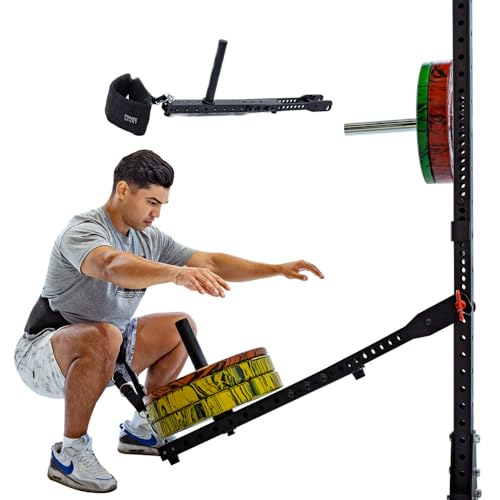
The Mammoth turns a power rack you already own into a belt squat station. The lever arm adjusts from 39 to 48.75 in, the loading pin offers 14 in of sleeve, and a padded belt is included, sized for waists from 28 to 48 in. It mounts to 2 x 2, 2 x 3 and 3 x 3 in uprights with 5/8 or 1 in holes, and at 32 lb it hangs on a wall between sessions. Fringe Sport publishes a 900 lb figure for the arm; independent testers who have loaded it heavily suggest treating roughly half that as a working ceiling.
Specs
- Model: Mammoth Belt Squat Attachment (part 8255)
- Type: Rack-mounted lever arm
- Frame: 11-gauge steel
- Lever arm: Adjustable, 39 to 48.75 in
- Loading pin: 14 in
- Capacity: 900 lb (maker figure)
- Rack fit: 2 x 2, 2 x 3 and 3 x 3 in uprights, 5/8 or 1 in holes
- Belt: Padded belt included, waist 28 to 48 in
- Weight: 32 lb
5. Signature Fitness Belt Squat Lever Arm — the simple single-arm conversion

This is the minimalist route: one plate-loaded lever arm, model SF-LEVER-WMR1, that pins to a rack upright and swings free, with your own belt clipped to the end. The arm runs 31.25 in long and weighs about 15 lb, so it stores anywhere. The same arm also works for guided deadlifts and rows. Two things to plan for: no belt is included, so a dip belt is a required extra, and the maker does not publish a capacity figure, so keep loads moderate.
Specs
- Model: SF-LEVER-WMR1
- Type: Rack-mounted lever arm
- Frame: 11-gauge steel, black powder coat
- Arm length: 31.25 in
- Capacity: Not published
- Belt: Not included
- Weight: 15 lb
Comparison Table
| Product | Type | Capacity | Footprint | Belt included |
|---|---|---|---|---|
| Bells of Steel Belt Squat Machine 2.0 | Standalone lever | 700 lb | 51 x 81 in | Yes, padded |
| Titan Fitness Belt Squat Machine | Standalone lever | 1,000 lb | 83 x 52 in | Yes, nylon |
| Mikolo Belt Squat Machine | Standalone lever | 1,000 lb | 81.8 x 52.3 in | Yes |
| Fringe Sport Mammoth | Rack attachment | 900 lb (maker figure) | Uses your rack | Yes, padded |
| Signature Fitness Lever Arm | Rack attachment | Not published | Uses your rack | No |
FAQ
Is a belt squat easier on the back than a barbell squat?
Yes, in the specific sense that matters: the load hangs from your pelvis, so the spine carries almost no compression while the legs work. The squat pattern itself is just as hard on the quads, glutes and hamstrings. Lifters with back trouble often find it is the only loaded squat they can train heavy, though a diagnosed condition should be cleared with a doctor first.
How much weight on a belt squat matches a barbell squat?
There is no fixed conversion. On a lever machine the plates sit partway along the arm, so the load at your hips is less than the load on the posts, and your own body weight is barely loaded at all. Judge progress against your own past sessions on the same machine rather than against barbell numbers.
Can I belt squat without buying a machine?
Improvised versions exist, usually a barbell in a landmine with a belt clipped to the sleeve, or plates hung from a dip belt while standing on two boxes. They work for a trial run, but they lack a platform, a controlled path and a safe way to set the load down. If the movement earns a weekly slot, a machine or rack attachment is the safer long-term answer.
What belt should I use if my machine ships with a thin one, or none?
A padded belt squat belt with a wide webbing band and a chain or strap lead. Padding matters more as loads climb: a narrow chain belt that feels fine at 100 lb becomes the limiting factor at 300 lb.
Do belt squats build the same muscle as barbell squats?
Largely, yes. Published research on vertical belt squat designs found quad, hamstring and glute activation close to a barbell back squat, with far less load through the trunk. Lever machines change the resistance curve slightly, heaviest in the middle of the lift, but the muscles worked are the same. What you give up is the bracing practice of a free barbell, which is why many lifters keep both.
Conclusion
Choose the family first. If you have the floor space and want a station that is always ready, the Bells of Steel 2.0 is the most complete package, the Titan gives you the longest posts and the most capacity headroom, and the Mikolo matches that formula with the belt in the box. If your rack is the platform, the Fringe Sport Mammoth is the adjustable, belt-included conversion, while the Signature Fitness arm is the bare-bones option for lifters who already own a good belt. Check depth before you buy, and make sure the machine lets you set a failed rep down safely.
More from Amazon
Programs that pair well with the guide above. Offers and eligibility are set by Amazon and may change.
Set up recurring deliveries of everyday items on eligible products. Terms and savings are set by Amazon.
Explore Subscribe & SaveCollect the home and kitchen items you want in one registry that guests can shop from.
Create a wedding registryFree shipping on eligible items, Prime Video and more. Eligible new members can start with a free trial.
Start a Prime free trialAudiobooks and podcasts to listen to on the go. Eligible new members can start with a free trial.
Try Audible freeAs an Amazon Associate we earn from qualifying purchases.