Key takeaways
- Exact model, horsepower, feed type, warranty, and who supplies it
- Reuse or replacement of flange and mount
- Cord, hardwire, switch, air switch, outlet, and circuit assumptions
- Discharge tube, trap, double-bowl waste, and wall-drain alignment
- Dishwasher hose connection and required routing
- Removal, recycling or haul-away, cabinet protection, and cleanup
- Permit responsibility and inspection where locally required
- Rates for corroded piping, failed electrical, damaged sink, or drain relocation
The fastest garbage disposal replacement uses the existing sink flange or compatible mount, reaches the same drain elevation, reconnects to compliant power, and accepts the dishwasher hose without rework. Change any of those interfaces and a small appliance swap can become a plumbing-and-electrical project.
This guide uses U.S. sources checked on August 26, 2026. Regional labor, service-call minimums, unit features, under-sink access, code adoption, corrosion, and connection changes affect local totals. Published costs are scope benchmarks, not quotes.
Our top picks
 InSinkErator Badger 5 Garbage Disposal
- Finish: Stainless Steel
- Material: Alloy Steel
- Power Source: electric
Galvanized steel grind components built for durability
Compact 11.5-inch housing fits tight under-sink spaces
Backed by a long-running disposer manufacturing history
Power cord is not included with this model
Listing does not specify the warranty length
 InSinkErator Badger 1 Garbage Disposal with Power
- Item Dimensions D x W x H: 8.75"D x 11.38"W x 8.75"H
- Material Type: Stainless Steel
- EU Spare Part Availability Duration: 1 years
Twist-on quick-lock mount speeds up replacement installs
Compact design leaves more room under the sink
Galvanized steel grind components built for durability
Only a 1-year limited warranty
Single-stage grind is less powerful than multi-stage units
| Product | Key specs | |
|---|---|---|
| InSinkErator Badger 5 Garbage Disposal | Finish: Stainless Steel Material: Alloy Steel Power Source: electric | Check price |
| InSinkErator Badger 1 Garbage Disposal with Power | Item Dimensions D x W x H: 8.75"D x 11.38"W x 8.75"H Material Type: Stainless Steel EU Spare Part Availability Duration: 1 years | Check price |
 InSinkErator Badger 5XP Garbage Disposal InSinkErator Badger 5XP Garbage Disposal | Check price | |
 GE Disposall Continuous Feed 1/2 Horsepower Motor GE Disposall Continuous Feed 1/2 Horsepower Motor | Check price | |
 Waste Maid Garbage Disposal Waste Maid Garbage Disposal | Item Dimensions D x W x H: 5.2"D x 5.2"W x 12.9"H Material Type: Stainless Steel Capacity: 1.8 pounds | Check price |
 Garbage Disposal Air Switch Kit Sink Top Garbage Disposal Air Switch Kit Sink Top | Check price | |
 Mr. Scrappy Garbage Disposal Drain Elbow Replacement Mr. Scrappy Garbage Disposal Drain Elbow Replacement | Check price | |
 Waste King Garbage Disposal for Kitchen Sink Waste King Garbage Disposal for Kitchen Sink | Material: Multi Voltage: 115 volts Number of Handles: 1 | Check price |
As an Amazon Associate we earn from qualifying purchases at no extra cost to you.
Affiliate disclosure: Qualifying product links may earn the site a commission at no extra cost to the buyer.
Current Replacement Cost References
Angi’s guide, updated August 3, 2026, reports $200 to $625 for professional garbage disposal replacement and an average around $550; its wider observed span is $150 to $950. It also separates unit prices by motor size: $50 to $225 for many 1/3- to 1/2-horsepower units, $120 to $310 for 5/8- to 3/4-horsepower, and $200 to $400 for 1- to 1-1/4-horsepower models. See Angi’s 2026 disposal dataset.
HomeGuide independently reports $200 to $550 for a replacement using existing connections and $250 to $650 for a new retrofit. Its breakdown lists $100 to $300 for the unit and $100 to $250 for replacement labor. See HomeGuide’s disposal installation data.
Those ranges overlap because both include common replacements, but neither means every unit should cost $550. A direct same-mount swap, an incompatible discharge height, and a first-time installation have different scopes. Classify the job before comparing prices.
Build the Estimate Around Seven Interfaces
| Interface | Decision | Cost-changing condition |
|---|---|---|
| Motor | Horsepower, duty, sound package, warranty | Larger or premium assembly |
| Feed | Continuous or batch feed | Switching control method or adding stopper activation |
| Sink mount | Flange material and mounting system | Incompatible mount, corroded flange, fragile sink |
| Electrical | Cord-and-plug, hardwire, switch, air switch | Missing grounding, outlet, protection, or compliant circuit |
| Drain | Discharge height, trap, double-bowl routing | New unit sits lower or existing piping is deteriorated |
| Dishwasher | Hose route, air-gap/high-loop rules, inlet plug | New connection or forgotten knockout plug |
| Removal | Disconnect, lift, haul-away, permanent deletion | Seized mount, corrosion, or conversion to basket strainer |
Ask the installer to mark each interface “reuse,” “replace,” or “not present.” This simple inventory explains far more than a single labor line.
Select Horsepower and Feed Type From Actual Use
Horsepower affects price, physical size, and often sound insulation. Household size is only a rough proxy; cooking volume, accepted food waste, septic-system guidance, and available cabinet space also matter. Do not buy the largest motor automatically. Confirm that the body clears the cabinet floor, trap, dishwasher hose, filters, and storage.
Continuous-feed units operate from a switch while food is added; batch-feed units activate through a compatible stopper and can suit users who prefer that operating sequence. Changing feed type can alter controls, not merely the appliance. Price any switch, air-switch button, tubing, outlet, or countertop drilling explicitly.
Compare warranty terms and service process, not just years. Some warranties include in-home service while others cover parts or have installation exclusions. Record the serial number and proof of purchase immediately after installation.
Replacement Scenario 1: Compatible Direct Swap
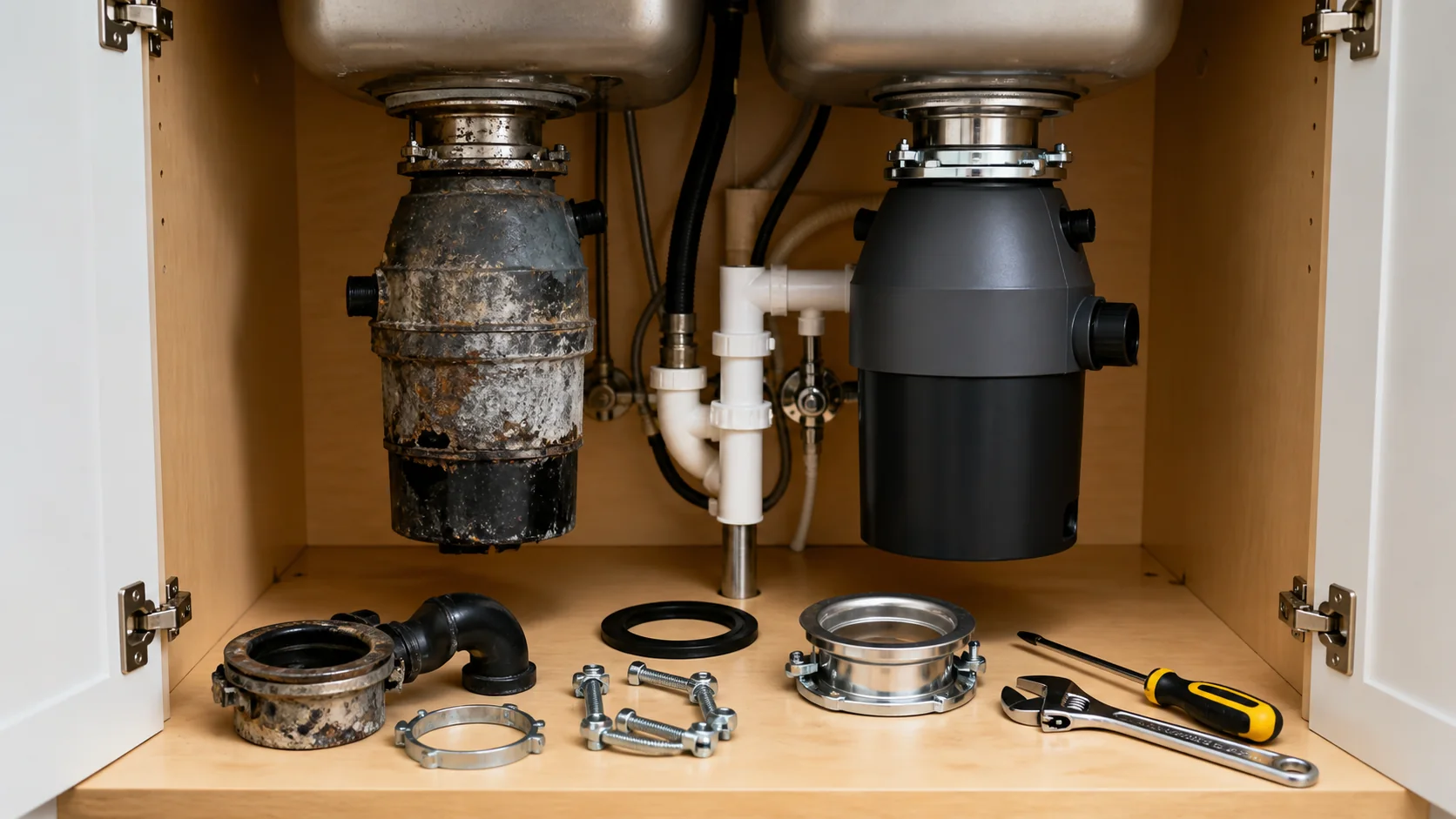
The low-complexity case keeps an approved compatible mount, existing power method, drain alignment, and dishwasher connection. Work includes shutting off power, disconnecting wiring or cord, supporting and removing the old unit, attaching the new disposal, reconnecting discharge and dishwasher, restoring power, and checking for leaks and vibration.
“Same brand” does not guarantee that every current model uses an identical mount or body dimension. Compare installation drawings. A taller unit may push the discharge below the wall drain or collide with the trap. A different outlet orientation may require new tubular waste parts even if the flange fits.
HomeGuide’s $200-to-$550 replacement range is most relevant to this scenario under favorable existing conditions. Confirm whether the quote includes the unit, removal, haul-away, flange, cord, discharge parts, and cleanup.
Replacement Scenario 2: New Mount or Drain Geometry
Replace the flange when it is incompatible, corroded, damaged, leaking, or being changed for finish. Sink material and condition matter: force used on a seized mount can damage a thin, brittle, or poorly supported basin. Budget sink protection and a contingency for deteriorated strainers or drain components.
Measure from the sink underside to the wall drain centerline before purchase. Waste piping must drain by gravity with an appropriate trap arrangement; it should not be forced uphill to meet a lower disposal outlet. A deeper sink plus a taller disposer is a common conflict. The correct remedy may involve another model, revised tubular waste, or qualified alteration of the wall connection.
Double-bowl sinks add a tee or continuous-waste layout. Keep joints accessible and avoid a crowded assembly that cannot be removed for service. Ask the plumber to price only the piping actually needed after measurements are confirmed.
Replacement Scenario 3: Electrical or First-Time Retrofit
A first-time disposal needs more than a flange. It may require a suitable branch circuit, receptacle or approved hardwire method, switch or listed air-switch control, plumbing changes, and permits. HomeGuide’s $250-to-$650 retrofit range is a starting point, but its own adders show why the total can grow: it lists $150 to $350 for adding an outlet, $100 to $350 for sink-drain pipe replacement, and locally variable electrical or plumbing permits.
Do not assume an under-sink receptacle is correctly grounded, continuously energized, switched as intended, or protected under the locally adopted electrical code. A qualified electrician should evaluate new or questionable work. Improvised extension cords and unlisted control arrangements are not budget solutions.
Permanent removal is a fourth path. It requires a basket strainer and revised drain, plus safe electrical disconnection. HomeGuide reports $125 to $350 for permanent removal, distinct from the smaller removal component inside a replacement.
Dishwasher Connection and Commissioning
If a dishwasher drains through the disposal, the new unit’s dishwasher inlet plug must be removed according to its instructions before attaching the hose. If no dishwasher connects, the plug generally remains. Moen’s installation diagram shows the mount stack, discharge elbow, dishwasher plug, and power components as separate interfaces; see the manufacturer installation reference. Always use the exact manual supplied with the purchased model.
Route and secure the dishwasher hose according to appliance instructions and local requirements, including any required air gap or high loop. Confirm that the knockout piece is retrieved rather than left inside the grinding chamber.
Commissioning should include cold-water flow, several start-stop cycles, dishwasher-inlet inspection, drain discharge, flange perimeter, reset access, vibration, unusual noise, and checks at every joint. Place dry paper beneath connections during our research to reveal small leaks.
Quote, Permit, and Contingency Checklist
- Exact model, horsepower, feed type, warranty, and who supplies it
- Reuse or replacement of flange and mount
- Cord, hardwire, switch, air switch, outlet, and circuit assumptions
- Discharge tube, trap, double-bowl waste, and wall-drain alignment
- Dishwasher hose connection and required routing
- Removal, recycling or haul-away, cabinet protection, and cleanup
- Permit responsibility and inspection where locally required
- Rates for corroded piping, failed electrical, damaged sink, or drain relocation
Use named contingencies rather than an unexplained percentage. Photograph existing wiring and piping, test the switch, identify leaks, and measure discharge geometry before bidding. Attach allowances only to uncertainties that remain.
Safety and scope limits
Disconnect and verify electrical power before touching the unit. Support the disposal during removal; it is heavy and can drop suddenly when the mount releases. Never place a hand inside. Use the manufacturer’s service tool and instructions for jams. Stop for damaged conductors, missing grounding, active leaks, cracked sink material, failed shutoffs, or plumbing that cannot drain correctly. Local codes and exact product documentation override this general guide.
Coordinate the next decision with the under-sink plumbing guide.
Garbage Disposal Cost FAQs
Can the old mounting ring stay?
Only when the new manufacturer’s instructions approve that mount and it is sound, clean, secure, and leak-free. Otherwise replace the full mounting assembly.
Does more horsepower require a new circuit?
Not automatically, but electrical requirements must be checked against the exact model, existing circuit, connection method, and locally adopted code.
Why does a deeper sink affect disposal cost?
It lowers the disposal outlet. If that outlet approaches or falls below the wall drain, piping may need reconfiguration or a different product selection.
Is dishwasher hookup normally included?
Some replacement quotes include reconnection; others exclude a new hose, air gap, routing correction, or inlet preparation. Specify it.
Should a leaking disposal be repaired?
A leak at a removable connection may be repairable. A cracked or internally leaking body, repeated failure, or unavailable parts can favor replacement after diagnosis.
Final System-Match Recommendation
Choose the unit only after verifying motor needs, feed control, sink mount, electrical supply, discharge elevation, dishwasher route, and removal scope. Then price the scenario that actually applies. The most well-supported garbage disposal replacement cost is not a generic average; it is the total for a documented appliance that matches every under-sink interface and can be safely commissioned.