Key takeaways
- Is this a full slab, remnant, prefabricated top, or integrated product?
- Who measures, templates, fabricates, delivers, and installs?
- Where will seams be, and how will pattern or veining align?
- How are sinks supported and faucet holes reinforced?
- What cabinet flatness and support are required?
- Which cleaner, sealer, heat, and chemical rules apply?
- Which damage is repairable, and who performs that work locally?
- What do product, fabrication, and installation warranties exclude?
Engineered quartz and marble can share a pale color and veined appearance while reacting very differently to cosmetics, acids, cleaners, heat, impact, and repair. A bathroom is a demanding test: water dries into mineral film, bottles leak, metal objects rust, and personal-care products can contain pigments, oils, acids, solvents, or oxidizers.
The correct choice depends less on which material is advertised as “luxury” and more on whether the household accepts its aging pattern and follows its care instructions.
Our top picks


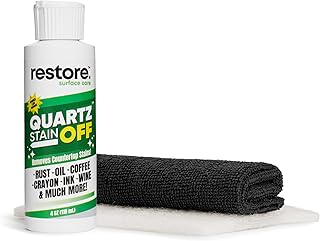


As an Amazon Associate we earn from qualifying purchases at no extra cost to you.
Affiliate disclosure: Purchases through eligible site links may produce revenue without changing the customer’s cost.
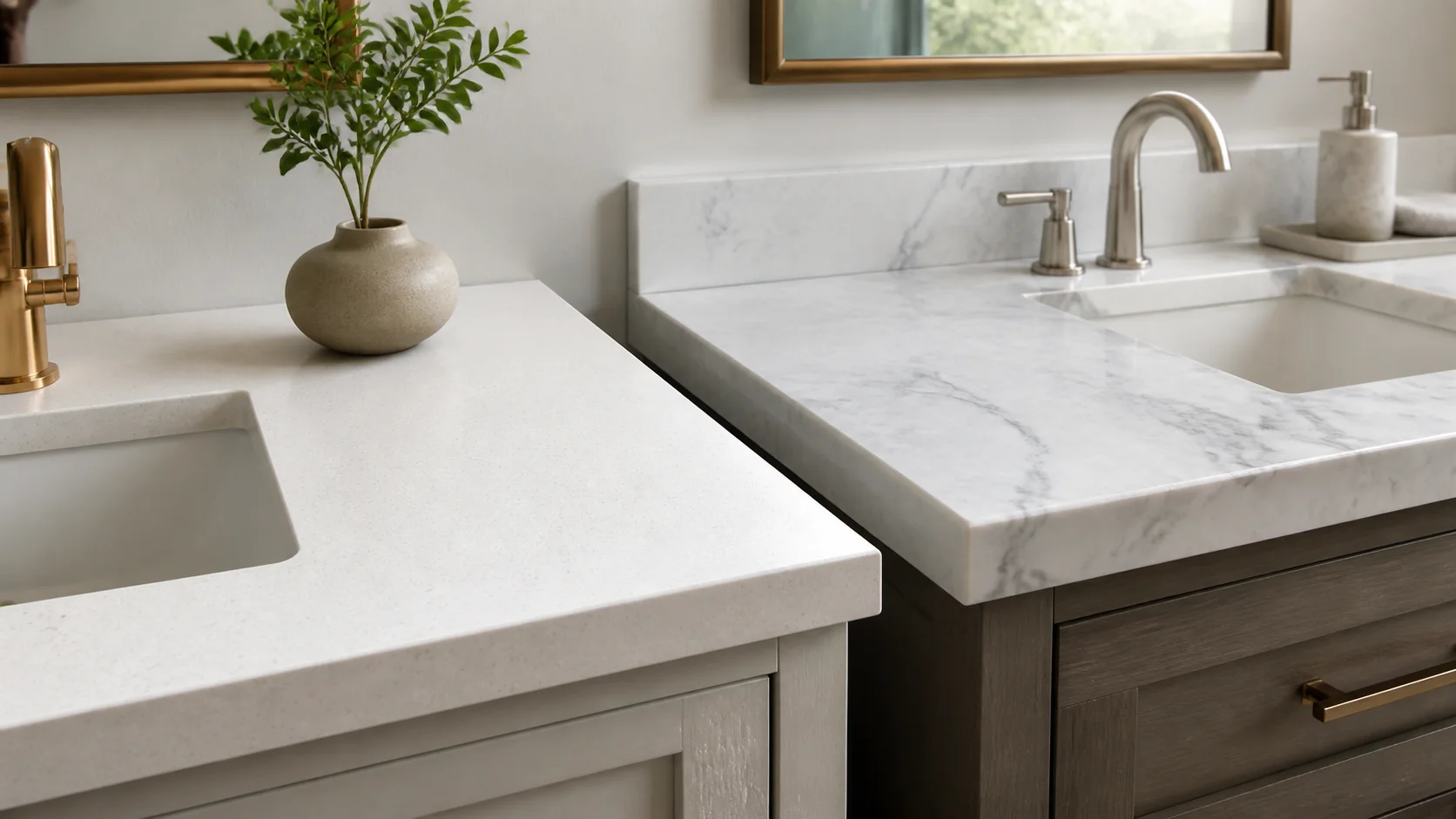
Composition Changes the Failure Mode
Marble is natural stone formed primarily from carbonate minerals. Each slab’s mineral content, veining, fissures, absorption, and appearance vary. Fabricators inspect and orient the actual slab, reinforce vulnerable areas where appropriate, cut it, finish edges, and may apply an impregnating sealer.
Engineered quartz is a manufactured slab made from selected mineral particles combined with binders, pigments, and other formulation components. Exact composition varies by brand and product generation; do not assume every product sold as quartz has the same mineral percentage, heat limit, cleaner approval, or warranty. Cosentino, for example, describes current Silestone as a blend of premium minerals and recycled materials rather than simply a block of natural quartz. See Cosentino’s current material description.
This difference matters. Marble’s carbonate surface can chemically react with acids. Engineered quartz is highly nonporous, but its binders and finish can be affected by high heat or aggressive chemicals. Neither surface is indestructible.
Staining Is Not the Same as Acid Etching
A stain is discoloration caused when a substance enters, adheres to, or otherwise marks the material. Oil, cosmetics, dyes, rust, and organic liquids can produce different stain colors and require different removal methods.
An etch is physical or chemical alteration of the finish. On marble, acids such as vinegar, lemon-based products, some toilet cleaners, or acidic cosmetics can dissolve the polished surface, leaving a dull or lighter patch. Removing absorbed color does not restore lost polish. The Natural Stone Institute explicitly warns that acids may dull or etch calcareous stones and says etched areas may require professional refinishing or repolishing. See its natural-stone care guidance.
An impregnating sealer can slow absorption and improve marble’s stain resistance. It does not create an acid-proof film and does not make stone stain-proof. The Natural Stone Institute describes these products as repellents and recommends consulting the stone and sealer suppliers about need and frequency.
Household Scenario Matrix
| Bathroom behavior | Engineered quartz response | Marble response | Decision signal |
|---|---|---|---|
| Children leave toothpaste and water overnight | Usually forgiving when wiped with approved cleaner; dried mineral film still shows | Water spots and product chemistry may alter polish or stain | Quartz is generally lower-friction |
| Careful adult accepts patina | Consistent appearance with routine mild cleaning | Natural variation and gradual etching may be acceptable character | Either can work |
| Hair dye, makeup, oils, and solvents are common | Prompt cleanup and brand-approved products remain important | Greater attention to absorption, acid, and professional stain treatment | Test habits against care documents |
| Hot styling tools land on the counter | Binder damage or thermal shock is possible; use a heat mat | Stone tolerates heat differently, but thermal shock and finish damage remain concerns | Add a protected landing zone |
| Owner wants a surface refinisher to renew wear | Repairs and sheen matching can be product-specific | Qualified stone professionals may hone or repolish many surface etches | Discuss repair locally before buying |
| Exact repeatability across two vanities matters | Manufactured patterns offer more consistency, subject to batch variation | Every slab and cut is unique | Quartz simplifies coordination |
Heat, Chemicals, and Everyday Cleaning
For engineered quartz, follow the brand’s current cleaner list. Caesarstone describes its quartz/mineral surfaces as highly nonporous, recommends warm soapy water for daily care, warns that prolonged chemical exposure can cause damage, and calls for trivets or hot pads. Its guidance also notes that honed, concrete, and rough finishes can show fingerprints and marks more readily than polished finishes. See Caesarstone care and maintenance.
That guidance should not be transferred blindly to another quartz brand. Products differ, and even a cleaner approved for one stain may damage nearby faucet plating, sealant, wood, sink finish, or mirror backing. Rinse residues and dry the top to limit water film.
For marble, begin with a neutral cleaner approved for natural stone and a soft cloth. Avoid acidic products and abrasive powders unless a stone professional specifies a treatment. Do not mix cleaning chemicals. Identify a stain before attempting removal; rust, oil, organic pigment, and ink require different methods.
Seams, Cutouts, Edges, and Weight
Both materials are heavy and vulnerable around sink and faucet cutouts. Cabinet support must be flat, level, and appropriate for the slab, overhang, sink method, and span. A double vanity introduces a long top and multiple openings; discuss seam placement and reinforcement with the fabricator rather than assuming a single piece is always preferable.
Undermount sinks require a supported mounting method and a finished cutout edge. Vessel sinks concentrate attention around the drain hole and can raise the working surface. Integrated or prefabricated quartz-look tops may use different materials and construction from a full fabricated slab, so verify the product description.
Marble veining should be reviewed around holes and edges because natural features can influence appearance and fabrication planning. Approve the actual slab and layout when possible. With patterned engineered quartz, ask how seams and adjacent pieces will align and whether the installed sample can differ from a small chip.
Finish, Repair, and How the Surface Ages
A polished marble top reflects light strongly, so etches interrupt the sheen. A honed finish begins matte and can make etching less visually abrupt, though it does not stop the chemical reaction and may show oils or handling differently. The household should see a full-size finished sample, not only a color photograph.
Engineered quartz usually maintains a more uniform finish, but chips, heat damage, seams, and altered sheen can be difficult to repair invisibly. Ask a local fabricator what repairs are realistic for the selected color and finish. Retain offcuts only if storage is safe and the fabricator believes they could help with future matching.
Marble can often be professionally honed or polished after surface damage, but deep stains, cracks, or edge failures may not disappear completely. Its service life can be very long when support and care are appropriate, while visible patina may develop well before structural failure. Engineered quartz can also serve for many years, but warranty duration is not a guaranteed lifespan and often excludes misuse, fabrication, installation, or chemical damage.
Cost Variability and Fabricator Questions
Material names do not establish installed price. Slab brand or quarry, grade, color rarity, finish, thickness, number of slabs, cutouts, edge work, backsplash, sink mounting, seams, delivery route, demolition, and regional fabrication labor all matter. Remnant pricing can make a small vanity economical, but the available piece must be large enough and free of unsuitable defects.
- Is this a full slab, remnant, prefabricated top, or integrated product?
- Who measures, templates, fabricates, delivers, and installs?
- Where will seams be, and how will pattern or veining align?
- How are sinks supported and faucet holes reinforced?
- What cabinet flatness and support are required?
- Which cleaner, sealer, heat, and chemical rules apply?
- Which damage is repairable, and who performs that work locally?
- What do product, fabrication, and installation warranties exclude?
Obtain quotes for the same drawing and sink/faucet schedule. Do not compare a remnant with one cutout against a premium slab with two sinks, a backsplash, and specialty edges as though material alone explains the difference.
Safety and fabrication limits
Slabs and tops can cause severe lifting injuries and may break around openings. Fabrication creates hazardous dust and belongs under professional controls. Never make field cutouts or drill a finished slab without the responsible fabricator’s approval. Product instructions, stone characteristics, cabinet support, and local requirements govern installation.
Coordinate the next decision with the vanity top materials compared.
Quartz vs Marble Vanity FAQs
Will sealing marble prevent etching?
No. Impregnating sealers improve resistance to absorbed stains; they do not stop acids from reacting with the carbonate surface.
Is engineered quartz completely stain-proof?
No material should be treated that way. Quartz is highly nonporous, but pigments, residues, aggressive chemicals, or prolonged exposure can still leave marks or damage. Follow the exact brand guide.
Can an etched marble top be cleaned back to a shine?
Cleaning can remove residue or a coincident stain, but an etch is altered finish. A stone professional may need to hone or repolish it.
Which material handles hair tools better?
Use a heat mat on either. Engineered quartz manufacturers warn against direct high heat, and natural stone assemblies can also suffer thermal or finish damage.
Which is easier to match later?
Engineered patterns are generally more repeatable, but batches change and colors can be discontinued. Natural marble is inherently unique, so exact matching is unlikely.
Material Decision
Choose engineered quartz when low porosity, pattern consistency, and simple approved daily cleaning match the household. Choose marble when natural variation, refinishable stone character, and visible patina are welcome—and users will avoid acids and manage staining risk. The deciding test is not whether one surface is “better,” but whether its failure modes and care routine fit the real bathroom.