A rainfall head and a handheld head use the shower’s available water differently. Rainfall spreads flow across a broad overhead pattern and asks the user to stand within it. A handheld concentrates control in a movable outlet that can rinse hair, feet, walls, mobility equipment, children, or pets. The right format depends on reach and task, not on which spray looks more luxurious.
Affiliate disclosure: Product links may earn this site a commission after a qualifying purchase. The comparison remains based on documented dimensions, flow, installation, and household scenarios.
Our top picks
 Rain Shower Head with Handheld Showerhead
- Installation Type: Wall Mounted
- Flow Rate Description: 1.75 GPM
- Number of settings: 9
Magnetic docking holds the handheld securely in place
Switches between fixed rain head and handheld spray
278 nozzles deliver broad, even rain-style coverage
Dual-head design means more parts that can wear over time
59-inch hose limits reach beyond the shower stall


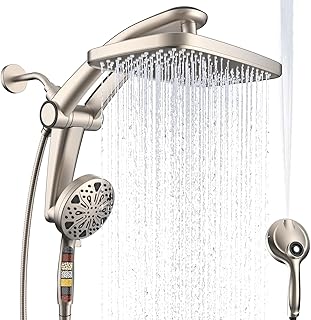
 Veken All Metal 10"Luxurious Rain Shower Head
- Installation Type: Wall Mounted
- Flow Rate Description: 2.5 Gallons Per Minute
- Other Special Features of the Product: Adjustable Height, Detachable

As an Amazon Associate we earn from qualifying purchases at no extra cost to you.
Review method: This article does not claim personal shower testing. EPA WaterSense guidance and current KOHLER and Delta specification resources were reviewed on August 26, 2026. Exact fixtures appear as dimensional examples rather than ranked recommendations.
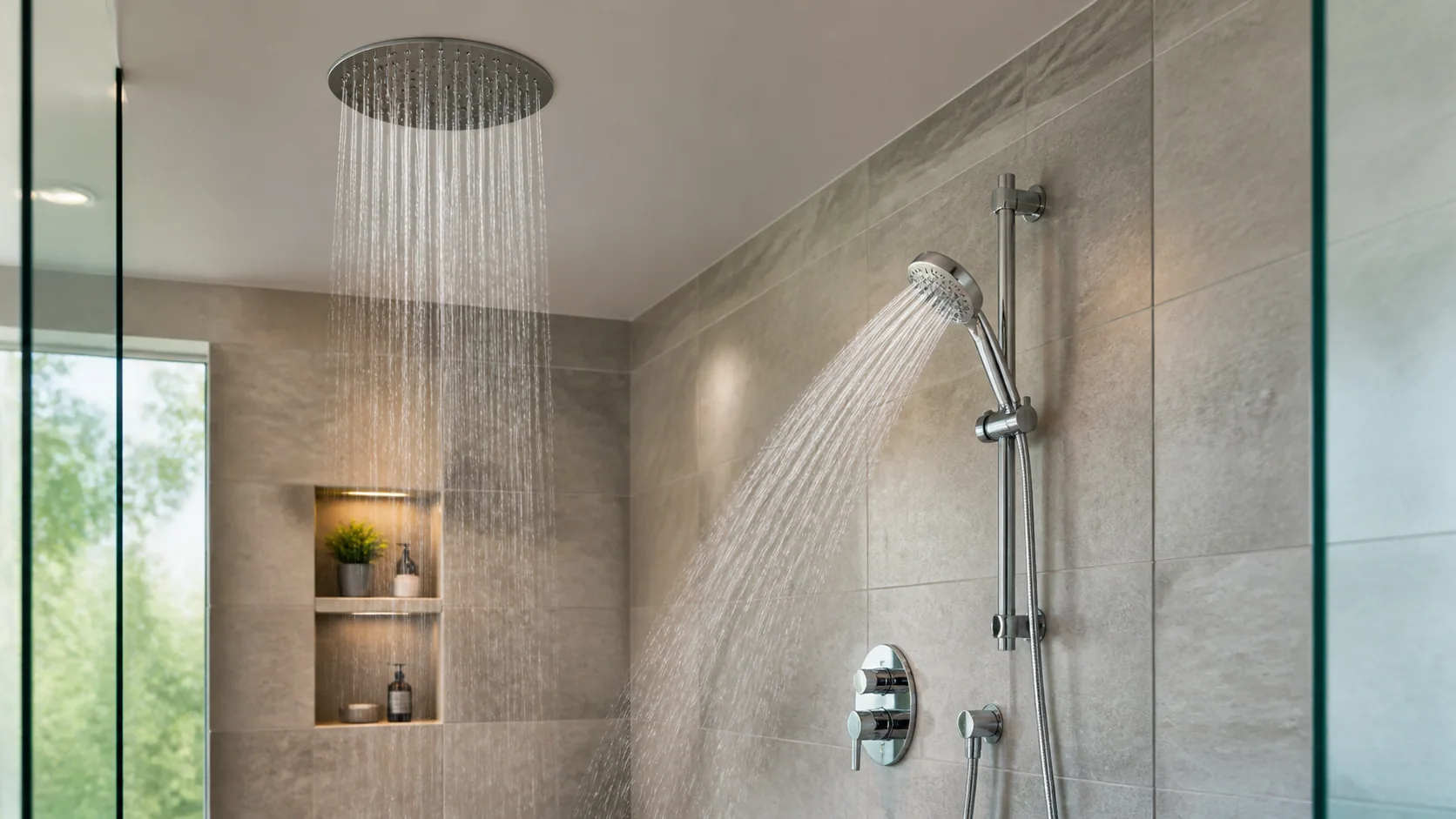
Two Spray Architectures at a Glance
| Design question | Rainfall head | Handheld head |
|---|---|---|
| Primary spray geometry | Broad face, many downward outlets | Smaller movable face, directed angle |
| User relationship | Body moves within a fixed pattern | Outlet moves toward the target |
| Mounting constraint | Height, arm projection, ceiling and enclosure coverage | Bracket height, hose reach, supply elbow, docking access |
| Cleaning task | Reaching a high face and wiping many nozzles | Handling hose, bracket, couplings, and a reachable spray face |
| Accessibility potential | Hands-free coverage when correctly placed | Seated reach and targeted rinsing when hose and bracket fit |
KOHLER’s Statement K-26301-G is a documented 9-inch round Open Rain head at 1.75 gpm. The Statement K-26284-G is an oblong three-function handshower rated at 1.75 gpm. Comparing these equal-flow examples isolates geometry more clearly than comparing a large high-flow rainhead with a lower-flow handheld.
Coverage and Pressure Are Not the Same Sensation
A rainhead divides water among a wide outlet field. At the same total flow, each stream may feel softer than a concentrated spray because flow is distributed and droplets travel farther. The payoff is shoulder and upper-body coverage. A user who wants a forceful scalp rinse may prefer a focused mode or a smaller face.
A handheld can place its outlets close to the body, reducing travel distance and letting the user target a small area. Adjustable models may concentrate or broaden the pattern. That control can feel stronger without increasing supply pressure or gallons per minute.
Neither format repairs a restricted valve, scaled cartridge, clogged screen, undersized pipe, or failing pressure regulator. Measure actual flow and diagnose whole-shower weakness before selecting geometry. A large overhead head is especially unforgiving when the supply cannot sustain its intended pattern.
Rainfall Mounting Height and Projection
A rainfall head needs enough elevation for the tallest user while keeping the spray inside the enclosure. A short wall arm can place the face too close to the wall; a long arm adds leverage. A ceiling-mounted outlet changes rough-in, waterproofing, and service access. Use the exact arm and head drawing rather than choosing from face diameter alone.
Mark the center of the spray on the shower floor. Compare it with the drain, door opening, bench, controls, and the position where a person naturally stands. Water should not strike the door seam or a shelf. In a small enclosure, a wide face may wet the entire room whenever it is activated.
Tall users need head clearance; shorter users need reachable controls rather than a reachable rainhead. Cleaning remains part of height planning. If the face cannot be wiped safely from the floor, provide a safe maintenance method instead of encouraging standing on a wet stool.
Handheld Bracket, Hose, and Reach
Hose length must be measured from the supply or diverter connection through the bracket to the farthest intended target. Include bends and avoid stretching the hose straight under tension. A hose that reaches the floor can improve cleaning but may loop into a trip hazard or rest against a hot surface.
Mount the bracket where every intended user can grasp and dock the handshower. A slide bar adds height adjustment but requires sound attachment and waterproof penetrations. A grab bar is a safety device with structural requirements; an ordinary handshower slide bar must not be represented or used as one unless explicitly rated.
Check hose material, swivel joints, vacuum-breaker or backflow requirements, wall elbow projection, and bracket angle. The handshower should remain secure when pressurized and should not rotate out of the dock. Test the planned reach to a seated position, feet, enclosure corners, and pet-washing height.
Rinsing, Cleaning, and Accessibility Scenarios
| Household scenario | Rainfall advantage | Handheld advantage |
|---|---|---|
| Long hair | Continuous overhead wetting | Close targeted rinse at scalp and underside |
| Limited grip or balance | Hands-free spray when centered correctly | Reachable seated control with suitable bracket and hose |
| Cleaning enclosure | Little directional help | Rinses walls, corners, bench, and floor |
| Children or pets | Broad fixed spray may be difficult to control | Temperature-tested directed rinsing |
| Quiet relaxation | Wide gentle overhead pattern | Depends on selected mode and holding effort |
Accessibility requires more than buying a hose. Consider control force, temperature safety, seated reach, transfer space, hose management, bracket height, and whether the user can return the outlet securely. A clinician, accessibility specialist, or qualified designer may be appropriate for individual needs.
Diverters and Combination Systems
A combination can use a two-way or three-way diverter to select rainhead, handheld, or both where the valve and product permit simultaneous operation. Delta’s In2ition products illustrate a different concept: a detachable handshower docks within or alongside a fixed shower head. Exact flow paths and modes vary by model.
Running two outlets simultaneously divides available flow and can increase total demand, depending on the valve and flow controls. At limited pressure, both sprays may become unsatisfying. Verify the mixing valve, diverter, pipe sizing, outlet ratings, and local limits as one system.
Integrated combinations reduce separate wall penetrations but can be heavier at the shower arm and more complex to clean. Separate outlets offer flexible placement but require additional rough-in and waterproofing. Do not add a diverter that overloads an existing arm or defeats required backflow protection.
WaterSense, Legal Flow, and Heater Demand
EPA states that WaterSense-labeled shower heads use no more than 2.0 gpm and meet performance criteria. States or local jurisdictions may require lower maximum flow. Confirm the exact suffix and package because one collection may be sold in several flow versions.
Flow rate multiplied by shower duration determines water use. Simultaneous outlets can change the calculation when the system allows combined operation. Higher hot-water demand can shorten shower duration from a storage heater, increase energy use, or expose limited recovery from a well or heater.
Do not remove flow regulators to improve sensation. Diagnose restrictions and choose a legal pattern that suits the supply. Temperature-limit settings, pressure-balancing or thermostatic valves, and heater capacity have a larger safety role than the outlet style.
Installation and Maintenance Differences
A simple wall-arm rainhead or handheld bracket may use a standard threaded connection, but thread engagement, seal method, orientation, and arm support follow the manufacturer. Support the arm while removing the old head so torque is not transferred into the concealed elbow.
Slide bars, supply elbows, ceiling arms, and separate diverters create wall penetrations that need planned blocking and waterproofing. Rough-in work behind tile belongs to qualified trades. Stop if the shower arm moves, threads are corroded, water appears inside the wall, or the valve does not shut off reliably.
Clean outlet nozzles by the exact finish and product guidance. Rainheads may collect scale across a large face; handhelds add hose and coupling seals. Inspect hoses for bulges, abrasion, kinks, and leaks. Replace pressure-bearing parts with the exact supported components.
Pre-Purchase Measurement List
- Measure actual delivered shower flow under normal household demand.
- Record shower-arm height, projection, thread, and structural stability.
- Plot rainhead spray center within the enclosure.
- Calculate hose reach to every intended cleaning and bathing target.
- Set bracket height for the shortest, tallest, and seated users.
- Verify valve, diverter, and simultaneous-flow capability.
- Confirm legal flow and hot-water capacity.
- Locate replacement nozzles, hoses, seals, brackets, and cartridges.
Coordinate the next decision with the compare shower-head flow spray patterns and fit.
Frequently Asked Questions
Does a rainhead use more water than a handheld?
Not necessarily. Compare exact rated flow and modes. Face size and spray sensation do not establish gallons per minute.
Can a handheld replace a grab bar?
No. A standard slide bar or bracket is not a structural safety support unless specifically designed, installed, and rated as one.
Will both outlets work well at the same time?
Only when the valve, diverter, piping, pressure, and allowed total flow support simultaneous operation. Otherwise each pattern may weaken.
What hose length is best?
The shortest length that reaches all intended targets without tension, dangerous floor loops, or hot-surface contact. Measure the actual route before ordering.
Which format is easier to clean?
A handheld helps rinse the enclosure and brings its face within reach. A rainhead has fewer hose joints but may be high and contain many nozzles.
Choose the Task Before the Outlet
Select rainfall when broad fixed overhead coverage and enclosure geometry align. Select handheld when directed rinsing, seated reach, pet care, or cleaning dominates. Combine them only after verifying valve capacity, flow law, heater demand, and safe mounting. The useful system is the one every household member can control, reach, maintain, and shut off.
Sources
- U.S. EPA official product page
- Kohler official product page
- Kohler official product page
- Delta Faucet official product page