A shower filter has no universal “change every six months” rule. The binding limit is the first one reached in the manual: time, rated gallons, an indicator, or a recognized performance symptom. Maintenance differs between a sealed inline cartridge, a filtered shower head, and a reusable housing. This guide covers scheduling, safe replacement, lost flow, leaks, and cleaning limits.
Start with the model, not a calendar reminder
Find the model number on the body, cartridge, box, receipt, or installation guide. Then record the installation date, rated capacity, approved replacement cartridge, pressure and temperature range, and required flushing procedure. This matters because two filters that look alike can use different seals, flow directions, media, and connection instructions.
Our top picks


As an Amazon Associate we earn from qualifying purchases at no extra cost to you.
For example, Aquasana specifies 10,000 gallons or approximately six months for its AQ-4125 cartridge used with listed AQ-4100 and AQ-4105 systems. Culligan lists the WHR-140 at 10,000 gallons or six months, with a 1.8 gpm rated flow and 40–100 psi operating range. WaterChef gives its RCSF-7 cartridge the same 10,000-gallon or up-to-six-month limit. These examples support a common interval; they do not transfer that interval to an unlisted product.
Estimate usage without pretending it is exact
Estimate gallons by multiplying measured flow by average shower minutes and number of showers. At 1.8 gpm, two ten-minute showers daily use about 36 gallons, reaching 10,000 in roughly 278 days. A six-month manufacturer cap would arrive sooner, so follow the first stated limit reached.
Heavy use can reach a gallon rating early. Sediment or scale may affect flow, while low use does not authorize extending a time cap. For a private well, boil-water notice, or uncertain microbiological quality, consult the maker and water authority; an ordinary shower filter should not be assumed to disinfect unsafe water.
Recognize symptoms without diagnosing by color
Cartridge color is not a capacity gauge unless the manual defines it as one. Smell and skin feel also cannot prove contaminant reduction; use them as prompts to inspect, not substitutes for rated life.
Gradually weaker spray can indicate a loaded cartridge, but first verify that other fixtures have normal pressure. Check shower-head deposits, a kinked hose, displaced washer, inlet debris, or reversed cartridge. Aquasana connects an overdue cartridge with slow flow and possible leaking, while requiring 30–80 psi for proper system flow.
No flow immediately after service suggests a shipping cap, misplaced gasket, reversed media, or overtightened collar. A sudden whole-house pressure drop is not a cartridge problem. The guide to compare rainfall and handheld shower heads helps separate fixture demand from filter maintenance.
A careful cartridge-change sequence
- Make the shower safe to handle. Turn the control off, wait until fittings are cool, place a towel below the assembly, and keep the drain closed or covered so a washer cannot disappear.
- Photograph the assembly. Capture cartridge direction, collars, washers, and hose order. Confirm that the new cartridge number matches both the housing and the manufacturer’s approved list.
- Support the filter during removal. Do not let torque transfer into the wall-mounted shower arm. Aquasana’s AQ-4125 instructions warn against removing its cartridge while the filter remains attached to the shower pipe because the connection can be damaged.
- Inspect every sealing surface. Look for a missing washer, grit, cuts, permanent flattening, swelling, or a twisted gasket. Replace a damaged seal with the specified part rather than stacking washers.
- Install in the documented direction. Remove shipping plugs or pull tabs identified by the instructions. Do not open a sealed cartridge, empty its media, or substitute a similar-looking refill.
- Reconnect without excess force. Begin threads by hand. Use thread tape only where the model’s current manual calls for it; gasket-sealed collars may require clean threads instead.
- Flush exactly as directed. For AQ-4125 replacement, Aquasana directs a two-minute cold-water flush with the shower head detached, followed by cycling the water until the initial surge is clear. It notes that carbon fines can discolor the first water and recommends catching the first one to two gallons in a bucket.
- Commission the assembly. Restore flow gradually, inspect every joint, operate each spray mode, and recheck after the first full shower.
The product sheet controls the actual order. Stop if the shower arm moves inside the wall, threads are corroded, or the specified washer will not seal. Use the guide to plan a shower head installation when work exceeds a cartridge change.
Housing, gasket, and O-ring care
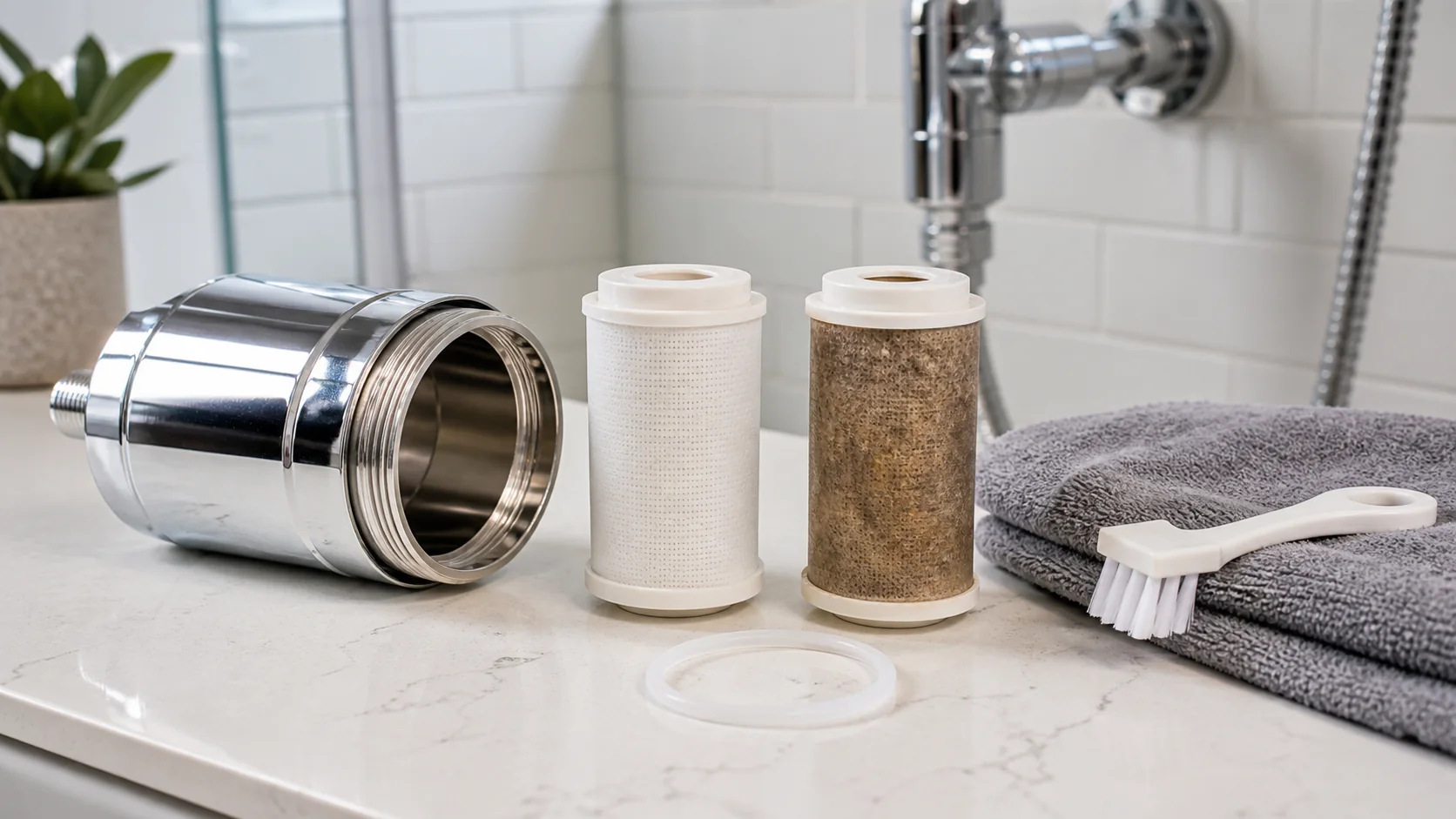
First determine whether the part the seller calls a “housing” is designed to open. Many shower-filter bodies are replaceable sealed cartridges. Wiping their exterior is maintenance; splitting them is not. Aquasana instructs users to wipe the system exterior with a damp cloth and prohibits strong or abrasive agents and solvent cleaners. That is a sensible default only until the exact manual says otherwise.
For a reusable housing, remove grit from the gasket groove with clean water and a lint-free cloth. Use only the approved cleaner and concentration. Replace an O-ring showing cuts, cracks, stretching, tackiness, or permanent flattening.
Do not improvise with petroleum jelly or household oil. The manual may specify silicone lubricant, forbid lubrication, or require a dry flat gasket. Use only the named lubricant and amount.
Sanitizing is not the same as cleaning
Do not put bleach, vinegar, alcohol, peroxide, boiling water, descaler, or disinfectant through a cartridge without an exact manufacturer procedure. Chemicals can damage media and seals. Never mix bleach with acids or ammonia. After floodwater, sewage, unexplained odor, or a boil-water event, seek manufacturer and health-authority advice; flushing is not validated disinfection.
Leak checks that reveal the actual fault
Dry the assembly, wrap tissue around one joint, and test at low then normal flow. Moisture at the wall-side connection suggests the inlet gasket, threads, or shower arm. Water at a housing seam points to a dirty, pinched, damaged, or misplaced seal. A hose swivel has its own washer.
Hand-tighten first and follow the model’s limited tool instruction. In its replacement guide, Aquasana permits only a further quarter-turn with pliers at the chrome collar if a leak remains and warns that overtightening can force the gasket into the shower pipe. Repeated tightening is not a repair for crossed threads, a cracked body, or an incompatible seal.
Check again after the first shower and next day. Remove a leaking filter from service if water can enter the wall. Never glue a cracked pressurized housing. Call a plumber when the arm rotates in the wall, corrosion is severe, or moisture appears behind the escutcheon.
Understand what certification does—and does not—cover
NSF/ANSI 177 is the shower-filtration standard commonly cited for free available chlorine reduction. Certification belongs to a listed system and cartridge combination under stated test conditions; it does not certify every contaminant mentioned in marketing copy, every aftermarket cartridge that physically fits, or indefinite performance after the rated capacity. Aquasana says AQ-4125 is independently researched to NSF/ANSI 177 when used in specified AQ models. WaterChef states that its RCSF-7 system is certified by IAPMO for chlorine reduction and explicitly notes that other chemical claims are not covered by that shower standard.
Check the certifier’s listing and performance sheet before relying on a claim. A shower filter is not automatically a softener, sediment filter, lead-removal device, or microbial purifier. Use the cartridge and certification guide to evaluate model-specific documentation.
Dispose of the spent cartridge responsibly
Let the removed cartridge drain in a contained area, then follow the manufacturer’s disposal or return instructions. Do not cut it open to separate media unless the company explicitly provides that process. “Carbon” does not make the whole cartridge compostable: housings, screens, binders, and mixed filtration media may prevent composting or curbside recycling.
Without a documented take-back program, ask the local waste authority whether the complete cartridge belongs in household trash. Known contamination may require different handling. Retain the model and replacement date in the maintenance log.
Frequently asked questions
Should I replace a shower filter at six months if the flow still feels normal?
Yes when six months is the manufacturer’s stated maximum for that cartridge. Normal flow shows only that water can pass; it does not demonstrate that the certified reduction claim remains effective.
Can hard water make a cartridge expire faster?
Scale or sediment may reduce flow or foul exposed components, but a chlorine-reduction shower filter is not necessarily a hardness treatment device. Follow the product’s limits, clean the shower head separately, and investigate the source water rather than extending or shortening life from appearance alone.
Why is the water gray after installing a new carbon cartridge?
New carbon media can release fines during its initial flush. Use the exact cold-water flushing sequence in the manual and do not bathe until the discharge clears. Persistent discoloration after the stated flush deserves manufacturer support.
May I clean and reuse a disposable shower cartridge?
No, unless the manufacturer expressly identifies it as reusable and supplies a regeneration method. Rinsing a spent sealed cartridge does not restore its rated contaminant-reduction capacity.
What belongs in a maintenance log?
Record the system and cartridge model, installation date, rated gallons or time, estimated household use, water-condition changes, replacement date, leak findings, and the manual or performance-sheet version consulted.
The maintenance rule worth keeping
Treat the shower filter as a documented water-treatment component, not a fit-and-forget accessory. Replace it at the earliest published limit, investigate flow loss before blaming pressure, preserve the correct gasket and thread arrangement, and never invent a sanitizing recipe. A dated log plus the current manufacturer manual provides a more well-supported schedule than cartridge color, odor, or a generic reminder.
Manufacturer references
- Aquasana AQ-4125 replacement instructions
- Aquasana AQ-4100/AQ-4105 installation, care, and troubleshooting guide
- Culligan WHR-140 product specifications
- WaterChef RCSF-7 capacity and certification information