The better sink is the one whose geometry matches the household’s real sequence of tasks. A single bowl concentrates width into one uninterrupted basin. A double bowl reserves two water zones but divides the usable footprint with a center wall, extra corners, and often a second drain. Before choosing, measure the cabinet and the objects you wash, map the drain and disposal below, and rehearse how food preparation, washing, rinsing, and drying happen on a busy day.
Start with four dimensions, not the bowl count
Record cabinet interior width, front-to-back clearance, countertop thickness, and vertical space above shelves, plumbing, or pullouts. Then obtain the sink’s exterior dimensions, each bowl’s interior length and width, depth, drain centerlines, rim profile, and minimum base-cabinet specification. “Thirty-three-inch sink” is not enough information: mounting clips, flange, reveal, sidewalls, and the divider all consume space.
Our top picks




As an Amazon Associate we earn from qualifying purchases at no extra cost to you.
Manufacturer data shows why model-level checking matters. Elkay lists one 25-1/2 by 18-1/2-inch single-bowl undermount workstation for a 30-inch minimum cabinet. Its Crosstown brochure lists both 31-1/2-inch single- and double-bowl workstation models for 36-inch cabinets. A larger Elkay 36-1/4-inch 60/40 double undermount specifies a 42-inch cabinet. Bowl count alone does not determine cabinet fit.
Measure face-frame openings and internal partitions, not only the cabinet’s nominal label. Kohler’s K-23651 specification lists a 29-inch undermount workstation for a 30- to 33-inch base and warns that a 30-inch cabinet may need modification. Modifying structural rails or stone is not an assumption to make after delivery. Use the site’s guide to measure for a kitchen sink before approving a cutout.
Test the largest object that actually enters the sink
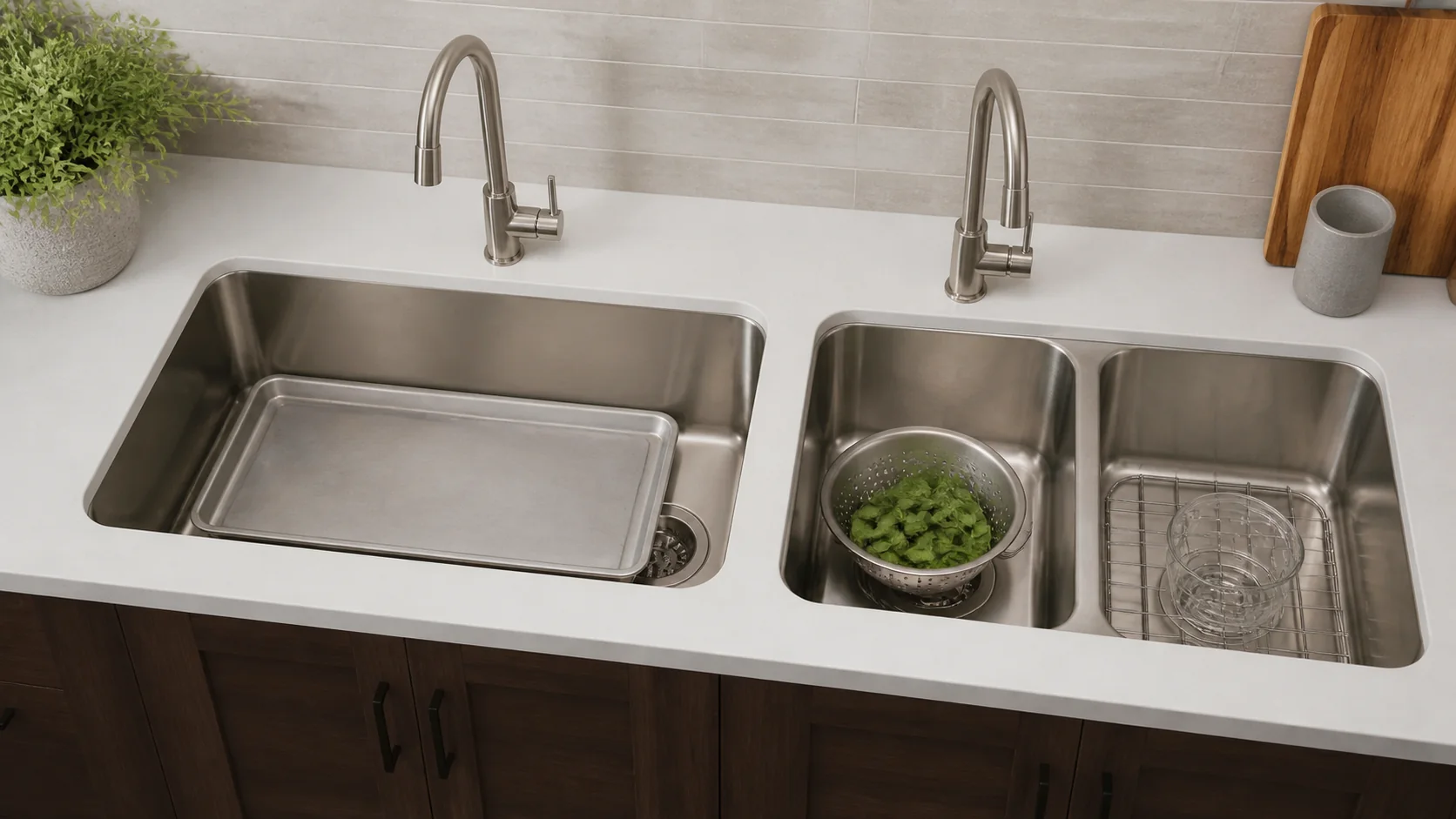
A single bowl usually suits sheet pans, oven racks, stockpots, roasting pans, wok rims, and large cutting boards because no divider interrupts their footprint. Bowl depth can contain splash and stacked dishes, but excessive depth may require more bending and reduce knee or under-sink clearance.
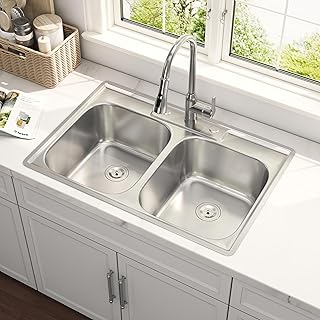
A double bowl works when the household repeatedly needs two simultaneous zones: wash and rinse, soak and prep, or dirty dishes isolated from a colander. The trade-off is not merely “smaller bowls.” Check whether the larger side of a 60/40 sink can lie the household’s widest pan flat and whether faucet reach covers both drains. A 50/50 split may provide symmetry while making neither side wide enough for cookware.
Create cardboard rectangles from the published interior bowl dimensions and place common cookware over them. Include handles and rims. This quick test exposes a mismatch that showroom exterior measurements conceal.
Choose a washing and rinsing sequence
For frequent machine dishwashing, one large basin often serves as a landing and rinsing area while the dishwasher handles the wash cycle. EPA WaterSense recommends scraping rather than prerinsing and running full dishwasher loads; it notes that dishwashers typically use less water than hand washing. In that workflow, a second water-filled bowl may add little.
For hand washing, a double bowl can keep a fixed wash bath separate from a rinse zone. A single bowl can reproduce that setup with a removable basin, leaving the full width available afterward. EPA advises plugging the sink or using a wash basin instead of washing under a continuously running tap. Therefore, neither bowl configuration is inherently water-saving: behavior, faucet flow, fill level, batch size, and dishwasher use determine consumption.
Households that soak dishes for long periods should ask what happens to the only basin. A divided sink preserves one side for handwashing or food tasks. In a single bowl, a removable tub can contain soaking items while leaving some space, but only if the bowl dimensions permit it.
Map drains, disposal, and storage below
A single-bowl sink normally presents one drain connection. An offset drain can move the trap and disposal toward a cabinet side, potentially preserving a more useful storage zone. Elkay describes an offset drain on its ECTRU17169W workstation as providing additional usable bowl and cabinet space; the model is also disposal-ready if space allows. “Ready” does not prove every disposal, trap, air gap, filter, and pullout will coexist.
A double bowl adds a second waste outlet and connecting branch before the trap in many installations. If a disposal occupies one drain, its body, discharge elbow, crossover, trap, dishwasher hose, and supply valves can consume much of the cabinet. Deep unequal bowls can place outlets at different elevations. Draw each component to scale and maintain service access; do not rely on flexible accordion drain fittings to solve poor geometry.
Verify the wall drain height before selecting a deeper sink or larger disposal. If the trap cannot maintain a code-compliant downward path to the wall connection, plumbing must be corrected rather than forced. A plumber should review relocated drains, vents, unusual dual-disposal ideas, or conflicts with filtration and instant-hot equipment.
Accessibility is about reach and task height
A wide single bowl may let users slide a heavy pot along the counter into the basin without lifting it over a divider. Conversely, reaching the bottom of a deep rear area can be difficult for a shorter user or someone seated. A double bowl can keep frequently used tasks nearer one side but requires lifting objects over the partition.
Test faucet-handle reach, spray control, bowl bottom, drain basket, and disposal switch from the intended position. Include counter thickness, sink depth, bottom grid height, and knee-clearance requirements. “ADA” on one sink specification applies only within a compliant installation; it does not make the whole workstation accessible automatically.
Workstation ledges can change the calculation
A workstation adds fitted ledges for cutting boards, colanders, racks, or trays. Elkay describes accessories sliding along its ledge to move from preparation to cleanup, and its single-bowl kits use the uninterrupted basin below for washing and stacking. This can give a compact kitchen separate vertical task layers without permanently dividing the water area.
Accessories also need storage and cleaning. Confirm their exact dimensions, material care, load limits, replacement availability, and whether several pieces can pass each other on the ledge. A cutting board over dirty dishes is not automatically a clean prep zone. The guide to choose a workstation kitchen sink can help compare what the kit genuinely includes.
Installation type can outweigh bowl layout
Undermount installation needs countertop-compatible support, a manufacturer cutout template, controlled reveal, approved clips or support, and a sealed rim. Drop-in installation transfers load through the rim but still requires the correct cutout and sealing method. Farmhouse sinks may need cabinet alteration and dedicated support independent of the countertop.
Do not enlarge stone or cut a cabinet rail merely because the exterior fits. Confirm faucet, backsplash, trim, dispenser, air gap, and hardware clearance. The comparison of undermount and drop-in sinks covers counter-interface differences.
Cleaning effort follows edges and accessories
A single bowl has no divider seam, but a large flat bottom may need deliberate rinsing toward the drain. Double bowls add a divider, extra corners, another drain flange, and possibly more drain hardware. Tight-radius designs maximize flat space but can take more attention at corners than rounded bowls.
Bottom grids protect surfaces but add feet and intersections to clean. Workstation boards and racks add maintenance. Compare complete daily cleanup, not an empty showroom basin.
Resale claims are weaker than fit evidence
No resale rule makes either bowl count more valuable. Buyers differ. Durable installation, plumbing, useful dimensions, and available accessories are stronger evidence than fashion. Keep the model, template, and plumbing record.
Household decision matrix
| Observed household pattern | Likely starting point | Verify before purchase |
|---|---|---|
| Frequent sheet pans, stockpots, or roasting racks | Single bowl | Interior footprint and safe lift path |
| Daily hand washing with separate rinse water | Double bowl | Larger bowl fits cookware; both drains align |
| Mostly full dishwasher loads | Single bowl | Landing space and removable wash basin |
| One side must stay available during soaking | Double bowl | Divider height and faucet reach |
| Compact counter needing prep accessories | Single workstation | Ledge kit, storage, and cabinet minimum |
| Existing low wall drain or crowded cabinet | Model-dependent | Depth, outlets, disposal, trap, and filters |
| User benefits from sliding heavy cookware | Single bowl | Bowl depth, reach, and bottom clearance |
Frequently asked questions
Can a double-bowl sink use a garbage disposal?
Often yes, but the disposal, second outlet, branch, trap, wall-drain elevation, and other cabinet equipment must fit the exact geometry. Confirm with sink, disposal, and plumbing instructions.
Does a single bowl always fit a smaller cabinet?
No. Minimum cabinet size follows the exact exterior width, mounting system, and required clearance. Large single bowls can require wider cabinets than compact double bowls.
Which configuration splashes less?
Splash depends on bowl depth and shape, faucet height and angle, flow, aeration, object placement, and user technique—not bowl count alone.
Is a 60/40 sink a compromise without drawbacks?
It preserves two zones and enlarges one, but the larger bowl may still be too narrow for certain pans while the smaller side may have limited usefulness. Test both interior dimensions.
Can a workstation replace a double bowl?
It can create separate prep, draining, and drying levels, but it does not create two independently fillable water zones. A removable basin can add that function when correctly sized.
Decide from a full-scale rehearsal
Measure the cabinet, trace the published bowl interiors, place real cookware on the template, and draw the complete under-sink drain path. Then rehearse the household’s washing and prep sequence. Choose a single bowl when uninterrupted capacity and movable accessories matter most; choose a double bowl when two persistent water zones justify the divided footprint and added plumbing. The well-supported choice is the model whose documented geometry supports both daily work and future service.
Authoritative references
- Elkay Crosstown workstation dimensions and cabinet requirements
- Elkay EFRU24169RTWC single-bowl specifications
- Elkay ELUH362110R double-bowl specifications
- Kohler K-23651 workstation specification sheet
- U.S. EPA WaterSense kitchen water-saving guidance
- U.S. EPA WaterSense dishwasher and kitchen maintenance guidance