Key takeaways
- Small game: Use only a model that complies with local regulations and is appropriate for the animal. A lower-speed bow can reduce unnecessary meat damage, but shot placement remains critical.
- Deer and similar medium game: A practical range is roughly 300–400 fps with a hunting bolt of appropriate weight and a fixed- or mechanical-blade broadhead approved for crossbow use.
- Elk-sized game: Favor a heavier bolt, strong broadhead construction, and a stable, energy-efficient crossbow rather than choosing solely by maximum speed. Verify that crossbow hunting is legal in the relevant season.
- Large or dangerous game: Equipment selection should follow local regulations and expert guidance. The crossbow must provide adequate penetration, but shot discipline and recovery planning matter just as much.
The best crossbows for hunting are the ones that match your game size, hunting position, carrying tolerance, and local regulations—not simply the bow with the highest advertised bolt speed.
This best crossbows for hunting reviews guide compares the specifications that matter in the field: draw weight, bolt speed, noise, total weight, cocking systems, and useful accessories. The market ranges below are practical buying benchmarks; exact performance varies with bolt weight, broadhead design, temperature, and manufacturer testing methods.
Our top picks
 Barnett Recruit XP Crossbow Package
- Compound crossbow with complete hunting accessory package in…
- The Recruit was built to be fun to…
- Barnett put safety first
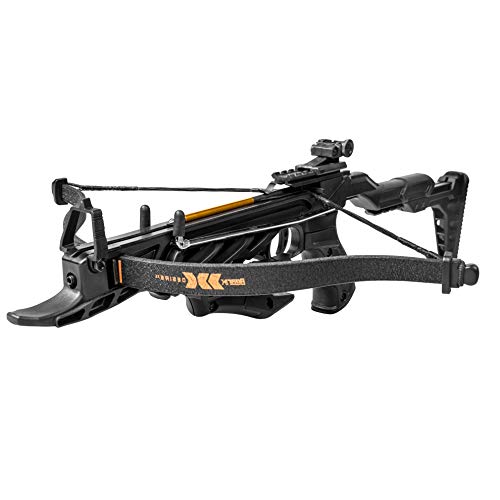 Bear X Desire XL Pistol Hunting Crossbow
- Adjustable: Adjustable stock up to 2.5” for increased…
- Compact: Compact design pistol crossbow with arrow speeds…
- Easy to Use: User-friendly self-cocking arm, forearm grip.
 RAVIN R8 Hunting Crossbow Black
- Helicoil grooves allow 340° cam rotation while keeping…
- Versa-Draw crank system offers easy cocking for all…
- Includes built-in sling mounts, draw handle, quiver with…
As an Amazon Associate we earn from qualifying purchases at no extra cost to you.
Quick Picks by Hunting Situation
| Hunter or situation | Best crossbow type | Useful target specifications | Why it fits |
|---|---|---|---|
| First-time whitetail hunter | Recurve or compact compound crossbow | 150–175 lb draw weight, 300–350 fps, 6.5–8 lb bare weight | Simpler maintenance and manageable carrying weight |
| Frequent treestand hunter | Narrow reverse-draw or compact compound model | Under 13 inches axle-to-axle when cocked, under 8 lb bare weight | Less interference with a seat, rail, or shooting rest |
| Ground-blind hunter | Full-size compound crossbow | 350–400 fps, adjustable stock, 7.5–9 lb bare weight | Extra stability matters more than minimum width |
| Hunter with limited upper-body strength | Crossbow with integrated crank cocking device | 150–185 lb draw weight, removable or built-in crank | Reduces the force and awkward movement needed to cock |
| Small-game or youth-oriented use | Low-draw-weight, lower-speed model where legal | Under 150 lb draw weight, approximately 250–320 fps | More controllable, but only suitable where regulations and quarry allow it |
Draw Weight: More Is Not Automatically Better
Draw weight is the force required to bend the limbs and store energy. A 150–175 lb crossbow can be entirely adequate for deer-sized game when paired with a suitable hunting bolt and broadhead. Higher draw weight may increase stored energy, but it also tends to make cocking harder, increase component stress, and add weight.
For small game, a lower-powered model can be easier to control, but many jurisdictions specify minimum draw weight, bolt length, or broadhead requirements. Check the current rules for the state or province where you will hunt before buying.
Choosing by game size
- Small game: Use only a model that complies with local regulations and is appropriate for the animal. A lower-speed bow can reduce unnecessary meat damage, but shot placement remains critical.
- Deer and similar medium game: A practical range is roughly 300–400 fps with a hunting bolt of appropriate weight and a fixed- or mechanical-blade broadhead approved for crossbow use.
- Elk-sized game: Favor a heavier bolt, strong broadhead construction, and a stable, energy-efficient crossbow rather than choosing solely by maximum speed. Verify that crossbow hunting is legal in the relevant season.
- Large or dangerous game: Equipment selection should follow local regulations and expert guidance. The crossbow must provide adequate penetration, but shot discipline and recovery planning matter just as much.
Bolt Speed, Noise, and Accuracy
Advertised speeds are usually measured with a light bolt and may be higher than the speed you obtain with a properly weighted hunting setup. A bow listed at 400 fps might produce a lower real-world speed with a heavier hunting bolt and broadhead. Heavier bolts generally carry momentum more effectively and can be quieter, but they also produce a slower trajectory.
| Specification | Entry-level range | Versatile hunting range | What to prioritize |
|---|---|---|---|
| Advertised bolt speed | 250–320 fps | 330–400 fps | Enough speed for a flatter trajectory without excessive weight or noise |
| Draw weight | 120–150 lb | 150–185 lb | A cocking system you can use consistently and safely |
| Bare crossbow weight | 6–7.5 lb | 7.5–10 lb | Balance and carrying comfort after adding scope, quiver, and bolts |
| Noise at the shot | Moderate | Low to moderate | Limbs, string stops, vibration control, and proper maintenance |
| Typical complete hunting weight | 7.5–9 lb | 9–12 lb | Remember that a sling, scope, quiver, and bolts add approximately 1–2 lb |
Noise matters most when hunting animals that can react before the bolt arrives. Look for string suppressors, limb dampeners, and a rigid stock, but do not remove factory vibration-control components to save a few ounces. A quiet crossbow is still not silent; use a solid shooting position and take ethical distances seriously.
Recurve, Compound, or Reverse-Draw?
Recurve crossbows
Recurve designs use simpler limbs and fewer moving parts. They are often easier to inspect and repair, making them appealing to backcountry hunters. Their drawbacks are greater limb width and, in many designs, a longer overall profile. That can be inconvenient in a narrow treestand or ground blind.
Compound crossbows
Compound models use cams and cables to create a compact power stroke. They commonly offer higher speeds and narrower profiles than traditional recurves, but cables and cams require more careful inspection and precise servicing. A damaged cable should be handled by a qualified bow technician rather than improvised in the field.
Reverse-draw crossbows
Reverse-draw layouts can shift the center of gravity toward the shooter and provide a narrow front end. They may feel well balanced from a rest, although their unusual geometry can make replacement parts and accessories more model-specific. Confirm that the supplied quiver, crank, and scope are compatible before purchasing extras.
Cocking Systems: The Feature That Changes Daily Use
A rope cocking aid reduces the effort required by giving you mechanical advantage and helps center the string. It is inexpensive, lightweight, and a sensible choice for many hunters, but it still requires enough hand and shoulder movement to operate.
An integrated crank or silent cocking device reduces the physical force substantially. It is especially useful for hunters with shoulder, back, or grip limitations and for anyone who must cock the crossbow repeatedly during practice. The trade-off is added weight, cost, and a possible obstruction around the stock or butt.
- Choose a rope aid if you can comfortably bend, pull, and control the string.
- Choose a crank system if repeatable, low-effort cocking is more important than minimum weight.
- Check decocking compatibility: Some systems allow controlled uncocking; others require a special discharge bolt or a safe target procedure.
Field-Ready Accessories Worth Buying
- Compatible hunting bolts: Buy the manufacturer’s recommended length, spine, and minimum weight. Mixing unknown bolts can affect accuracy and damage the bow.
- Crossbow-rated broadheads: Fixed and mechanical designs are both available, but confirm the manufacturer’s speed rating and practice with the same style you will hunt with.
- Illuminated scope: Helpful in changing light, though it cannot make an illegal or unsafe low-light shot ethical.
- Rail lubricant and string wax: Use only products approved for the bow’s rail, serving, and string materials.
- Sling: A padded sling makes a 9–12 lb fully equipped crossbow much easier to carry between a vehicle, blind, and stand.
- Hard or padded case: Protects limbs, cams, scope, and trigger mechanism during transport. Follow local transport rules.
- Rangefinder and target: Practice at known distances and confirm point of impact after changing bolts, broadheads, or scope settings.
What the Specifications Do Not Tell You
Measure the hunting setup, not just the bow. A crossbow listed at 29 inches long may become 31–33 inches with a butt extension, crank handle, or stock adjustment. A wide recurve can be awkward through a 30-inch doorway or between tree branches. In a treestand, leave enough clearance to rotate the bow without striking the platform rail or seat; roughly 18–24 inches of unobstructed space beside the shooting position is a useful planning target.
Weight also changes once accessories are installed. A 7.8 lb crossbow can become approximately 9.5 lb with a scope, quiver, six bolts, sling, and crank. Carry it unloaded around your home or on a short practice walk before committing to a long hike. The first parts to show wear are commonly the serving, string, rail surface, cable areas, and fasteners loosened by vibration.
How to Make the Final Choice
- Confirm that crossbow hunting, your chosen game, draw weight, season, and broadhead type are legal where you hunt.
- Set a maximum complete weight, including scope, quiver, bolts, sling, and cocking aid.
- Choose the cocking system before comparing speed. A bow that is difficult to cock may receive less practice and become less accurate.
- Compare real hunting bolt specifications rather than relying on the fastest advertised number.
- Check replacement-string, cable, bolt, and service availability for the brand and model.
- Practice from the same seated, kneeling, or supported position you will use in the field, then verify accuracy with your hunting broadheads.
Brands such as TenPoint, Wicked Ridge, Ravin, Excalibur, and Barnett offer several established crossbow formats, but the best choice depends on the individual model’s dimensions, cocking method, service support, and legal suitability. Expect approximately $300–$600 for many basic hunting packages, $600–$1,200 for feature-rich compound models, and more for premium compact systems with advanced cocking and vibration-control features.
The strongest buying decision is usually a balanced one: enough energy and bolt weight for the intended game, a cocking system you can use without strain, acceptable noise, and a total field weight you can carry and stabilize confidently.