Key takeaways
- Fit: holes, deck thickness, height, reach, and handle sweep.
- Workflow: stream landing, cookware clearance, spray grip, and docking.
- Plumbing: supply compatibility, valve access, hose path, and pressure.
- Service: identified cartridge, hose, spray head, electronics, and warranty.
- Care: finish behavior, approved cleaners, nozzle access, and seam count.
A kitchen faucet is a small fixture with an unusually demanding job. It must fill tall pots, rinse the sink corners, clear a window or shelf, resist constant wet-hand operation, and remain repairable inside a crowded cabinet. Choosing by finish and silhouette ignores the interactions most likely to cause regret.
This guide treats the sink as a work zone. First map where water needs to land. Then confirm holes, clearances, controls, supply connections, flow, and service parts. Features come last.
Our top picks

 FORIOUS Kitchen Faucets Pull Down Sprayer
- Mounting Type: Deck Mount
- Flow Rate: 1.8 gpm
- Handle Lever Placement: Left or Right
Certified to cUPC, NSF 61/372 and lead-free standards
18-inch retractable hose with 360-degree swivel reach
Five-layer nano finish resists fingerprints and spots
Deck plate install for 1 or 3-hole sinks adds a step
Single-handle design gives less fine temperature control than two-handle sets


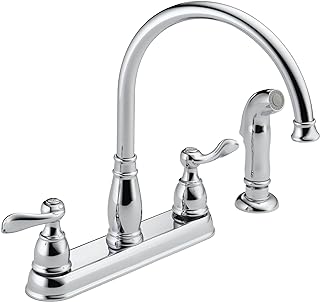
 2-Handle Kitchen Faucet with Sprayer 4 Hole
- Mounting Type: Deck Mount
- Number Of Handles: 2
- Hole Count: 4 units
 WEWE High-Arc Pull-Down Kitchen Faucet
- Mounting Type: Deck Mount
- Hole Count: 1 holes
- Flow Rate: 1.8 gpm
Pre-installed hoses cut installation time to under 15 minutes
Sprayer head auto-retracts to the spout after each use
304 stainless steel construction resists everyday wear
Only three spray settings versus pricier multi-mode faucets
Single-hole mount limits fit to compatible sink layouts
As an Amazon Associate we earn from qualifying purchases at no extra cost to you.
Draw the Water-Landing Map
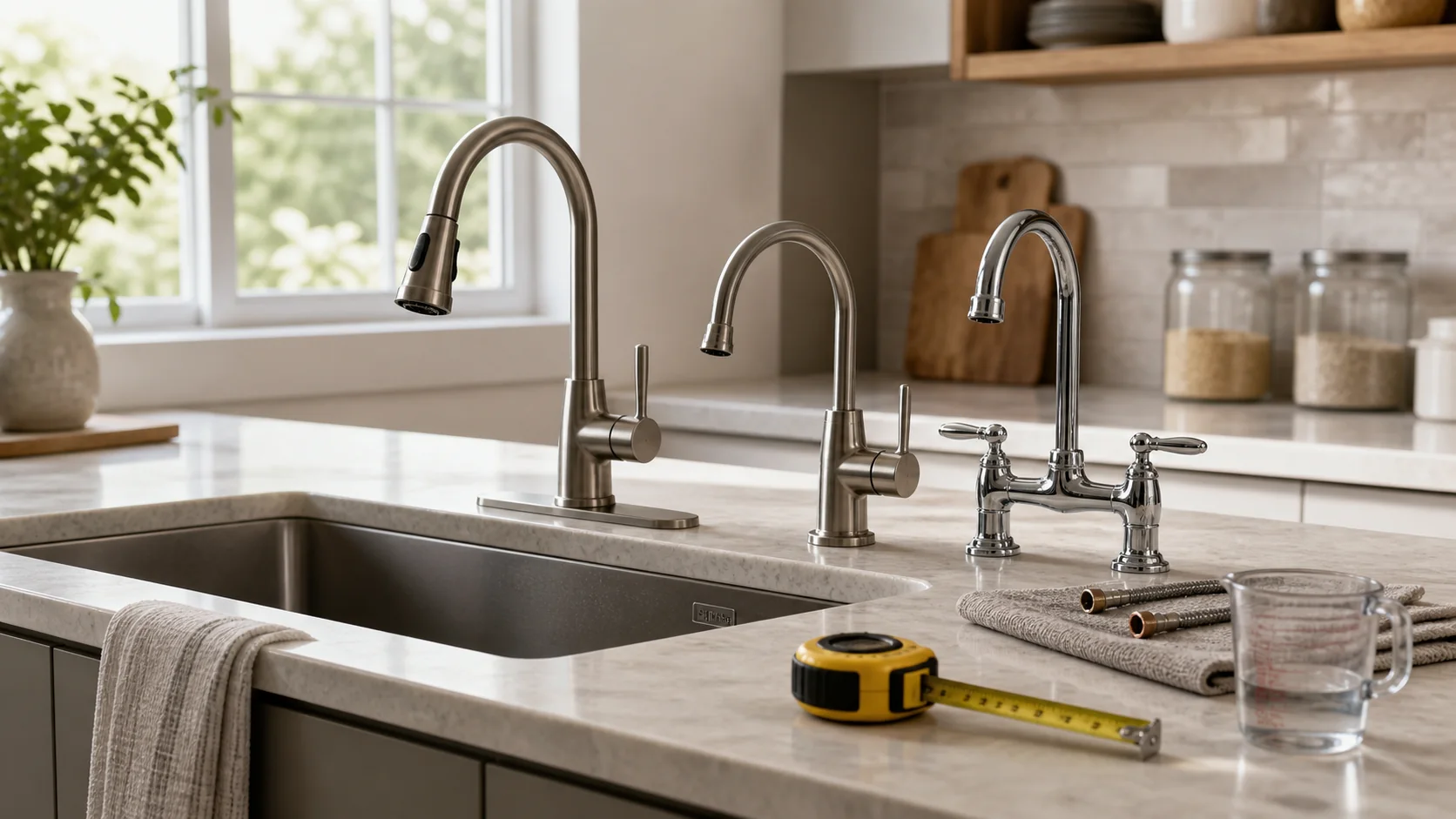
Measure from the faucet mounting center to the front and back walls of the bowl. Note the drain position and where large cookware usually sits. Compare those dimensions with spout reach, generally measured horizontally from the body center to the aerator. The stream should land in a useful part of the bowl without striking the drain so directly that it splashes.
For a double bowl, test whether the fixed stream reaches both compartments. For a workstation sink, check whether boards and colanders interrupt it. A pull-down spray extends the working radius, but its docked position still matters for hand washing and filling.
Make a paper side profile showing the deck, backsplash, window sill, shelf, and deepest pot. Add the exact faucet’s overall and spout heights. This exposes overhead conflicts and tells you whether a tall vessel fits below the outlet.
Audit the Mounting Area Above and Below
Count usable holes, measure their diameter and spacing, and identify countertop thickness. A deck plate can cover unused holes, but it cannot create structural support or correct incompatible spacing. If the faucet mounts through a thin sink deck, inspect for flex and determine whether an approved support is appropriate.
Below the deck, locate the basin wall, disposal, filter, soap bottle, shelves, shutoffs, and drain. Pull-down hoses need a clear vertical path and room for the counterweight or spring. A hose that rubs a valve or catches on stored supplies will feel defective even if the faucet itself is sound.
Check handle travel. Some side levers rotate toward the backsplash; others move mainly forward. Electronic faucets require battery access or suitable power depending on the model. The kitchen faucet installation guide covers a complete pre-installation survey.
Choose the Spray Format Around Real Tasks
| Format | Strong use case | Watch for |
|---|---|---|
| Pull-down | Deep sinks, pots, broad rinse coverage | Overhead clearance, docking, hose path |
| Pull-out | Shallower bowls and lower profiles | Grip size and retraction space |
| Fixed plus side spray | Existing multi-hole deck | Extra hole, routing, another leak point |
| Bridge or two-handle | Explicit controls and traditional styling | More cleaning and slower adjustment |
| Hands-free or touch | Reducing handle contact while cooking | Sensor logic, power, override, solenoid parts |
Hold the display spray head with wet hands if possible. Switch modes, return it to the dock, and imagine repeating the action many times. A long feature list has little value if the selector is stiff or the head twists in its cradle.
Evaluate Controls and Failure Modes
A ceramic-disc valve is common in quality faucets, but the label alone does not guarantee easy repair. Ask whether the cartridge has a published part number, whether the model remains supported, and how it is replaced. Proprietary hoses, magnets, electronic valves, and spray heads should also be available separately.
Single-handle faucets allow quick one-handed adjustment. Two handles make hot and cold positions explicit but require more movements and deck space. Hands-free designs can be useful; judge sensor placement, timeout behavior, manual override, battery replacement, and power-failure behavior rather than novelty.
Interpret Flow Rate in Context
Flow varies with supply pressure, aerator condition, local requirements, and faucet design. EPA WaterSense does not currently label kitchen faucets in the same way it labels qualifying bathroom faucets, so do not infer a WaterSense kitchen-faucet certification from general water-saving language.
Lower flow can save water, but filling time and spray pattern affect satisfaction. If current flow is poor, diagnose partially closed shutoffs, debris, a clogged aerator, kinked lines, or broader pressure trouble before buying a faucet advertised as “high pressure.” A new fixture cannot correct every plumbing restriction.
Match Finish to Water and Cleaning Habits
Chrome is reflective and easy to coordinate but shows droplets. Brushed finishes may disguise fingerprints; darker finishes can make pale mineral deposits conspicuous. Finish names are not standardized, so compare physical samples under kitchen lighting when matching hardware.
Read care instructions before choosing. Abrasives, aggressive acids, bleach, and rough pads can damage coatings and plated surfaces. In hard-water areas, accessible contours and flexible nozzles are practical advantages. See the hard-water kitchen faucet guide for a scale-focused method.
Compare Ownership Cost, Not Sticker Price
Add the deck plate, adapters, new shutoffs, professional labor, filter connections, and electrical provisions if required. Then consider cartridges, spray heads, hoses, batteries, and finish-specific parts. A modest faucet with transparent documentation may be better long term than a feature-heavy model whose wear components cannot be identified.
Warranty length needs context. Read exclusions for labor, commercial use, water conditions, electronics, and finish wear. Keep the receipt, model number, serial information, installation manual, and finish code. Photograph the label before it becomes hard to reach.
Use a Weighted Selection Sheet
Score candidates from one to five, weighting categories for the kitchen. A frequent cook might give reach and spray control triple weight. A rental may prioritize simple controls and parts availability. A sink below a window makes height pass-or-fail rather than a preference.
- Fit: holes, deck thickness, height, reach, and handle sweep.
- Workflow: stream landing, cookware clearance, spray grip, and docking.
- Plumbing: supply compatibility, valve access, hose path, and pressure.
- Service: identified cartridge, hose, spray head, electronics, and warranty.
- Care: finish behavior, approved cleaners, nozzle access, and seam count.
Reject any faucet that fails fit or service access even if its total score looks competitive. The sheet compares viable candidates; it cannot average away a physical conflict.
Pre-Purchase Checklist
- Photograph the sink deck and cabinet interior.
- Record hole count, diameter, spacing, and deck thickness.
- Measure reach, height, backsplash distance, and window clearance.
- Trace the pull-down hose route below the sink.
- Verify supply connection size and shutoff condition.
- Download the exact specification, installation, warranty, and care documents.
- Confirm replacement-part numbers and availability.
- Inspect the delivered finish and parts before removing the old faucet.
After installation, follow the kitchen faucet maintenance checklist to catch loose mounting, hose abrasion, and small leaks early.
Frequently Asked Questions
Should the stream hit the drain?
Not necessarily. Direct impact can increase splashing, especially in a shallow bowl. Aim for a useful work area and evaluate the whole sink geometry.
Is a taller faucet always more useful?
No. Height helps with cookware but can increase splash and conflict with windows or shelves. Reach and bowl depth matter equally.
Do I need a deck plate?
Only when required or when covering compatible unused holes. Confirm that it fits the pattern, lies flat, and clears the backsplash.
Are touchless faucets difficult to repair?
They add sensors, power supplies, and solenoid valves. Repairability depends on documentation, manual override, access, and parts support.
When should a plumber install it?
Get help when shutoffs do not close, connections are corroded, the deck needs modification, damaged cabinetry is present, or electrical and plumbing changes exceed your scope.
Bottom Line
The best kitchen faucet is the one whose stream lands correctly, controls clear the room, hose moves freely below the sink, and wear parts remain obtainable. Measure the work zone first, verify exact documents second, and compare convenience features only among faucets that pass those tests.
Sources
- U.S. EPA WaterSense faucet information
- Delta Faucet: Kitchen service FAQs
- Kohler: Kitchen faucet care
- Moen: Installation support