Key takeaways
- Rinse away food acids, salt, soap, and cleaner overspray.
- Wipe the body and handle with a soft damp cloth.
- Dry around the base, seams, and spray-head dock.
- Run each spray pattern and note uneven or sideways streams.
- Return the pull-down wand fully without forcing it.
- Look at the cabinet floor before storing supplies.
Kitchen faucet maintenance is not a yearly deep clean. It is a sequence of brief observations that keeps finish damage, mineral deposits, hose abrasion, battery leakage, and slow cabinet leaks from accumulating unnoticed. The useful schedule depends on the exact model, local water, household use, and manufacturer care instructions.
Find the model number and finish suffix before using any cleaner or ordering a part. Save the product page, maintenance sheet, exploded-parts diagram, warranty, receipt, and aerator key in one labeled file. A collection name alone may cover different cartridges, hoses, electronics, and coatings.
Our top picks


As an Amazon Associate we earn from qualifying purchases at no extra cost to you.
Weekly: Protect the Finish and Observe the Spray
- Rinse away food acids, salt, soap, and cleaner overspray.
- Wipe the body and handle with a soft damp cloth.
- Dry around the base, seams, and spray-head dock.
- Run each spray pattern and note uneven or sideways streams.
- Return the pull-down wand fully without forcing it.
- Look at the cabinet floor before storing supplies.
Start with water and a soft cloth. Delta’s care guidance warns against abrasive cleaners and certain harsh chemicals; Moen and KOHLER likewise direct owners to model- and finish-appropriate methods. Never assume vinegar, bleach, ammonia, solvent, powdered cleanser, or a melamine pad is safe merely because it is sold for bathrooms.
Drying is especially useful in a hard-water home because it removes droplets before minerals remain. It does not sterilize the fixture or replace approved cleaning. Pay attention to the underside of the spout and the joint where a wand docks; residue often begins where it is not visible from standing height.
Monthly: Check Movement, Docking, and Flow
Operate hot, cold, and mixed positions separately. Compare flow with the previous month and listen for whistling, hammering, grinding, or a delayed shutoff. Move the handle and spout through their full intended range. New stiffness, looseness, or a change in temperature control is a diagnostic clue rather than an invitation to spray household lubricant into the faucet.
Extend a pull-down hose completely and let it retract several times. Confirm the head docks squarely and the hose does not twist. Open the cabinet while another person moves the wand. The hose and weight should clear the disposal, trap, shutoffs, filter cartridges, shelf edges, and stored bottles.
For touch or touchless faucets, wipe the sensing surface using approved finish care, confirm manual operation, and check the indicator described by the manufacturer. Do not open a sealed solenoid or electronics housing. A sensor problem can originate from batteries, cable seating, handle position, grounding or isolation components, or objects inside the sensing field.
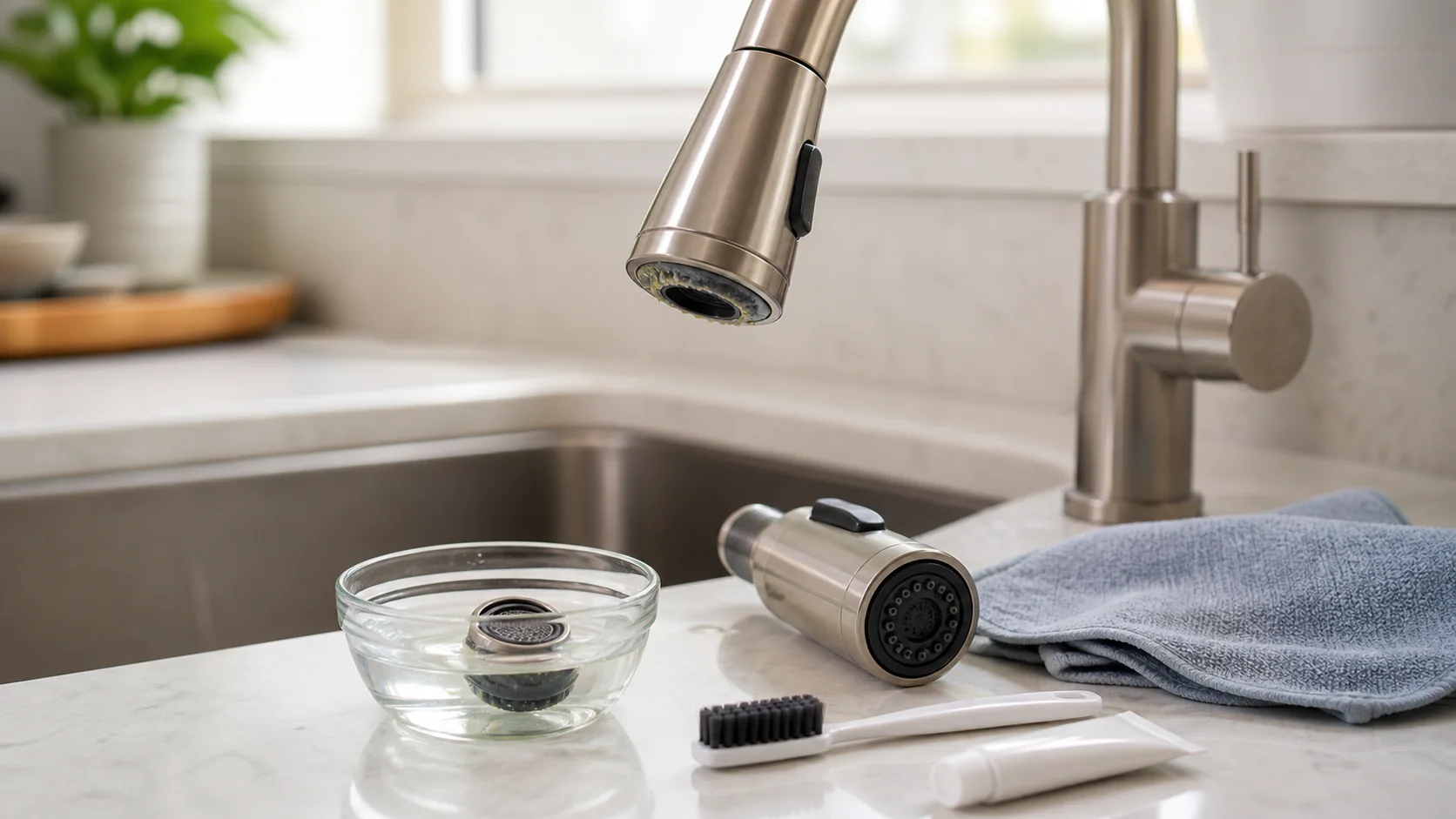
Quarterly: Service the Aerator and Spray Head
- Close the drain or cover it so tiny washers cannot disappear.
- Photograph the aerator, screen, and gasket orientation.
- Use the supplied key or a protected tool specified by the faucet maker.
- Rinse loose particles from the removable parts.
- Apply only the approved mineral-removal method and contact time.
- Rinse completely, reinstall in order, and flush.
- Compare the restored pattern with the model’s normal operation.
Do not submerge an electronic spray head or soak a plated faucet body. Delta describes wiping mineral residue from Touch-Clean spray holes, while KOHLER provides cleaning instructions for MasterClean surfaces; those features reduce effort but do not make every chemical safe. Moen’s guidance should be checked for the exact finish and outlet.
If both hot and cold remain weak after the outlet is clean, inspect for a kinked hose and confirm fixture stops are open. Hot-only or cold-only weakness points toward that supply path or cartridge. Weak flow at multiple fixtures suggests an upstream system issue. Repeated debris may require a plumber to investigate piping, a water heater, or recent utility work.
Quarterly: Inspect the Cabinet Under Pressure
Empty the cabinet and use a bright flashlight. With water running, inspect both shutoffs, supply connections, faucet shank, quick-connect, hose, side-spray fitting, filter tees, and the cabinet floor. Then fill and drain the sink to distinguish faucet-side moisture from a drain leak.
Dry each joint and hold clean tissue beneath it. A tissue edge reveals a small fresh drop better than a dark cabinet interior. Look for mineral tracks, green or white corrosion, swollen particleboard, peeling finish, rusty fasteners, or a musty odor. Evaporation can hide the puddle while leaving evidence.
Do not tighten every fitting as preventive maintenance. Overtightening can deform a gasket, crack a plastic connector, strip a thread, or rotate a valve inside the wall. If moisture appears, close the relevant stop, identify the connection type, and use the exact service procedure.
Six-Month Battery, Hose, and Weight Review
Electronic faucet battery intervals vary with technology, battery size, use, and model. Follow the indicator and manual instead of replacing on a universal calendar. When replacement is due, use a complete matched set of the specified type. Do not combine old and new cells or different chemistries.
Keep the holder dry and mounted where required. Examine contacts for leakage or corrosion. Test manual override after power service and use only the manufacturer’s approved AC adapter.
Inspect the entire visible pull-down hose for fraying, flattened areas, bulges, split outer braid, and abrasion. Check the weight clamp and its marked position. A hose repeatedly rubbing a sharp cabinet edge needs routing correction, not tape. Replace a damaged pressure-bearing hose using the exact model part.
Annual: Exercise Valves and Audit Service Parts
Confirm that fixture shutoffs are identifiable and accessible. Operate them gently only when their condition permits. A valve that seizes, spins, leaks around the stem, or moves attached piping needs professional repair. Know the dwelling’s main shutoff before testing a questionable stop.
Audit part numbers for the cartridge, aerator, spray head, hose, quick-connect, battery holder, and solenoid where present. Confirm availability from the manufacturer or authorized channel. Keep a spare proprietary aerator tool. Stock a cartridge only when the exact part and storage conditions are known.
Finish-Safe Care by Surface Type
| Surface description | Conservative starting care | Main mistake to avoid |
|---|---|---|
| Polished chrome | Soft damp cloth followed by drying | Abrasives that create visible fine scratches |
| Brushed or stainless-look finish | Wipe in the documented direction with approved cleaner | Treating finish names across brands as identical materials |
| Matte black or coated color | Mild manufacturer-approved method and soft cloth | Strong acids, bleach, solvents, and aggressive rubbing |
| Living finish | Follow the maker’s intended patina guidance | Polishing away a change the finish is designed to develop |
| Electronic sensor area | Lightly damp approved cloth; keep openings dry | Spraying cleaner directly into seams or controls |
Finish names describe appearance, not universal chemistry. Use the care sheet tied to the brand and suffix. Rinse approved cleaner fully and dry the area. Protect nearby stone, wood, caulk, and sink coatings.
Hard-Water Maintenance Strategy
Track the time between cleaning and visible scale return. Begin with weekly spray-face wiping and quarterly aerator inspection, then adjust from evidence. A sudden acceleration may reflect a supply change, while constant whole-home deposits indicate a water condition rather than a faucet defect.
Hardness minerals are not generally removed by an ordinary activated-carbon drinking-water filter. Test hardness before considering treatment. A whole-home softener involves sizing, salt or other media, drainage, bypass, maintenance, and local requirements; it should be evaluated independently from faucet replacement.
Never respond to recurring scale by lengthening acid contact on plated surfaces. Controlled treatment of a removable, approved component is different from wrapping the entire fixture. If deposits obstruct internal passages repeatedly, consult the manufacturer or plumber about service and water treatment.
Symptom: Maintain, Repair, or Replace?
| Observation | Reasonable next action | Escalation boundary |
|---|---|---|
| Uneven spray with visible deposits | Clean outlet by the approved method | Persistent restriction after correct servicing |
| Drip from spout when off | Identify exact cartridge and service instructions | Corroded body, failed stops, or repeated cartridge damage |
| Leak only while hose is extended | Inspect head joint and full hose under flow | Split, bulged, or unavailable proprietary hose |
| Loose faucet base | Inspect deck and mounting system | Cracked sink, damaged counter, or inaccessible hardware |
| Erratic touchless operation | Follow model diagnostics for power, cables, and sensor | Wet electronics or failed sealed module |
Repair is sensible when the body and deck are sound, the cause is identified, and an exact supported part is available. Replacement becomes more well-supported when the faucet body is cracked or corroded, multiple proprietary systems have failed, critical parts are discontinued, the model cannot fit current needs, or labor approaches a better-supported replacement.
Coordinate the next decision with the identify the source of a faucet drip.
Frequently Asked Questions
How often should a kitchen aerator be cleaned?
Begin quarterly, then shorten or lengthen the interval based on measured flow, visible debris, and local scale. Clean immediately when the spray pattern changes.
Can vinegar be used on every faucet?
No. Finish coatings, seals, electronics, and adjacent materials may be damaged. Use it only when the exact manufacturer guidance permits a stated dilution and contact time.
Should a faucet cartridge be replaced on a schedule?
Usually it is serviced for a diagnosed symptom rather than age alone. Use the correct model part and investigate pressure, debris, or water conditions when failures repeat.
What is the first sign of a pull-down hose problem?
Slow retraction, abrasion, a wet braid, leakage only during extension, or a changing spray-head joint can appear before a major failure. Inspect under operating pressure.
When should a plumber inspect the faucet?
Call for failed shutoffs, pipe corrosion, concealed moisture, mold, unsafe pressure, recurring debris, inaccessible leaks, or any repair that affects plumbing beyond the documented fixture service.
Keep a One-Page Maintenance Record
Record inspection dates, flow changes, aerator cleaning, battery replacement, part numbers, and leak repairs. Photograph any developing wear from the same angle. This history prevents repeated guesswork and gives manufacturer support or a plumber useful evidence when a symptom changes.
Sources
- Delta Faucet official product page
- Moen faucet finish care and cleaning guide
- Kohler support guidance
- Delta Faucet support guidance